
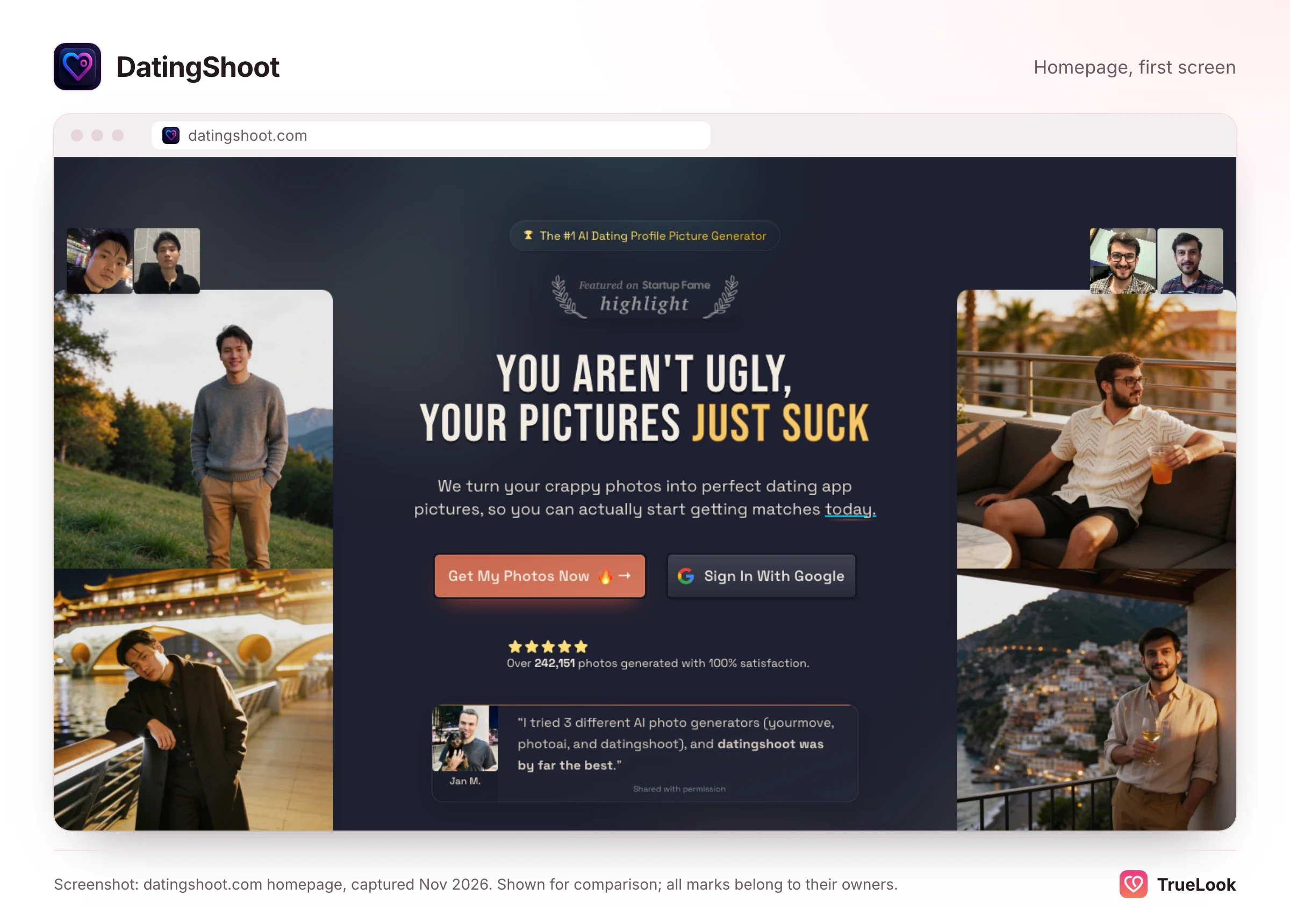
DatingShoot sells one big package: $69, paid once, for 200+ AI photos and 50 editing credits, delivered within a few hours and filtered by Amazon's face-matching software so that only photos scoring 99% or higher against your uploads reach you. TrueLook is also paid once, with no subscription, but it makes photos one at a time, about a minute each, from 4 selfies, with HyperReal™ keeping your face exactly the same and changing only the place, outfit and light. If you want the largest single batch for one payment, DatingShoot gives you more photos in one go than either TrueLook pack. If you'd rather choose each photo, see it right away, and have a refund route after you've tried the results, TrueLook fits better.
This page explains what DatingShoot is and who it's aimed at, what you get for the price at the time of writing (November 2026), what its face-matching claim does and doesn't mean, what its privacy policy, terms and refund rules say, what independent feedback exists, and how the two services compare point by point. Every fact about DatingShoot comes from its own pages or public sources we opened on 2 November 2026, listed at the end. We haven't tested the two services side by side, so this page contains no scores or match-rate figures of our own.
What DatingShoot is and how it works
DatingShoot is a web-based AI dating photo service. The footer of its homepage names DatingShoot, Inc., and its terms of service say they're governed by US law "with jurisdiction in Indiana". Neither page gives a street address or names a founder. The terms and privacy policy were last updated on 20 April 2025, and a company blog post from May 2025 describes the face-matching feature as newly added, so the service has been running since at least spring 2025.
Who it's for
The homepage speaks almost entirely to men, with headlines such as joining "the top 10% of men on dating apps". Its FAQ says that "more than half of our users are over 40" and argues that older men often have the most to gain, because people tend to take fewer photos of themselves as they get older. It also says the service has recently expanded to women, with scenarios designed by a female expert.
That focus on older men is a real gap in the market. Pew Research Center found in 2023 that 37% of US adults aged 30 to 49 and 20% of those aged 50 to 64 had used a dating site or app. Plenty of people in those age groups have few recent photos of themselves alone, which is exactly the problem a dating profile exposes. A service that starts from that problem is solving something real.
The workflow
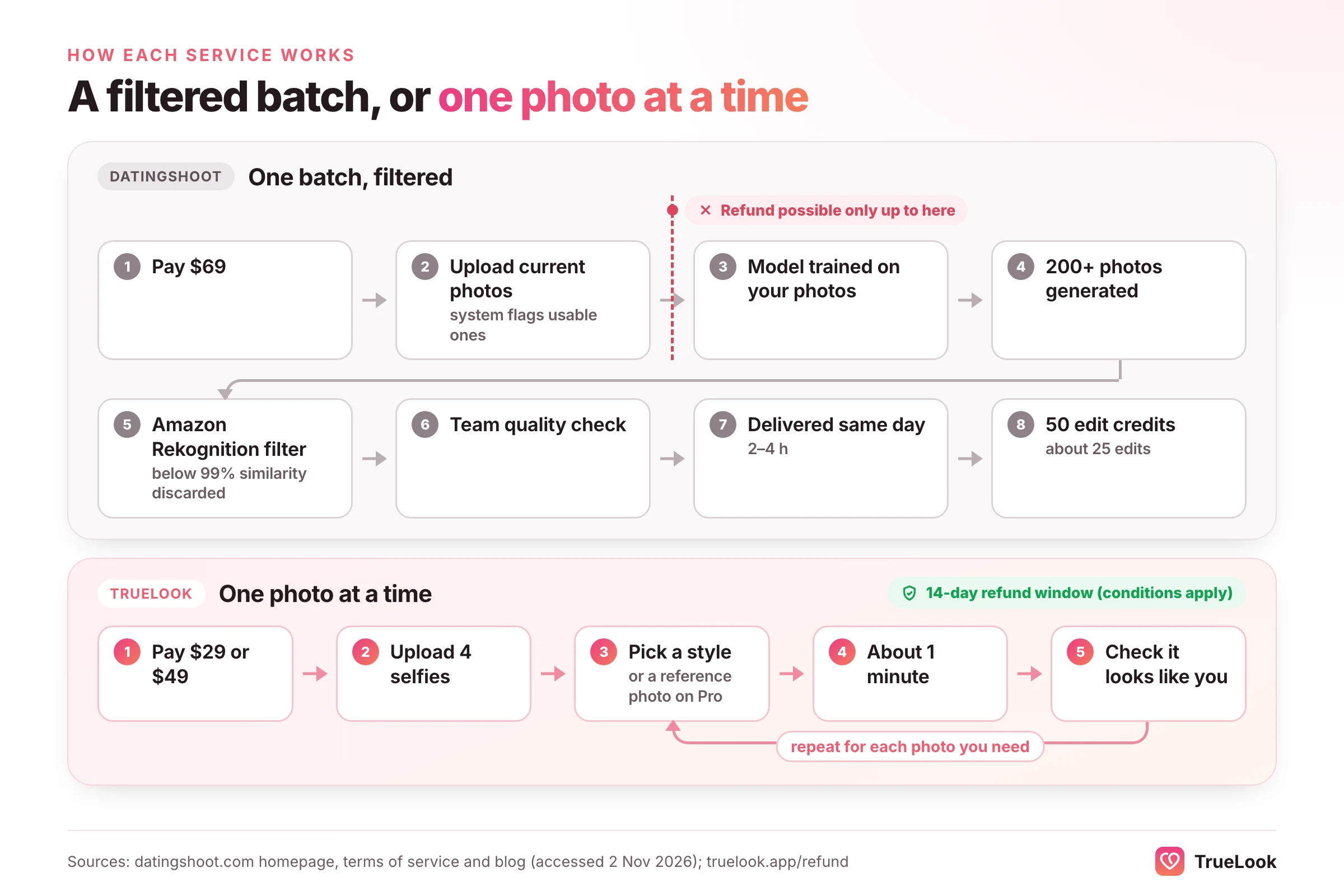
- Upload. You upload your current photos, and the system analyses your face and tells you which ones it can use. The homepage doesn't give a required number. A 2026 update added a "Manage My Training Photos" page where you can swap them yourself.
- Training and generation. DatingShoot trains a model on your photos and generates 200+ photos across what it calls "research-backed scenarios".
- Face-matching filter. Every photo is compared with your uploads using Amazon Rekognition, and any photo below 99% similarity is discarded before you see it.
- Delivery. The homepage promises same-day delivery with an "average 2 hour turnaround time"; a heading on the same page says "just 3 hours", and an April 2026 update says about 4 hours. Plan on a few hours.
- Edit and regenerate. Your purchase includes 50 custom photo credits. Editing a photo with a reference image costs 2 credits, so that's about 25 edits: changing clothes, adding a pet, swapping a background, or creating a photo in your own location and outfit.
A May 2025 post also says that "every single AI photo job gets personally processed by a member of our team" for quality assurance. That's a reassuring step for quality, and worth knowing for privacy: a person at the company may see your photos.
DatingShoot pricing in detail
At the time of writing (November 2026), the homepage lists a single package:
| Item | What DatingShoot lists |
|---|---|
| Price | $69, one time; no subscription |
| Photos | 200+ ("over 200 studio-quality photos") |
| Editing | 50 custom photo credits included; an edit costs 2 credits |
| Delivery | Same day; quoted as 2, 3 or about 4 hours on different pages |
| Likeness filter | Amazon Rekognition, 99%+ similarity to your uploads |
| Extra photo packs | Available, according to the terms; not refundable |
| Payment | Stripe; major cards and Amazon Pay |
| Price per photo | $69 ÷ 200 = $0.35 (or less, if you count more than 200) |
One note on price: an April 2026 blog post on DatingShoot's site quotes $89 for the same package, while the homepage shows $69. Prices on this service have changed during the year, so confirm the figure at checkout.
The refund policy
DatingShoot's refund rule is short and strict, and it's the single most important thing to understand before you buy. Its homepage FAQ says you can get "a full refund any time before starting the training process", no questions asked. The terms then say: "After the training process has started, refunds are no longer available", because the company has to pay for the server time to train the model and generate the photos. Additional photo packs bought later aren't refundable at all.
In plain terms, you can change your mind after paying but before you upload and start training. Once training starts, there is no refund, whatever the results look like. The company points to direct access to its support team and to the editing credits as the remedy for disappointing photos.
That is a legitimate policy; AI generation does cost real money per run. But it is the least flexible refund in this group. DatePhotos.AI and Fotto.ai both allow 7 days, provided you haven't downloaded anything. TrueLook allows 14 days under its own conditions: you must have used less than 20% of your credits and kept the photos on a live dating profile for 7 days in a row. TrueLook's packs are one-time, so there's no renewal to cancel either.
The 99% face-match claim, explained
DatingShoot's most distinctive feature is its likeness filter, and it deserves a fair, careful look, because it's both genuinely useful and easy to misread.
What it does
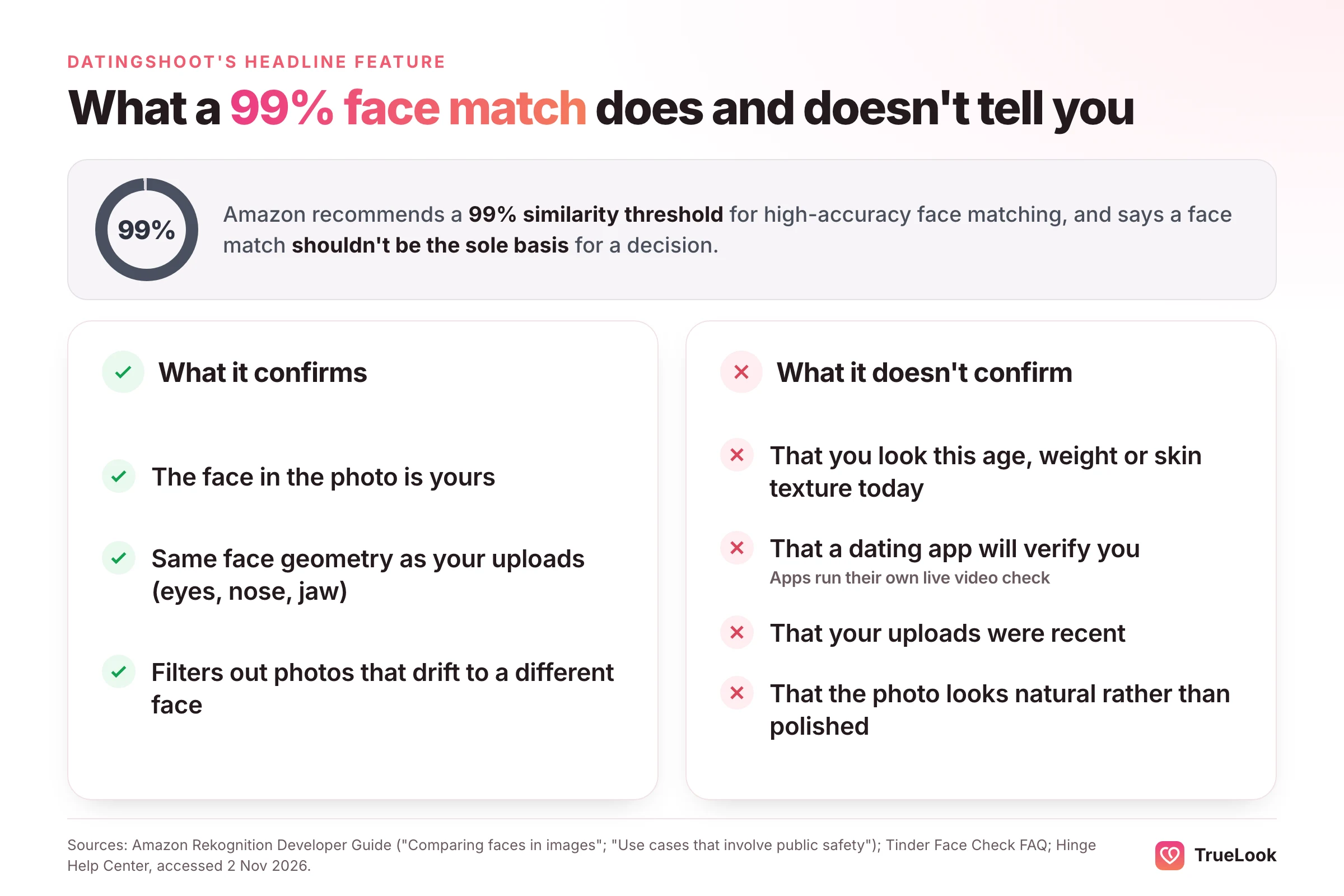
Amazon Rekognition's CompareFaces feature compares a face in one image with a face in another and returns a similarity score. According to Amazon's documentation, the default threshold is 80%. DatingShoot sets its threshold at 99%, and says it discards every generated photo that falls below it. Amazon's own guidance for high-accuracy uses recommends a 99% similarity threshold "for scenarios where highly accurate face similarity matches are necessary", and confidence thresholds of 99% or higher for law-enforcement uses. So DatingShoot's description of 99% as the standard used by law enforcement is grounded in Amazon's published guidance.
This is a real, automated safeguard against one of the most common failures in AI dating photos: the slow drift towards a face that's almost, but not quite, yours. It's also a more concrete mechanism than most competitors publish, and TrueLook doesn't advertise an equivalent automated score.
What it doesn't do
- It confirms identity, not accuracy. Face-recognition systems are designed to recognise the same person across different lighting, expressions and angles. A 99% score tells you the photo shows your face. It doesn't tell you whether the photo makes you look younger, slimmer, smoother-skinned or more polished than you look today, which is what a first date will notice.
- It isn't dating-app verification. Tinder's Face Check compares a live video selfie with your profile photos, and Hinge's Selfie Verification works from the photos on your profile when you verify. Those are the apps' own systems, with their own thresholds. DatingShoot's homepage says "get verified on all major dating apps, confirmed", but its own terms say it isn't responsible for "any dating platform's decision to accept or reject generated photos". The terms are the more accurate statement: no generator controls an app's decision.
- It compares against your uploads. If your uploaded photos are old, the filter keeps photos that match an older you.
- Amazon itself cautions against relying on a score alone. Its guidance says face matches "shouldn't be used as the sole determinant for taking action". The blog post's line that the photos "could literally be used to identify you in a court of law" goes further than Amazon's guidance does.
The last two points matter especially for daters over 40. Hancock and Toma's 2009 study of online dating photos found that independent judges rated about a third of real profile photos as inaccurate, and outdated photos were one of the common reasons. Whichever service you use, upload recent photos that show how you look now, including your current hairline and grey.
Output and realism
What DatingShoot says about its photos
The homepage describes a "Sophisticated Realism Algorithm" trained on real, professional dating photoshoots, aimed at removing "waxy skin" and what it calls "unrealistically high quality". It also says the company tunes for "realistic quality, not necessarily the best quality" because "real photos have flaws". That's a thoughtful design goal: a photo that looks a little too perfect is one of the most common giveaways on dating apps.
The sample photos on DatingShoot's site are, by its own FAQ, of "professional models whom we have compensated" for permission to generate AI photos of them. That's an honest disclosure, and a useful reminder: samples of professional models show the engine at its best, with ideal source photos. Your results depend on your own uploads.
Claims to read with care
- "4x-11x more matches" and "7.9x more opening messages". These figures have no published method or sample on the page.
- "3.2 points more attractive", citing Photofeeler. The homepage shows one before-and-after example with 25 votes. It's a single illustration, not a study.
- "Can people tell it is AI? Absolutely not!" No service can guarantee this for every photo and every viewer.
- App rules. The FAQ quotes Hinge's AI principles: if you include generative AI images, they "should not be used to misrepresent yourself or your intentions". That's an accurate quote and the right standard. Bumble's guidelines likewise require at least one photo that shows only you with your full face visible.
Volume as a strategy
Two hundred photos is far more than any profile can use. Tinder and Hinge profiles hold six photos, so the value of the batch is choice: a big pool to pick from, already filtered for face match. The cost is the sorting. Set aside time to go through the set with a strict eye, ideally with a friend who'll tell you which ones don't look like you. And keep the final six consistent with each other, so the profile reads as one person on different days.
Privacy and data
DatingShoot's privacy policy (last updated 20 April 2025) is brief. It says the company collects the photos you upload for AI generation and uses your information to "generate AI photos" and to "provide and improve our service". It doesn't mention model training, biometric data or facial recognition, and it doesn't name its service providers. On retention, it says data is kept "only as long as necessary", and that "after account deletion, we will remove your data within 30 days". Data may be processed in the United States.
Two statements on DatingShoot's pages don't fully line up, and you should know about both:
- The homepage FAQ says your photos "can only be accessed by you" and that the company will never share them with any third party or "use them in any marketing or advertising materials".
- The terms of service say users own the generated photos, but "DatingShoot retains a license to use generated images for service improvement and marketing purposes".
The homepage promise is reassuring, but the terms are the contract. If it matters to you that your generated photos are never used in marketing, ask DatingShoot to confirm in writing before you upload. The privacy policy also doesn't say whether a model trained on your face is deleted after delivery.
TrueLook's privacy policy says we don't use the photos you upload or generate to train any AI model, and we don't use your photos for advertising. Your selfies and results stay in your account so you can keep generating, and you can delete any of them yourself from your dashboard at any time.
What users say about DatingShoot
Independent feedback is very hard to find. On 2 November 2026 we found no Trustpilot page for DatingShoot, no Reddit threads discussing it by name, and no app in the Apple App Store. The only reviews we found are the testimonials on its own website. The homepage says more than 242,000 photos have been generated, and a blog post says more than 7,000 men have upgraded their photos. Those are the company's own figures, and we can't check them.
No independent reviews doesn't mean bad reviews. It means you're relying on DatingShoot's own word, together with a refund policy that ends once training starts. Weigh those two facts together.
TrueLook vs DatingShoot, dimension by dimension
| Dimension | TrueLook | DatingShoot |
|---|---|---|
| Purpose | Dating profile photos for anyone 18+ | Dating profile photos, marketed mainly to men, many over 40 |
| Input | 4 selfies | Your current photos; the system tells you which are usable (no number given) |
| Output count | Up to 30 (Fix Pack) or 140 (Pro Pack), made one by one | 200+ photos once, plus 50 edit credits (about 25 edits) |
| Styles | 43 on both packs, 4 shots per style | Its own scenario set; custom photos via edit credits |
| Likeness approach | HyperReal™: your face stays the same; only place, outfit and light change | Model trained on your photos; 99%+ Amazon Rekognition filter; human review |
| Speed | About a minute per photo | A few hours for the batch (2 to 4, by its own pages) |
| Price per photo | $0.97 (Fix) or $0.35 (Pro) | $0.35 |
| Billing | One time, no subscription | One time |
| Refunds | 14 days, with usage and profile conditions | Full refund only before training starts |
| Use of your photos | Never used to train any model or in advertising | Terms keep a licence to use generated images for service improvement and marketing |
| Dating-app fit | Every style built for dating profiles on Tinder, Hinge and Bumble | Scenarios built for dating apps, with a focus on men over 40 |
Price per photo, with the maths
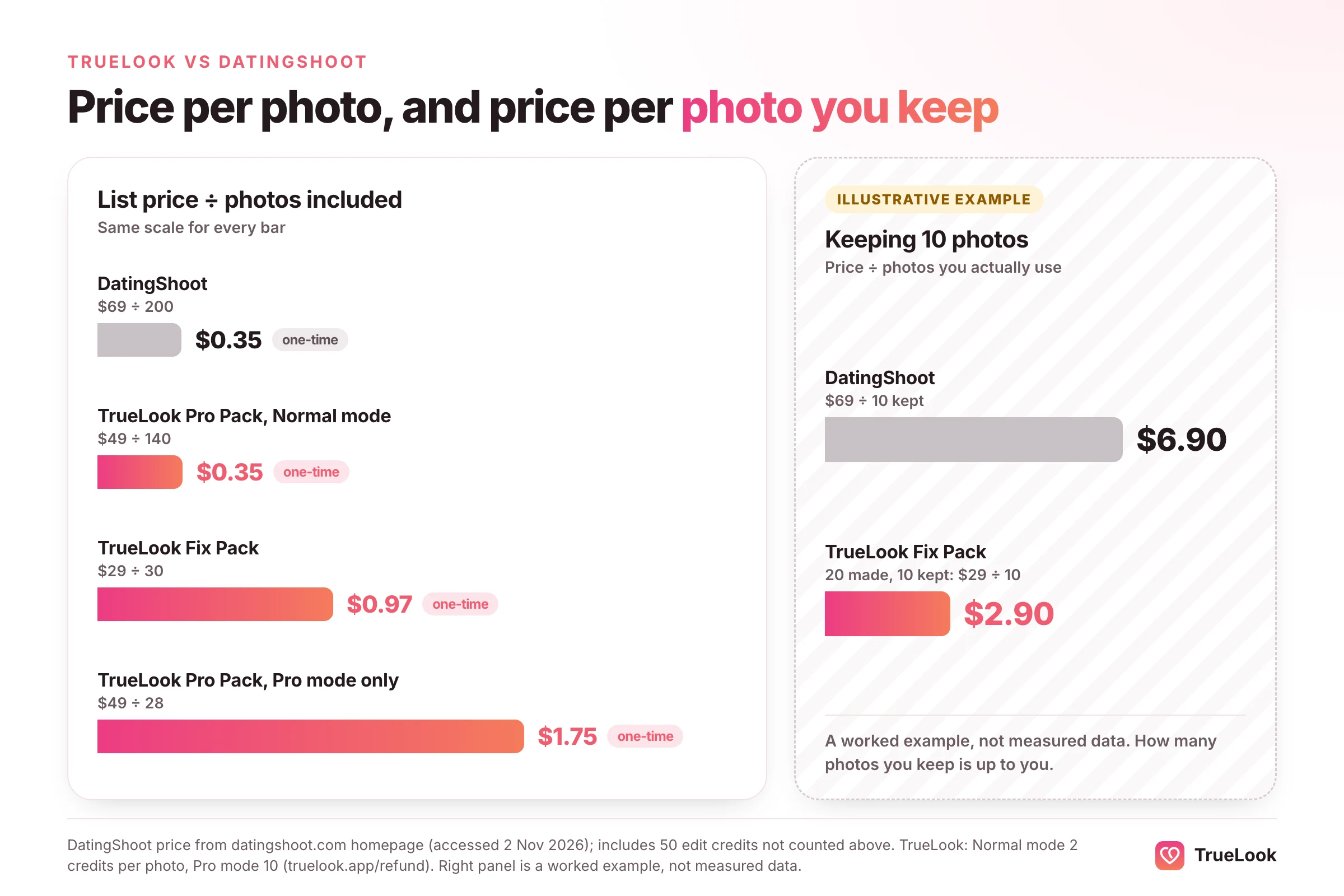
DatingShoot: $69 ÷ 200 photos = $0.35 a photo, with 50 edit credits on top. TrueLook Fix Pack: $29 ÷ 30 = $0.97. TrueLook Pro Pack: $49 ÷ 140 = $0.35. One credit is one photo, and each style you pick makes 4, so 140 photos is about 35 styles.
So DatingShoot is far cheaper per photo than TrueLook's Fix Pack, and level with TrueLook's Pro Pack. On volume, it clearly wins: 200 photos for $69 in one go, against up to 140 for $49 on TrueLook's Pro Pack. If you want the biggest pool possible from a single payment, DatingShoot is the better deal on paper, and we'd say so to any reader.
The other side of that maths is that a profile needs about six photos. Here's an illustrative example, not a measurement: if you keep 10 photos from DatingShoot's batch, each one you use cost $6.90. If you make 20 on TrueLook's Fix Pack and keep 10, each one cost $2.90. Neither number is "right". The point is that the price per photo you use depends on how many you'll actually use, and on whether you'll want more later.
Speed and feedback
A few hours is quick for 200 photos, and same-day delivery is a fair promise. The trade-off is timing of feedback. On DatingShoot you commit at upload, wait, then see everything. On TrueLook you see your first photo in about a minute, so if a selfie is causing trouble (an old haircut, a strong filter, a hat), you find out right away and fix it before making more.
Control
DatingShoot chooses the scenarios; you then customise with edit credits, including putting yourself in your own location or outfit. TrueLook works the other way: you choose each style, and each one gives you 4 different shots with your face kept the same. If you know exactly which photos your profile needs, choosing them directly is quicker. If you'd rather have a large selection made for you, DatingShoot's approach suits that.
Who should choose which
| If you… | Choose | Why |
|---|---|---|
| want the most photos possible for one payment | DatingShoot | 200+ photos and about 25 edits for $69 |
| value an automated face-match filter | DatingShoot | Every photo is checked at 99% similarity before you see it |
| want the lowest outlay to start | TrueLook (Fix Pack) | $29 once, against $69; neither is a subscription |
| want a refund route after seeing results | TrueLook | 14 days, under its conditions; DatingShoot ends refunds when training starts |
| want to see each photo before making the next | TrueLook | About a minute per photo |
| want your current photos checked before you pay | TrueLook | A free photo check scores each photo and suggests styles |
| want your photos kept out of marketing | TrueLook | Photos are never used in advertising; DatingShoot's terms keep a marketing licence |
Example scenarios (illustrative)
A 47-year-old divorced father with almost no solo photos from the past five years, who wants to rebuild Tinder, Hinge and Bumble at once and is happy to spend an evening sorting, would get the biggest selection from DatingShoot's single package. He should upload only recent photos, so the face filter matches the man who'll turn up to the date.
A 52-year-old who wants five or six strong photos and would rather not commit $69 before seeing a result could start with TrueLook's Fix Pack, check the first photo for likeness, then make exactly the shots his profile is missing. Our guide to the best dating apps for over 40 covers which apps to put them on.
A 38-year-old who refreshes her profile every couple of months would pay again on either service. On DatingShoot that means a new batch or non-refundable extra packs; on TrueLook, another pack or a one-time top-up, from which she makes only the photos she needs.
How to switch, or use both
Both services give you standard image files, so there's nothing to migrate. If you already have a DatingShoot batch, keep your favourites and use TrueLook to fill a gap, such as a scene the batch didn't include. Before mixing, line up all six profile photos and check that face, hair, skin tone and build are consistent. One practical check: DatingShoot described its photos as square (1:1) in 2025, so preview how each one crops in your dating app before you post it.
For a broader view, see our guide to the best AI dating photo generators, our explainer on whether AI photos are allowed on dating apps, and two related comparisons: TrueLook vs DatePhotos.AI, another one-time batch service, and TrueLook vs Ablaze Dating. Every comparison is on the compare page.
Sources
- DatingShoot homepage, DatingShoot, Inc. (2026). https://datingshoot.com/
- Terms of Service, DatingShoot (updated 20 April 2025). https://datingshoot.com/terms-of-service
- Privacy Policy, DatingShoot (updated 20 April 2025). https://datingshoot.com/privacy-policy
- Major updates to DatingShoot, DatingShoot blog (2025). https://datingshoot.com/major-updates-to-datingshoot
- DatingShoot's biggest update yet, DatingShoot blog (2026). https://datingshoot.com/datingshoot-biggest-update-2026
- Comparing faces in images, Amazon Rekognition Developer Guide, Amazon Web Services (2026). https://docs.aws.amazon.com/rekognition/latest/dg/faces-comparefaces.html
- Use cases that involve public safety, Amazon Rekognition Developer Guide, Amazon Web Services (2026). https://docs.aws.amazon.com/rekognition/latest/dg/considerations-public-safety-use-cases.html
- Key findings about online dating in the U.S., Pew Research Center (2023). https://www.pewresearch.org/internet/2023/02/02/key-findings-about-online-dating-in-the-u-s/
- Putting Your Best Face Forward: The Accuracy of Online Dating Photographs, Hancock and Toma, Journal of Communication (2009). https://sml.stanford.edu/publications/2009/putting-your-best-face-forward-accuracy-online-dating-photographs
- Face Check FAQ, Tinder (2026). https://policies.tinder.com/faq-mandatory-liveness-check/intl/en/
- What is Selfie Verification?, Hinge Help Center (2026). https://help.hinge.co/hc/en-us/articles/10303221435539-What-is-Selfie-Verification
- AI Principles, Hinge (2026). https://hinge.co/ai-principles
- Community Guidelines, Bumble (2026). https://bumble.com/en/guidelines


 Photographer