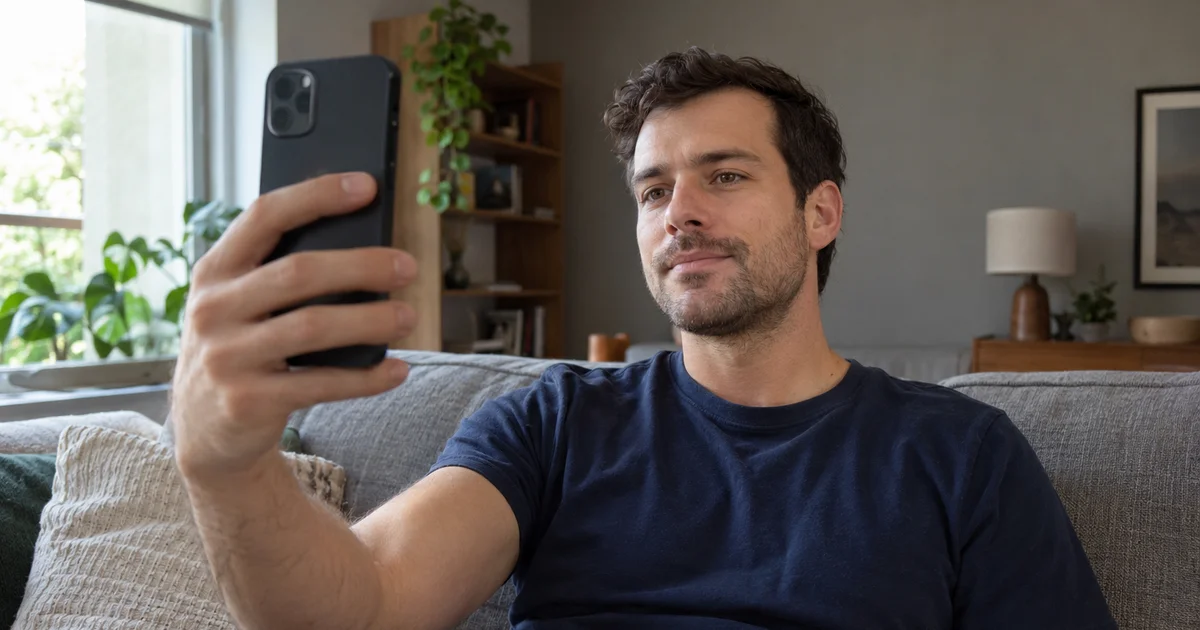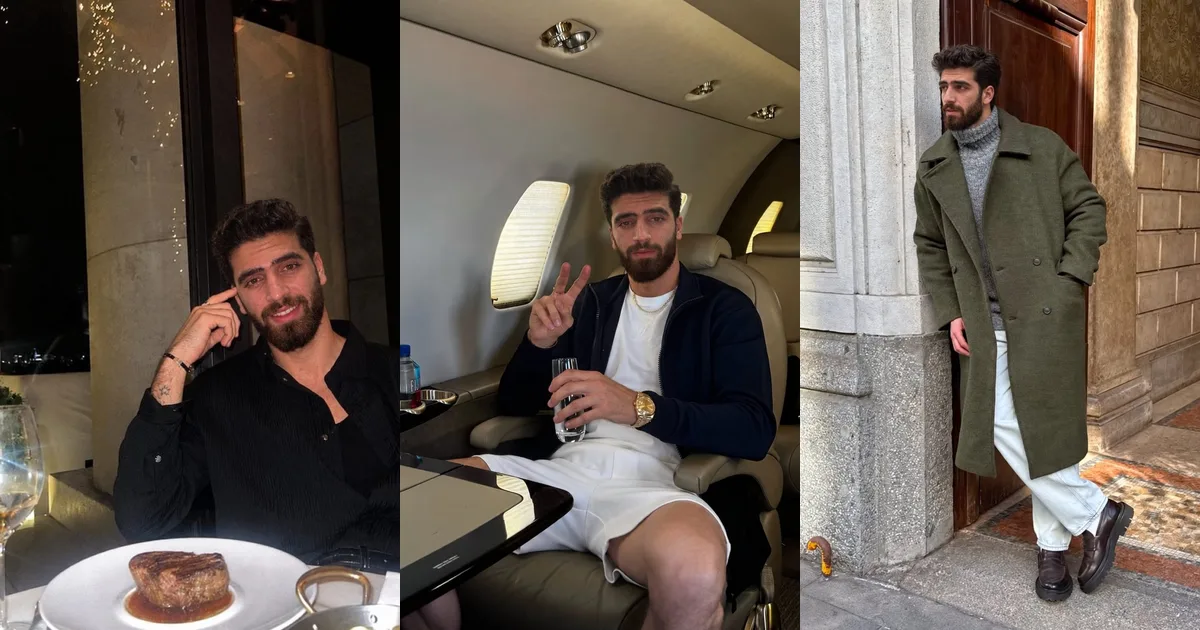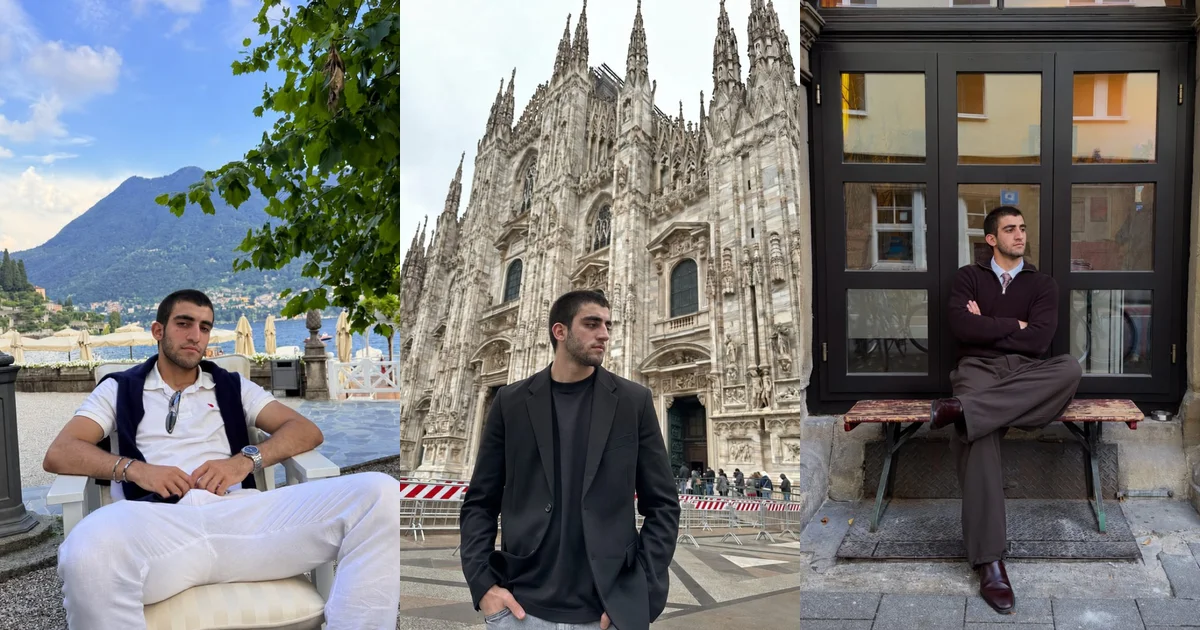
The best photos for Tinder are recent, sharp, well-lit pictures in which a stranger can recognise your face in a fraction of a second, arranged so that each one adds something new: a clear solo portrait first, then a full-length shot, then pictures of you doing things, with people, and somewhere that hints at your personality. Five or six strong photos beat nine uneven ones, and the first photo matters more than all the others combined.
This guide explains why, using the research on how people judge faces and profiles, then walks through each slot, the order, how to shoot every picture yourself with a phone, the mistakes to delete today and three worked example lineups.
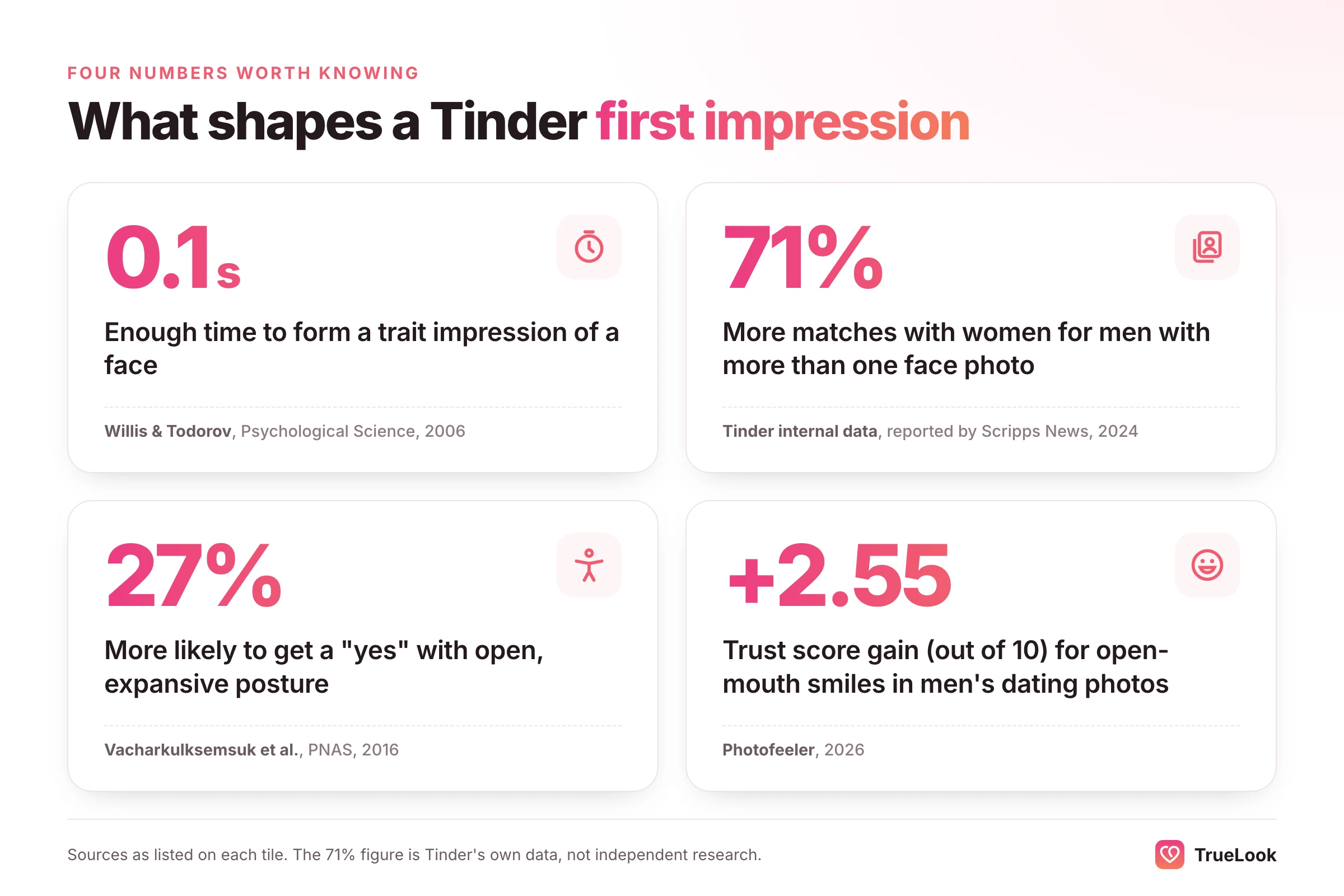
- People form a trait impression of a face after seeing it for a tenth of a second, and longer viewing barely changes it (Willis and Todorov, 2006). Your first Tinder photo gets about that long.
- Tinder's own data, reported when it launched its Photo Selector in 2024, says men with more than one clear face photo see a 71% increase in matches with women.
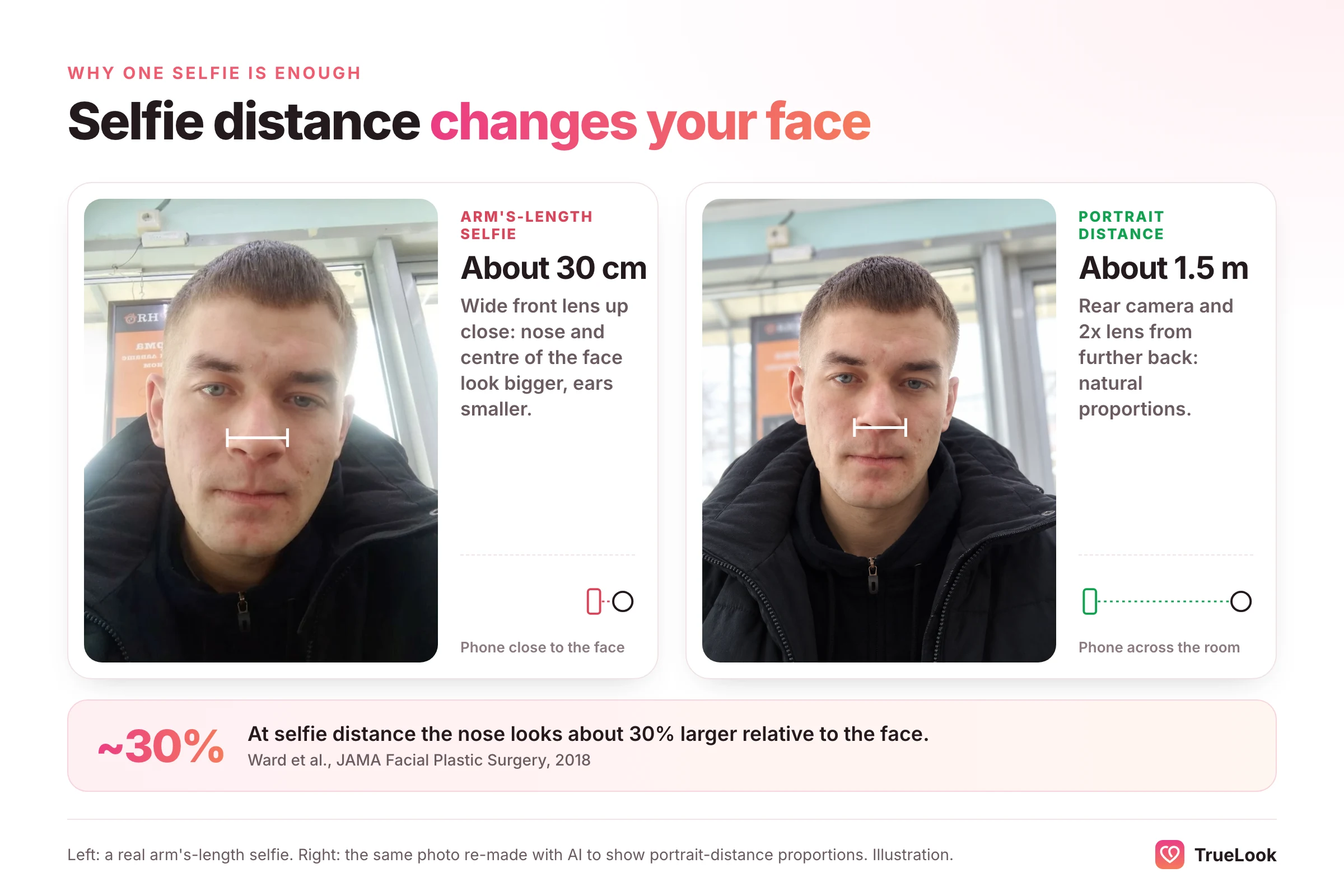
- A phone held at arm's length makes the nose look about 30% wider than a photo taken from about 1.5 metres; have someone else take your portrait from further back.
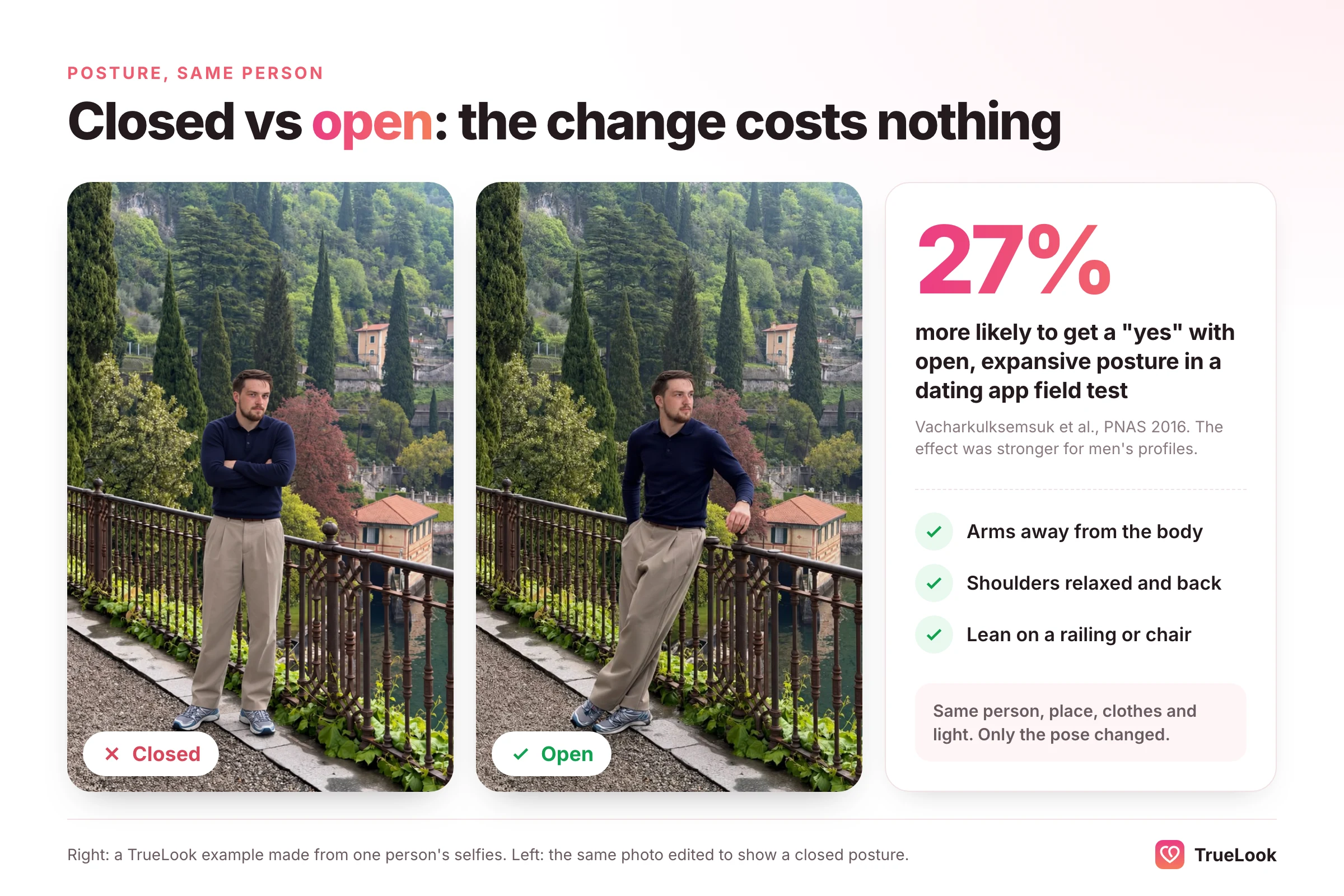
- In a field test on a dating app, profiles with open, expansive posture were 27% more likely to get a "yes" than the same people in closed postures.
- Photofeeler's analysis of millions of photos found that smiling raised perceived trustworthiness in men's dating photos by 2.55 points out of 10 for open-mouth smiles.
- Selfies are judged as less trustworthy and less socially attractive than photos of the same person taken by someone else, so keep selfies to one at most.
- You are a poor judge of your own best photo: in two studies with 610 people, pictures chosen by strangers made better impressions than pictures people chose for themselves.
How people actually judge Tinder photos
Before choosing photos, it helps to picture the conditions under which they are seen. Someone is lying on a sofa or standing on a train, thumbing through a stack of cards. Each card shows one photo at a time, your name and your age. Most people decide on the first image, and only those who pause tap through to the rest.
What the research says about snap judgments
A widely cited 2006 study in Psychological Science by Janine Willis and Alexander Todorov showed volunteers faces for 100 milliseconds, 500 milliseconds or one second and asked them to rate attractiveness, likeability, trustworthiness, competence and aggressiveness. Judgments made after a tenth of a second correlated highly with judgments made with no time limit. Extra viewing time mostly made people more confident, not different in their verdict.
That is the reality of your first photo. Nobody reads it carefully. They take in the light, the expression, whether they can see your eyes and whether the picture looks like effort or neglect, and they move on.
Context matters too. In 2016, Scientific American summarised research in which women saw men's faces for 300 milliseconds each; a face was more likely to be rated attractive if the face before it had been rated attractive. You cannot control who appears before you in someone's stack. You can control how quickly and clearly your own photo communicates.
Why the stakes are high on Tinder in particular
Tinder is still the default app for a large share of single people. A 2023 Pew Research Center report found that 30% of US adults have used a dating site or app, rising to 53% of adults under 30, and that 46% of online daters have used Tinder, more than any other platform. Among online daters under 30, the share who have used Tinder was 79%. Large audiences mean fast swiping, and fast swiping rewards photos that can be understood instantly.
What Tinder itself says makes a good photo
When Tinder launched its AI Photo Selector in July 2024, a spokesperson told TechCrunch that the feature was trained on the company's findings about strong profile images, including lighting and composition, and that it favours fewer group photos because they can confuse people about whose profile it is. Scripps News reported Tinder's internal figures from the same launch: most single women want at least four images that reflect the person, and men with more than one face photo see a 71% increase in matches with women. Those are the app's own numbers, not independent research, but they point the same way as the academic work.
The four-question test for any Tinder photo
Every photo in your lineup should pass four questions. Use them as a filter before thinking about slots or order.
- Can a stranger read your face on a small screen? Eyes visible, face large enough in the frame, no hat-brim shadow, no sunglasses in the opener, nothing in front of you.
- Is it honest? Same haircut, facial hair, glasses and roughly the same build as the person who will turn up to the date. Photos older than a year or two fail this, and so do heavily smoothed or filtered images.
- Does it add something new? If you removed it, would the profile lose information? Two near-identical portraits from the same afternoon tell the viewer nothing extra.
- Does it invite a message? A place, a dog, a hobby, an instrument or a dish you cooked gives the other person an easy opening line.
A photo that fails question one or two should go regardless of how much you like it. A photo that fails three or four can stay if you have nothing better, but it is the first one to replace.
The six-photo lineup, slot by slot
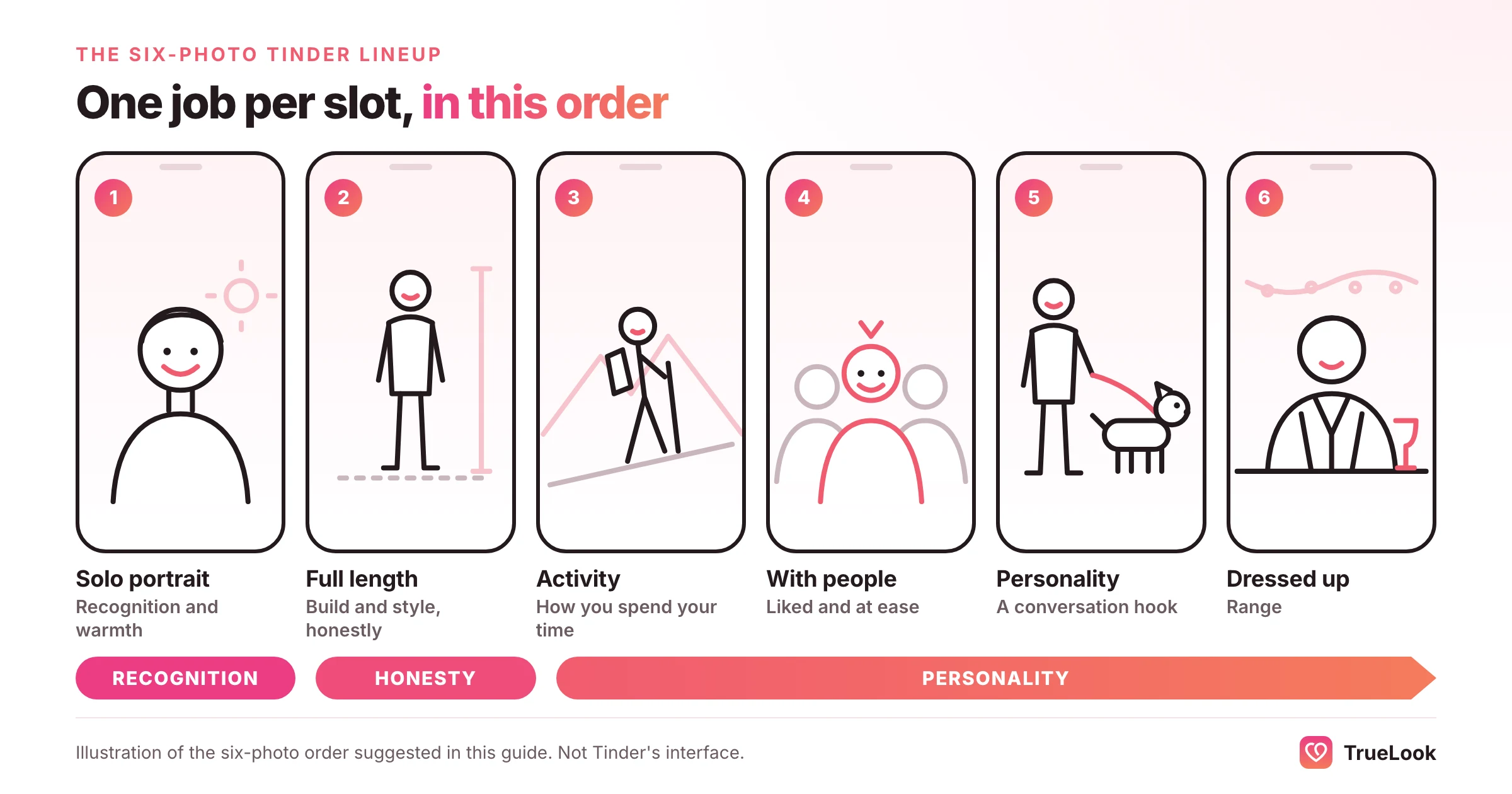
Think of the profile as a short story in pictures. Each slot has a single job, and no two slots should do the same job.
| Slot | Job | What works | What fails |
|---|---|---|---|
| 1. Solo portrait | Instant recognition and warmth | Chest-up, soft daylight, eyes visible, relaxed smile | Group shot, sunglasses, car selfie, dark bar photo |
| 2. Full length | Shows build, height and style honestly | Head to toe or seated full figure, outdoors, clothes that fit | Mirror selfie, cropped at the knees, baggy clothes |
| 3. Activity | Shows how you spend your time | Mid-activity, face visible, something you really do | Blurry action, back of your head, trophy pose |
| 4. With people | Shows you are liked and socially at ease | Two to four people, you obviously the subject | Big group, you hard to find, more than one such photo |
| 5. Personality | Gives a conversation hook | Pet, travel, instrument, cooking, a sense of humour | Borrowed dog, cropped-out ex, landmark with you tiny |
| 6. Dressed up | Shows range | Wedding, dinner, event, a sharper outfit | Corporate headshot that looks like a LinkedIn page |
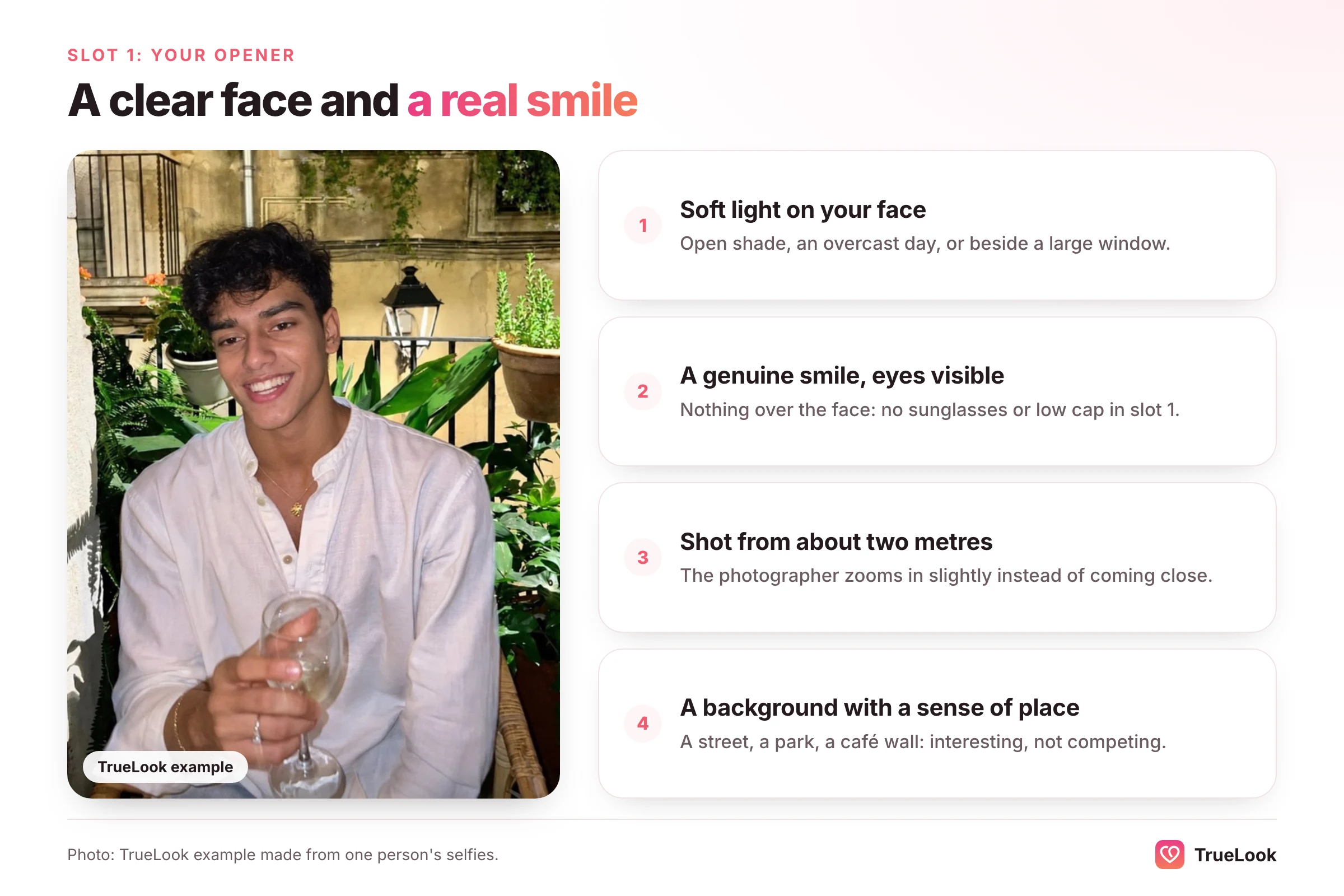
Slot 1: a clear solo portrait
This is the photo nearly everyone sees, and for many people the only one. Frame from the chest up, with your face turned toward the camera or slightly angled, in soft natural light. A relaxed, genuine smile helps most people here; the section on expression below explains the nuance for men.
Shoot it outdoors in open shade, on an overcast day, or beside a large window with the light falling on the front or side of your face. Have the photographer stand around two metres away and zoom in slightly instead of coming close. Background should add interest without competing: a street, a park, a café wall, not a pile of laundry.
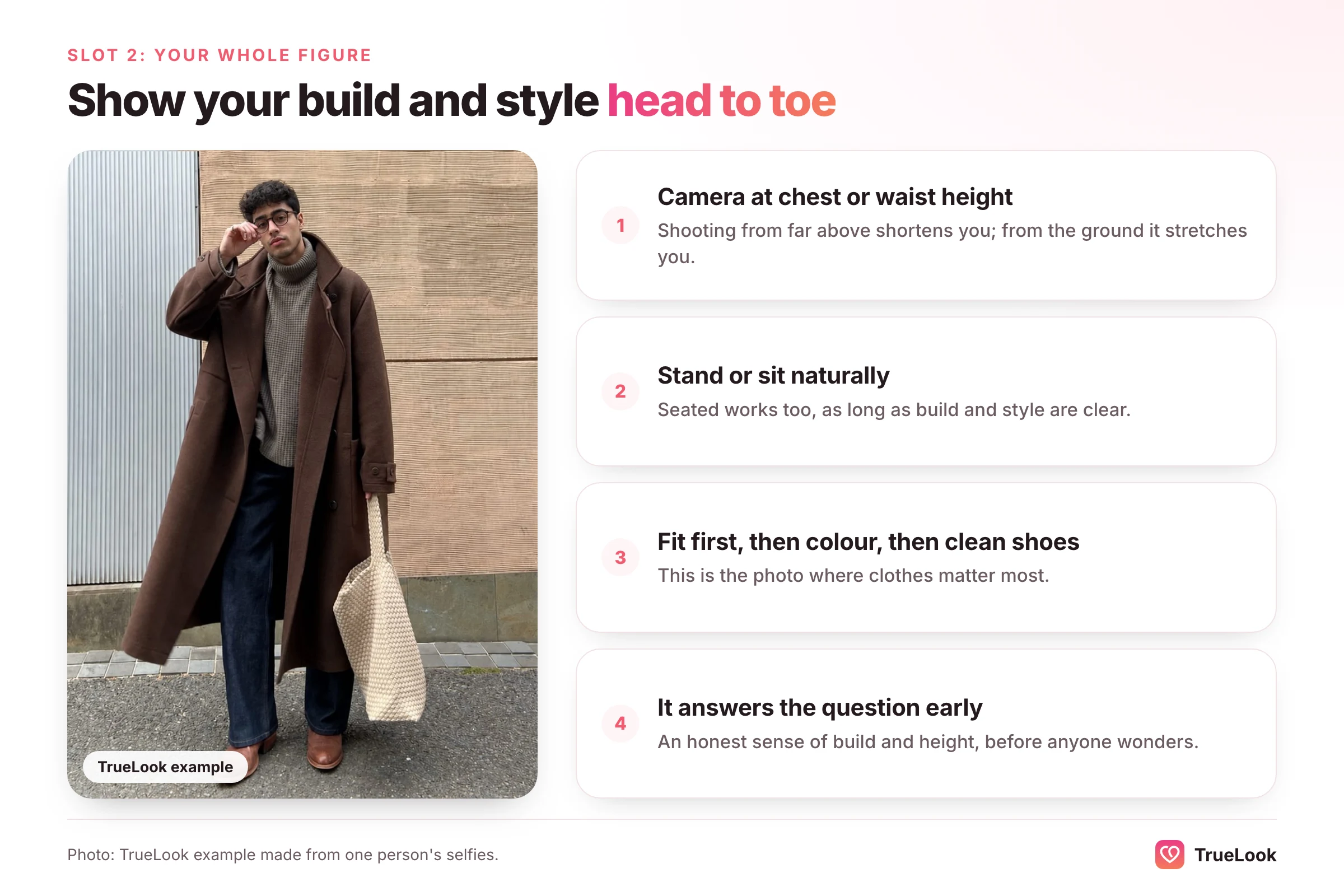
Slot 2: your whole figure
Someone deciding whether to meet you wants an honest sense of your build, your height relative to the surroundings and how you dress. A profile made only of close-ups invites the question of what is being left out. The full-length photo answers it before it is asked.
Stand or sit naturally, with the camera at roughly chest or waist height so your proportions look true. Shooting from far above shortens you; from the ground it exaggerates your legs and chin. This is the photo where clothes matter most: fit first, then colour, then clean shoes.
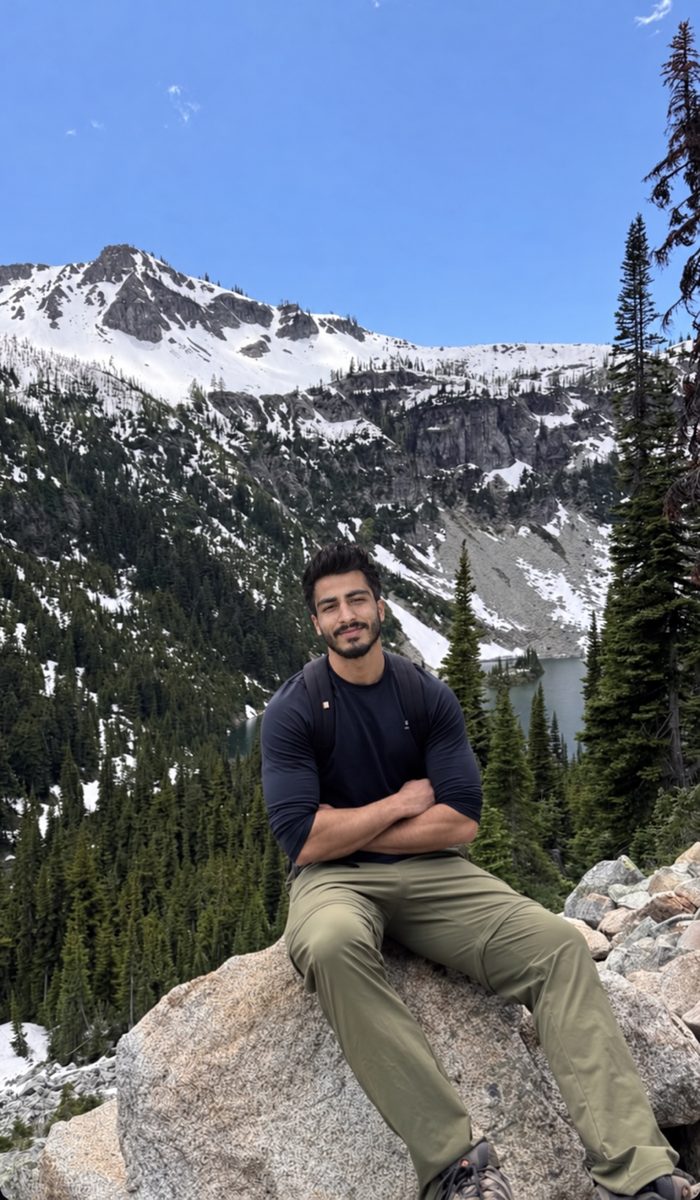
Slot 3: doing something you actually do
Cooking, climbing, running a trail, playing a guitar, building a shelf, swimming in a lake. An activity photo gives matches an easy first message ("Where is this?" or "What are you making?") and shows how you spend a free Saturday. Choose something you would happily talk about for ten minutes on a date, not something you did once for the picture.
Your face still needs to be visible. A distant figure on a mountain ridge is a landscape photo with you in it. Ask whoever is shooting to stay close enough that your expression reads.
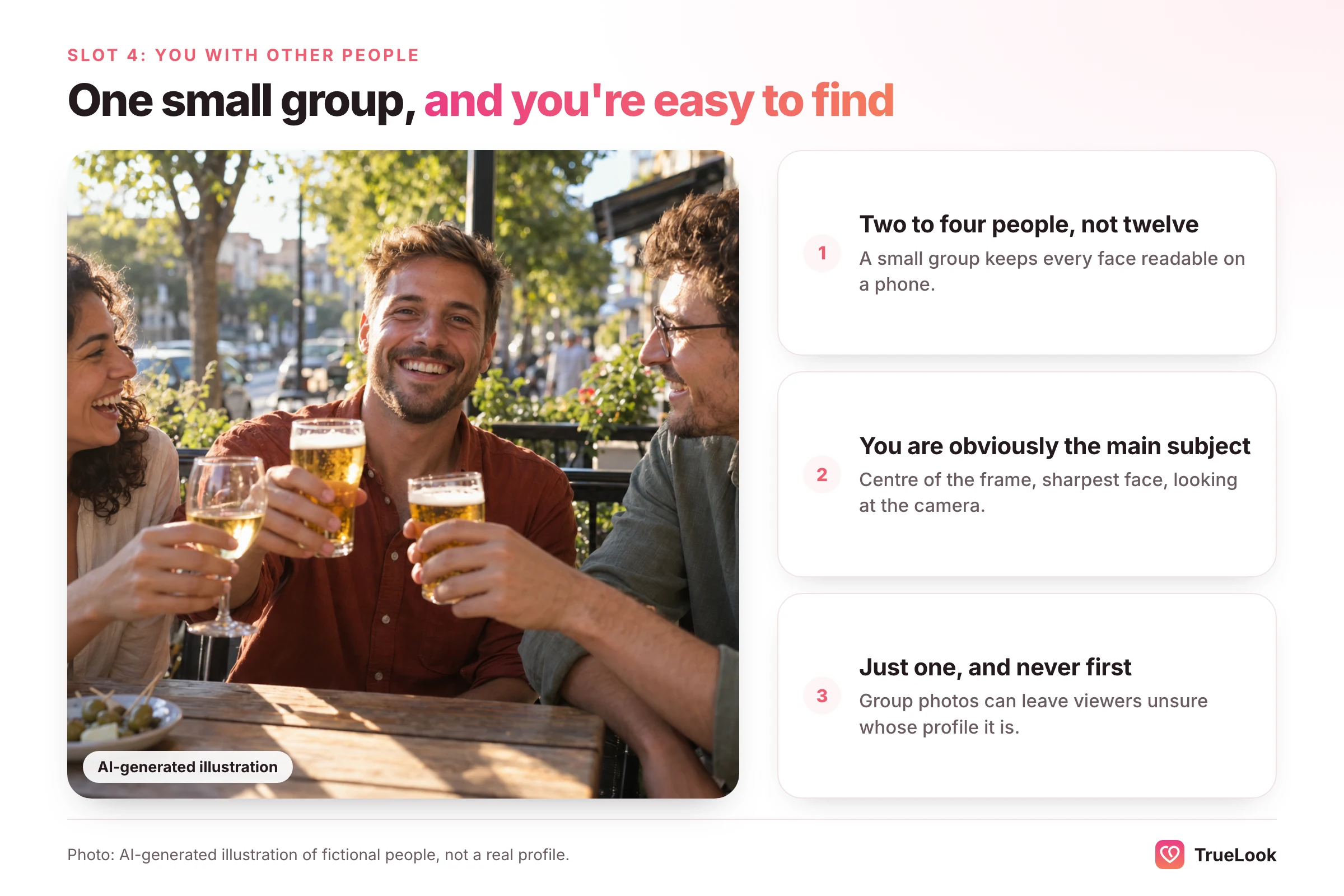
Slot 4: you with other people
One photo with friends or family shows that people enjoy your company. Keep it to one, make sure you are obviously the main subject, and pick a picture with two to four people rather than twelve. Tinder's spokesperson said in 2024 that group photos can leave viewers unsure whose profile they are looking at, which is exactly why the Photo Selector favours fewer of them.
There is an interesting nuance here, covered in the group-photo section below: faces can look slightly more attractive in a group. That effect is small, and it never helps if the viewer cannot work out which face is yours.
Slot 5: a personality or conversation photo
This slot carries texture. A trip, a dog, a costume party, a dish you are proud of, a hobby that surprises people. If you own a pet, it fits well here. If you borrowed one for the photo, skip it; the first date question about your dog will come.
Slot 6: a dressed-up shot
A wedding, a nice dinner, a work event or simply a sharper outfit. Seeing you in a jacket or a dress shows range and suggests what a date night might look like. If you have nothing suitable, a second strong portrait in a different setting and outfit works as well.
What about slots seven and beyond?
Tinder lets you add more photos than six, and short video clips too. Empty slots cost you nothing. A weak photo does, because viewers tend to judge a set by its worst image as much as its best. Add a seventh photo only if it is as good as your sixth and does a job the others do not.
What order should your Tinder photos be in?
Put your strongest solo face photo first and a full-length photo second, then alternate the rest so similar photos are never next to each other. The logic is simple: lead with recognition, resolve the "what do they look like" question early, then move from appearance to personality.
A decision table for the first slot
| If your best-looking photo is… | Then… |
|---|---|
| A solo, well-lit portrait | Put it first. You are done with slot 1. |
| A group photo where you look great | Crop it to you alone if it stays sharp; otherwise use it in slot 4 and take a new portrait. |
| A photo in sunglasses or a hat | Move it to slot 5 or later. Your opener needs your eyes. |
| A full-length shot where your face is small | Slot 2. Do not lead with it. |
| A selfie | Use it lower down, or retake it with the rear camera from further away. |
| More than two years old | Retire it. It fails the honesty test and can complicate photo verification. |
Should you use Smart Photos?
Tinder's Smart Photos setting reorders your pictures over time, moving the ones that are on screen when people swipe right toward the front. It is convenient and costs nothing to try. It also has limits. Photofeeler's critique of Smart Photos, written by a company that sells a competing rating service, makes some fair points: right swipes on men are relatively rare, so the feature learns from small numbers; a swipe may be about the profile as a whole rather than the photo on screen; and while it experiments, weaker photos are being shown to real potential matches.
A sensible approach: turn Smart Photos on only when you have two or three photos that could each plausibly lead, and turn it off if it keeps promoting a group shot or a photo in sunglasses.
How many pictures should you have on Tinder?
Aim for five or six. Fewer than four leaves questions unanswered and, according to the Tinder figures reported at the Photo Selector launch, falls short of what most single women say they want to see. More than six helps only when every extra photo is strong.
| Number of photos | What it signals | Advice |
|---|---|---|
| 1–2 | Low effort, or something to hide | Add a full-length and an activity photo before anything else. |
| 3–4 | Acceptable, but thin | Fill the missing slots from the lineup table. |
| 5–6 | Complete picture of a real person | The target for most people. |
| 7 or more | Either a rich life or padding | Keep extras only if each is as good as the rest. |
Expression and posture: what the research says
Smiling: mostly yes, with one honest caveat
Photofeeler's 2026 analysis of smiles, based on millions of profile photos rated by its users, found that smiling helped men's dating photos on every trait it measured. Open-mouth smiles performed best, lifting perceived trustworthiness by 2.55 points on a 10-point scale over non-smiling photos; closed-mouth smiles added 1.86. Attractiveness moved less than half a point. For women's dating photos, open-mouth smiles gave the largest trust gain, and closed-mouth smiles slightly edged ahead on attractiveness. Photofeeler notes the data are correlational: people who smile may also simply take better photos.
The caveat comes from a 2011 study by Jessica Tracy and Alec Beall at the University of British Columbia, published in Emotion. Over 1,000 adults rated photos of the opposite sex showing happiness, pride or shame. Women rated happy, smiling men as less sexually attractive than proud or brooding men, while men were most attracted to smiling women. The researchers stress that they measured first-impression sexual attraction, not whether someone would make a good partner, and that the sample was heterosexual North American adults.
How to use both findings: lead with a warm, natural smile, because trust and approachability are what get someone to pause. Then include one photo with a more composed, confident expression, such as a slight smile or a relaxed serious look with good posture. That gives the profile range without making it cold.
Posture: open beats closed
A 2016 PNAS paper led by Tanya Vacharkulksemsuk tested posture in speed dating and on a mobile dating app. As social psychologist Jeremy Nicholson summarised in Psychology Today, profiles whose photos showed open, expansive body language were 27% more likely to receive a "yes", and the effect was stronger for men's profiles. Expansive here means an open torso and arms: shoulders relaxed and back, arms away from the body, not hunched or folded.
Practical translation: uncross your arms, take your hands out of your pockets, lean on a railing or rest an arm on a chair back, and stand tall without stiffening.
Eyes and eye contact
Eyes carry much of what people read as warmth and trustworthiness, which is why sunglasses belong lower in the order. Looking straight into the lens works well for a portrait; looking slightly away works for candid activity shots. Mix both across the set.
Selfies: why one is enough
Selfies cause two separate problems: optics and perception.
The optical problem is distance. A 2018 study in JAMA Facial Plastic Surgery by Brittany Ward and colleagues, covered by ZME Science, found that a photo taken about 30 centimetres (12 inches) from the face makes the nose look roughly 30% larger relative to the rest of the face than a photo taken from a standard portrait distance of about 1.5 metres. Arm's length is selfie distance. Your face in a selfie is literally a different shape from your face across a table.
The perception problem is how selfies read. In a 2017 experiment in Frontiers in Psychology, 297 people viewed mock social media profiles; the same person was rated less trustworthy and less socially attractive in a selfie than in a photo taken by someone else. The effect was small to moderate, but it is consistent with what dating coaches have said for years.
The fix is not to ban selfies but to cap them: one, lower in the order, ideally taken with the rear camera on a timer from a couple of metres away, which is not a selfie at all in the optical sense.
Group photos: the useful effect and the trap
Researchers Drew Walker and Edward Vul at UC San Diego described what they called the cheerleader effect. In five experiments reported by ScienceDaily in 2013, people were rated slightly more attractive when shown in a group than alone, even when the "group" was just a collage of separate photos. The boost was small, roughly from the 49th to the 51st percentile. The likely explanation is that viewers average the faces in a group, smoothing out individual quirks.
That is a reason to include one group photo, not five. The trap is identification: a viewer who has to hunt for you does extra work, and on a fast-swiping app extra work tends to end in a left swipe. Keep the group small, stand where you are easy to find, and make sure your solo photos come first so viewers already know your face by the time they reach the group.
Do dog photos help on Tinder?
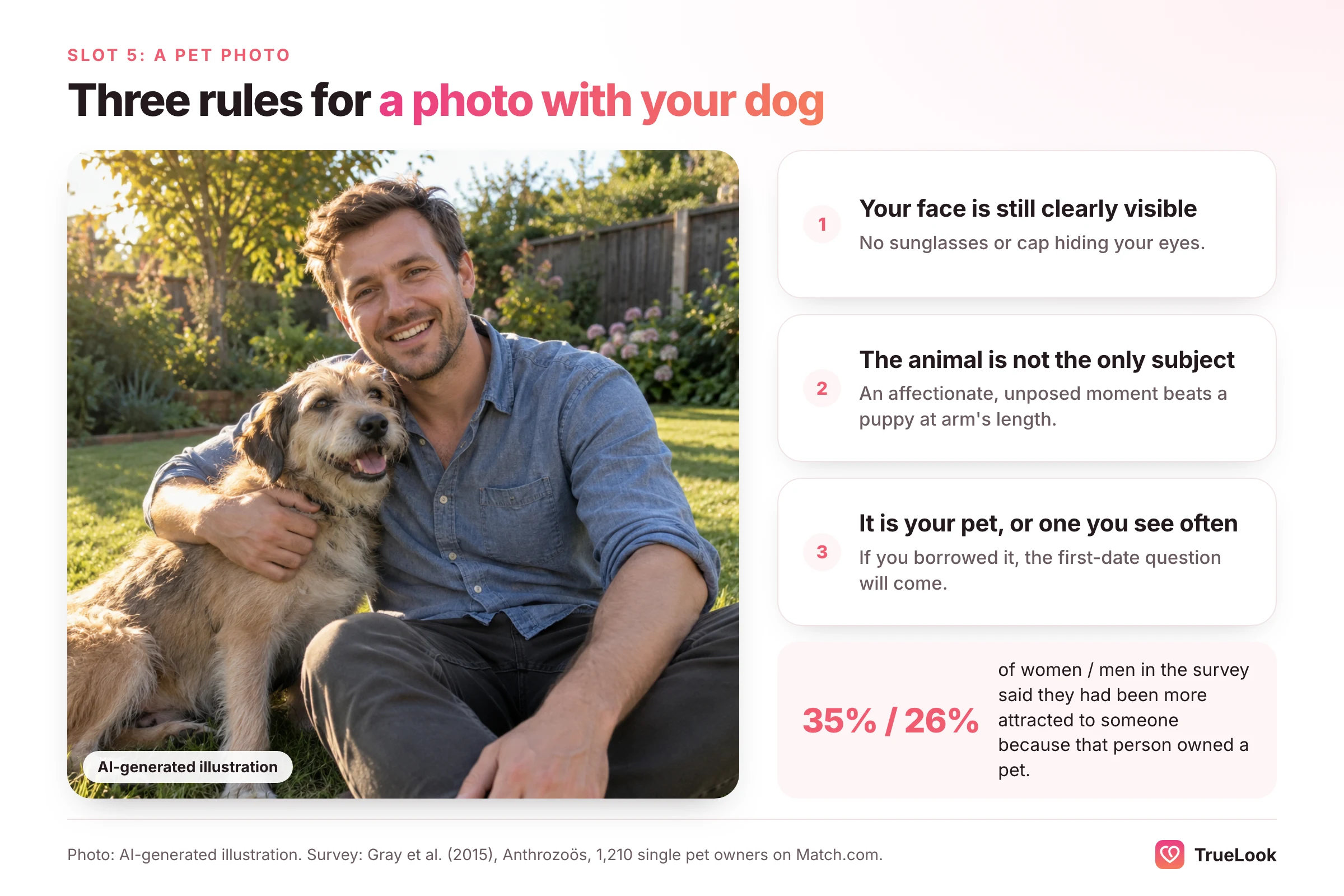
Usually, if the dog is yours. A 2015 study in the journal Anthrozoös by Peter Gray and colleagues surveyed 1,210 single pet owners on Match.com. As psychologist Hal Herzog reported in Psychology Today, 35% of women and 26% of men said they had been more attracted to someone because that person owned a pet, and 22% of men admitted using a pet to attract dates. Dogs were seen as a better signal of caregiving than cats.
Three rules for a pet photo: your face should still be clearly visible, the animal should not be the only subject, and the pet should be yours or a pet you see regularly. An affectionate, unposed moment beats you holding a puppy at arm's length.
How to take good Tinder photos by yourself
You do not need a photographer. You need decent light, a stable phone, two or three outfits and about an hour. Here is a plan that produces enough material for a full lineup.
Step-by-step: a one-hour phone shoot
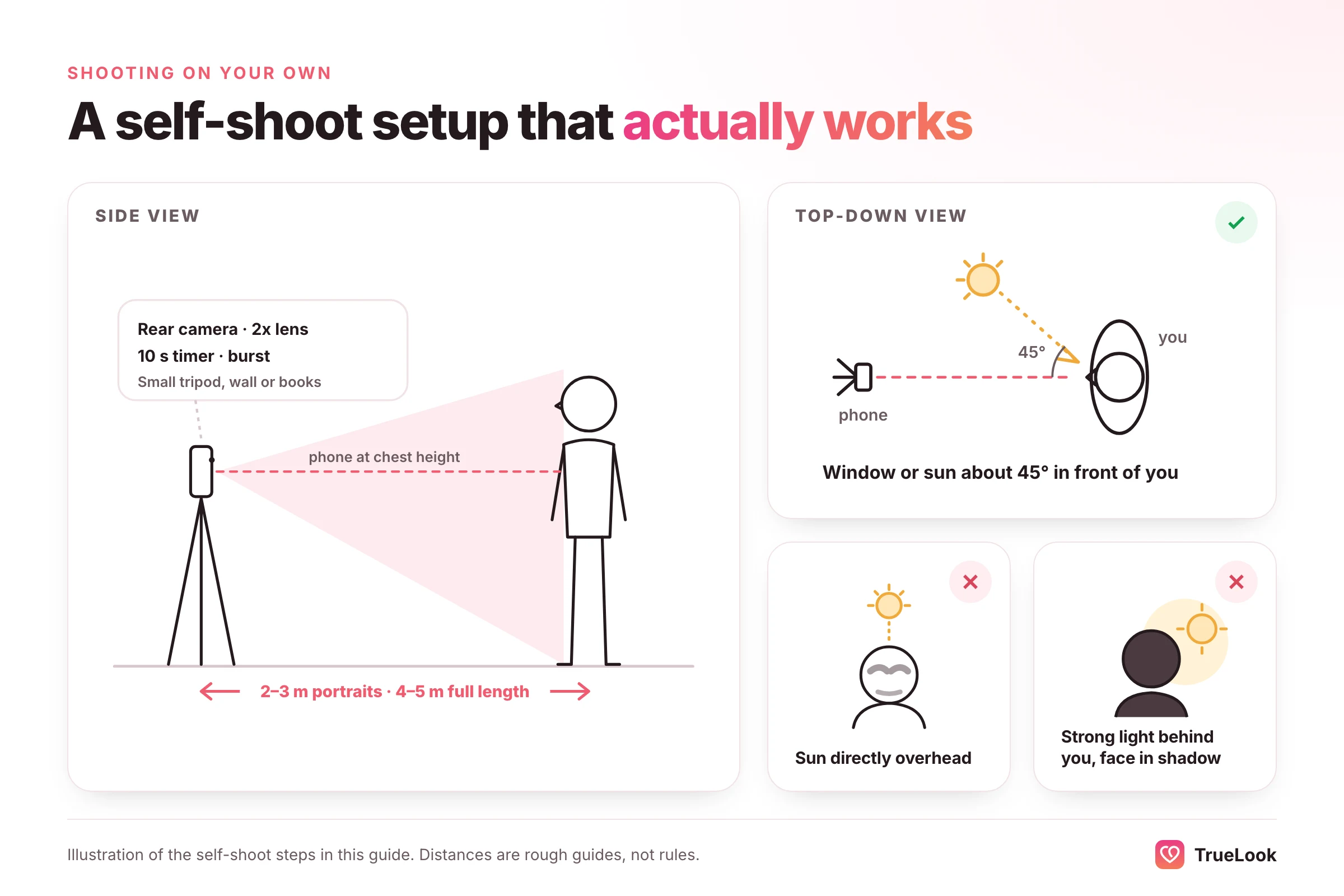
- Pick the light. The hour after sunrise or before sunset gives warm, low, soft light. A bright overcast day gives soft light all day. Avoid midday sun, which casts hard shadows under the eyes and nose.
- Use the rear camera. It is sharper than the front camera on almost every phone and lets you use the zoom lens.
- Use the 2x or 3x lens if you have one. Standing further back and zooming in gives more flattering proportions than the default wide lens up close, for the same reason selfies distort.
- Stabilise the phone. A small tripod, a wall or a stack of books at chest height. Set it two to three metres away for portraits and further back for full-length shots.
- Use a timer and burst mode. A 10-second timer plus burst gives dozens of frames per pose. Natural expressions appear between the posed ones.
- Face the light. The sun or window should be in front of you or about 45 degrees to one side. If the sun is behind you for a glowing edge, make sure your face is still lit, or the camera will turn you into a silhouette.
- Move, do not pose. Walk toward the camera, laugh at something, look away and back, adjust a sleeve. Stiff poses read as stiff.
- Change outfit and location at least twice. Variety is what makes six photos look like a life rather than one afternoon.
A shot list for one session
| Location | Outfit | Shots to get | Slot |
|---|---|---|---|
| Quiet street or park, open shade | Plain top in a colour that suits you | Chest-up portraits, smiling and composed | 1 |
| Same place, step back | Same | Full-length standing and walking | 2 |
| Somewhere you do a hobby | Whatever you wear for it | Mid-activity, face visible | 3 |
| Café, market or friend's place | Smarter layer or jacket | Seated, relaxed, with or without a friend | 4 or 6 |
Briefing a friend
A friend with no photography experience can still take great pictures if you give them a short brief: stand back about two metres, zoom in slightly, keep the phone at my chest height, keep shooting while we talk. The best frames usually come mid-conversation, when you forget the camera.
Why are my Tinder photos blurry, and how do I fix it?
Blurry Tinder photos almost always start before the upload. The usual causes and fixes:
- You uploaded a copy, not the original. Photos saved from social media, screenshots, or images forwarded through messaging apps have already been compressed, sometimes several times. Upload the original file from your camera roll.
- The crop is too tight. Zooming deep into a group photo to isolate your face leaves very few pixels. If the crop looks soft on your own phone, it will look worse on someone else's.
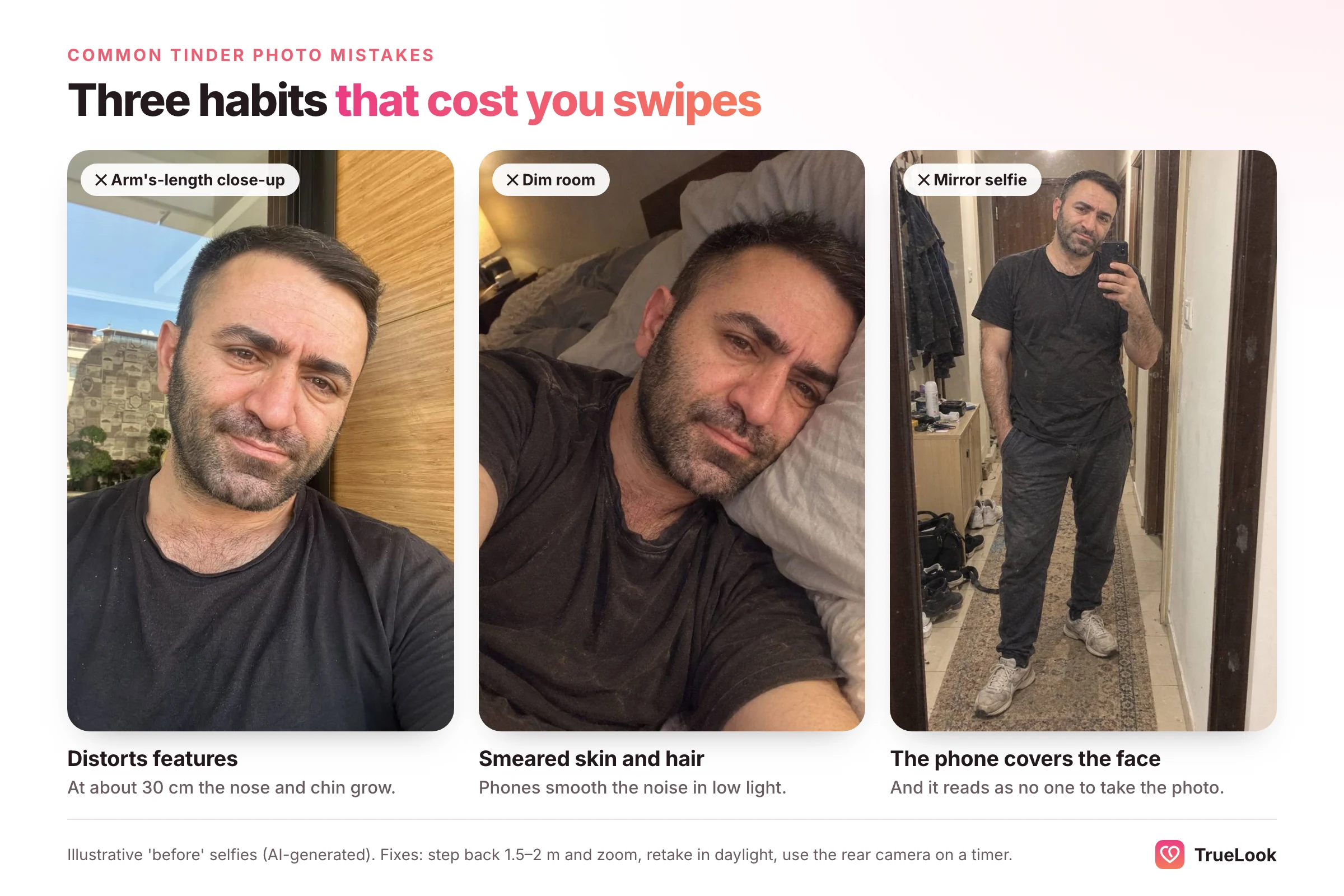
- Low light. Phones in dim rooms raise sensitivity and smooth the noise, which smears skin and hair. Retake in daylight.
- Motion blur. Hand shake or a moving subject. Use a tripod or lean the phone on something, and use burst mode.
- Heavy filters or "enhance" apps. Over-sharpened or smoothed images often look worse after the app compresses them.
Tinder does not prominently publish a recommended pixel size, so the safest rule is to start from the sharpest, full-resolution original and let the app do the resizing.
Tinder photo mistakes, and the fix for each
| Mistake | Why it hurts | Fix |
|---|---|---|
| Group photo first | Viewers cannot tell which person you are | Lead with a solo portrait; one group photo in slot 4 |
| Sunglasses or hat in the opener | Hides the eyes, which carry warmth and trust | Move to slot 5 or later |
| Mirror selfies | Phone covers the face; reads as no one to take the photo | Rear camera on a timer, or ask a friend |
| Arm's-length close-ups | Distorts features at about 30 cm | Shoot from 1.5–2 m with a zoom lens |
| Only close-ups | Leaves build and height unknown | Add a full-length photo in slot 2 |
| Outdated photos | First date disappointment; verification trouble | Use photos from the last year or two |
| Heavy filters and smoothing | You look unlike yourself | Light colour correction only |
| Cropped-out ex | The stray shoulder is always noticed | Replace the photo |
| Six photos from one day | Same shirt, same light, no sense of a life | Two or three sessions, different outfits |
| Trophy shots: fish, cars, cash | Clichés that say little about you | Show the activity, not the object |
| Bathroom shirtless shot | Context makes it read as vanity | Shirtless only where it fits: beach, swim, sport |
Myths and facts about Tinder photos
| Myth | Fact |
|---|---|
| "Only very attractive people get matches." | Light, framing, expression and posture change how the same face is judged. The posture study above changed "yes" rates by 27% with the same people. |
| "More photos is always better." | Five or six strong photos beat nine uneven ones. A weak photo can drag the set down. |
| "You need a professional camera." | A recent phone in good light, held by someone else at a sensible distance, beats a professional camera under a fluorescent ceiling. |
| "Men should never smile." | Smiling raises perceived trust a lot. One study found smiling men less sexually attractive at first sight, so mix a warm opener with one composed photo. |
| "You know your best photo." | Strangers pick better profile photos for you than you pick for yourself, according to research covered below. |
| "Group photos hide flaws, so use lots." | The attractiveness boost from groups is tiny, and being hard to find costs more. |
Best Tinder photos for guys
The lineup above works for everyone, but a few points come up again and again in men's profiles.
- Include more than one clear face photo. Tinder's own reported figure, a 71% increase in matches with women for men with more than one face photo, is the single most useful number for men in this guide.
- Smile in the opener, add one composed shot. The research on expression points to warmth first and range second.
- Open up your posture. The posture effect was stronger for men's profiles than women's.
- Show effort in grooming, not in posing. A fresh haircut, a trimmed beard and a shirt that fits do more than a dramatic angle.
- Skip the trophy shots. If fishing matters to you, show yourself on the water, not holding the fish to the camera.
- Keep shirtless photos rare and in context. One on a beach or after a swim can work; a bathroom or gym-mirror version rarely does.
For a broader look at men's profiles across apps, see our guide to the best dating profile photos for men.
Best Tinder photos for women
Women often face a different problem from men: not too few likes, but too many from the wrong people, and more safety concerns. The photo principles are the same, with a few adjustments.
- Choose photos that filter, not just attract. An activity or hobby photo draws people who share it, which tends to lead to better conversations.
- Smile in the way that feels like you. In Photofeeler's data, closed-mouth smiles slightly edged open-mouth smiles on attractiveness in women's dating photos, while open-mouth smiles led on trust. Either works; forced versions of either do not.
- Include a full-length photo too. The honesty logic applies equally, and it reduces awkward first-date surprises in both directions.
- Remove location clues. House numbers, your street sign, a work badge, a uniform with a logo or a gym you visit daily. Pew found that 52% of online daters say they have come across someone they thought was trying to scam them.
- Filters off. Light colour correction is fine; face-smoothing apps make you look unlike yourself and can complicate verification.
Three example lineups
These are illustrative profiles, built to show how the slots fit real lives. They are not real people.
Example profile: a 34-year-old software engineer who mostly works from home
Before: a car selfie, a cropped photo from a friend's wedding, a group photo at a conference, a screenshot of a video call and a photo of his desk setup.
After: (1) a chest-up portrait in open shade on his street, taken by a friend with the 2x lens; (2) full-length walking along a canal; (3) at the climbing gym mid-route, face visible; (4) at a board game night with three friends; (5) cooking with his sourdough starter on the counter; (6) the wedding photo, retaken uncropped with him in a suit. The car selfie and the video call screenshot are gone.
Example profile: a 27-year-old nurse working shifts
Before: five photos, three in scrubs at work with a hospital badge visible, one in sunglasses at a festival as the opener, one group shot of six friends.
After: (1) a natural-light portrait by a window on a day off; (2) full-length at a weekend market; (3) on a paddleboard; (4) with two friends at a birthday dinner; (5) the festival photo, now in slot 5 where the sunglasses are fine. The badge photos are removed for privacy, and one photo hints at her work without showing where.
Example profile: a 45-year-old divorced father of two
Before: a professional headshot from work, three photos with his children, and an old photo from ten years ago.
After: (1) a relaxed portrait outdoors, smiling, in a casual jacket; (2) full-length on a hike; (3) coaching his kids' football team, shot from behind the children so their faces are not shown; (4) at dinner with friends; (5) with his dog; (6) the work headshot, kept last for range. The decade-old photo goes. Children's faces stay off the profile; Tinder's own community guidelines do not allow photos of unaccompanied minors, and most parents prefer to keep their children's faces private anyway.
How to choose your best photos (hint: do not do it alone)
A 2017 study by David White, Clare Sutherland and Amy Burton, published in Cognitive Research: Principles and Implications and reported by Neuroscience News, asked 610 people to choose profile pictures of themselves and of strangers for social, professional and dating sites. Images chosen by strangers made more favourable impressions than images people chose for themselves. The authors called it the curse of self.
Turn that finding into a simple process:
- Shortlist 12 to 15 photos that pass the four-question test.
- Send them, numbered, to three people who are the kind of person you hope to match with, or at least share their perspective. Ask each to pick their top five and their best opener, without discussion.
- Use the photos that appear on more than one list. If one opener gets two or more votes, it goes first.
- Run the new lineup for two weeks without changing it, then swap the weakest photo and compare.
Two weeks matters. Daily changes make it impossible to tell what helped, and match numbers move with the day of the week, the weather and your own swiping habits.
If you do not have good photos
Plenty of people have no recent, well-lit, solo photos of themselves. There are three realistic routes: a one-hour shoot with a friend using the plan above, a professional dating photographer, or an AI tool that creates photos from your own selfies. Our comparison of dating photographers versus AI sets out the cost, time and trade-offs of each.
TrueLook is one option in the last group. You upload four selfies and it makes hyperrealistic photos of you in different settings, each in about a minute, like the hiking and café examples above. If you go this way, choose results that look like you on a good day, not like someone else, and keep at least one or two ordinary phone photos in the mix. Our page on AI Tinder photos made from your own selfies explains how it works. Tinder decides who passes its checks; our guide on what to do when Tinder photo verification fails covers that process, and whether AI photos are allowed on dating apps covers each app's rules. Tinder's guidelines are clear on one point: do not pretend to be someone you are not.
The honest limits of photo advice
Better photos raise your chances; they do not guarantee anything. Some limits worth knowing:
- Much of the research is about impressions, not dates. Lab studies measure ratings of faces, and app data measures swipes. Neither tracks who ends up in a relationship.
- Company data is self-interested. Tinder's and Photofeeler's numbers come from companies with products to promote. They are useful, but they are not peer-reviewed.
- Samples are narrow. Several studies here used North American, heterosexual or student samples. Preferences vary by culture, age and orientation.
- Photos are not the only factor. Location, age range settings, how selectively you swipe and how quickly you reply all affect results. If your photos pass every test here and things are still quiet, our guides on why you get no matches on Tinder and how to get more matches on Tinder cover the other levers.
Frequently asked questions
What pictures should I put on Tinder?
Use a clear solo portrait first, then a full-length photo, an activity photo, one photo with a small group of friends, a personality photo such as a pet or travel shot, and one where you are dressed up. Every photo should be recent, well lit and make your face easy to recognise.
How many pictures should you have on Tinder?
Five or six strong photos is the right target for most people. Fewer than four leaves questions unanswered. Tinder allows more, but extra photos help only if each is as good as the rest, because a weak photo drags down the whole set.
What is the best first photo for Tinder?
A solo photo from the chest up, in soft natural light, with your eyes visible and a relaxed, genuine smile, taken by someone else from about two metres away. Avoid sunglasses, hats, group shots, car selfies and mirror selfies in the first slot.
Should guys smile in Tinder photos?
Yes, in the first photo and in most of the others. Photofeeler's data shows smiling raises perceived trustworthiness in men's dating photos considerably. One 2011 study found smiling men less sexually attractive at first sight, so include one photo with a more composed, confident expression for range.
Why are my Tinder photos blurry?
Usually because the file was already compressed before upload, such as a screenshot or a photo saved from social media, or because it was cropped too tightly, taken in low light or affected by hand shake. Upload the full-resolution original from your camera roll, taken in daylight.
Do dog photos help on Tinder?
Often, if the dog is yours. In a 2015 survey of 1,210 single pet owners, 35% of women and 26% of men said they had been more attracted to someone because of their pet. Keep your face clearly visible and put the pet photo in slot 5, not first.
Does Tinder Smart Photos work?
Smart Photos reorders your pictures based on which are on screen when people swipe right. It is worth trying when two or three photos could each lead, but it learns from limited data and tests weaker photos on real viewers. Turn it off if it promotes a group shot or a photo in sunglasses.
Can I use AI photos on Tinder?
Tinder's guidelines prohibit pretending to be someone you are not, so photos of another person or images that misrepresent you are out. Photos generated from your own face that still look like you are a different matter, but verification decisions are always Tinder's. Our guide on whether AI photos are allowed on dating apps covers each app's position.
Sources
- First impressions: making up your mind after a 100-ms exposure to a face, Psychological Science via PubMed (2006). https://pubmed.ncbi.nlm.nih.gov/16866745/
- The Follies of Speed Swiping in Dating Apps, Scientific American (2016). https://www.scientificamerican.com/article/the-follies-of-speed-swiping-in-dating-apps/
- Key findings about online dating in the U.S., Pew Research Center (2023). https://www.pewresearch.org/short-reads/2023/02/02/key-findings-about-online-dating-in-the-u-s/
- Tinder's AI Photo Selector automatically picks the best photos for your dating profile, TechCrunch (2024). https://techcrunch.com/2024/07/17/tinder-ai-photo-selection-feature-launches
- Tinder's new AI tool helps users choose pictures that are most likely to get matches, Scripps News via KXLF (2024). https://www.kxlf.com/science-and-tech/artificial-intelligence/tinders-new-ai-tool-helps-users-choose-pictures-that-are-most-likely-to-get-matches
- Community Guidelines, Tinder (current). https://policies.tinder.com/community-guidelines/intl/en/
- The Science of Smiling in Photos: How Different Expressions Impact First Impressions, Photofeeler (2026). https://blog.photofeeler.com/the-science-of-smiles/
- Should I Use Tinder ‘Smart Photos’? How Does It Work? (HINT: It Doesn’t), Photofeeler (2022). https://blog.photofeeler.com/tinder-smart-photos-photo-rating-ranking/
- Happy guys finish last, says new study on sexual attractiveness, ScienceDaily (2011). https://www.sciencedaily.com/releases/2011/05/110524070310.htm
- How Our Body Language Can Make Us Attractive, Psychology Today (2017). https://www.psychologytoday.com/us/blog/the-attraction-doctor/201709/how-our-body-language-can-make-us-attractive
- A new study has found that selfies make noses appear 30% larger, and people aren’t happy about it, ZME Science (2018). https://zmescience.com/science/news-science/selfies-make-hate-nose-02032018
- Beware of Selfies: The Impact of Photo Type on Impression Formation Based on Social Networking Profiles, Frontiers in Psychology (2017). https://www.frontiersin.org/journals/psychology/articles/10.3389/fpsyg.2017.00188/full
- People seem more attractive in a group than they do apart, ScienceDaily (2013). https://sciencedaily.com/releases/2013/10/131029092028.htm
- Does Having a Pet Make You More Attractive?, Psychology Today (2015). https://www.psychologytoday.com/us/blog/animals-and-us/201511/does-having-pet-make-you-more-attractive
- What's the Best Way to Choose Your Profile Pic? Ask Someone Else to Do It, Neuroscience News (2017). https://neurosciencenews.com/profile-pic-psychology-6417/
Get better dating photos from your own selfies
TrueLook’s HyperReal™ method turns 4 selfies into hyperrealistic photos of you for Tinder, Hinge and Bumble.
AI Tinder photos made from your selfies
Written by the TrueLook Team
TrueLook makes hyperrealistic dating photos from your own selfies. Our articles cover dating profile photos, the apps and how to get noticed.