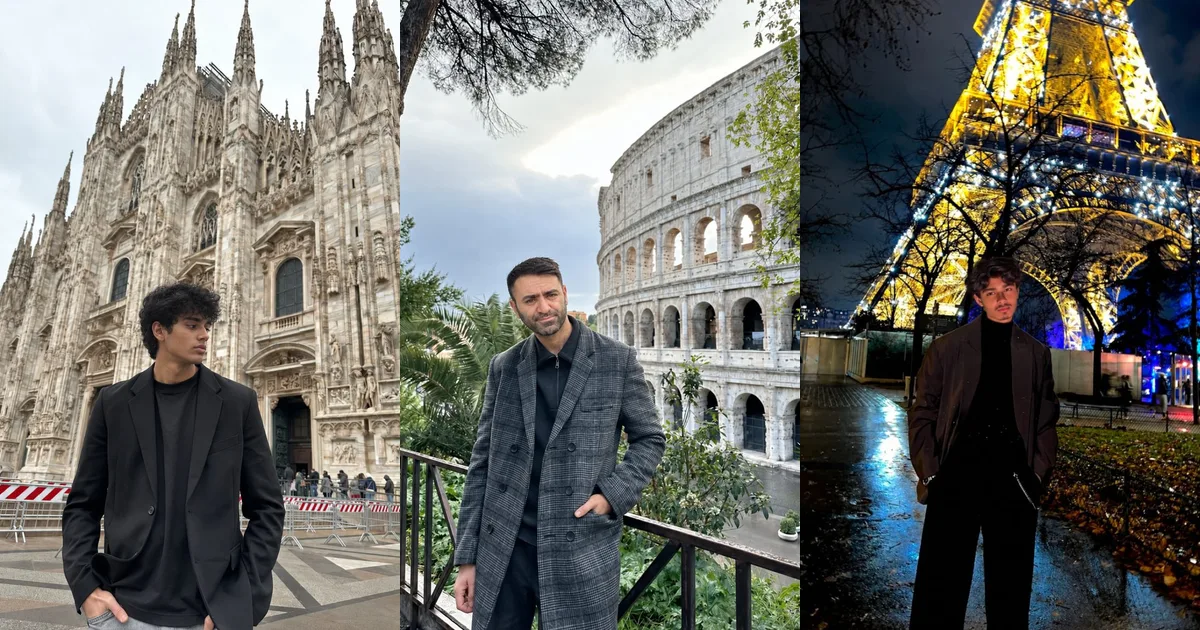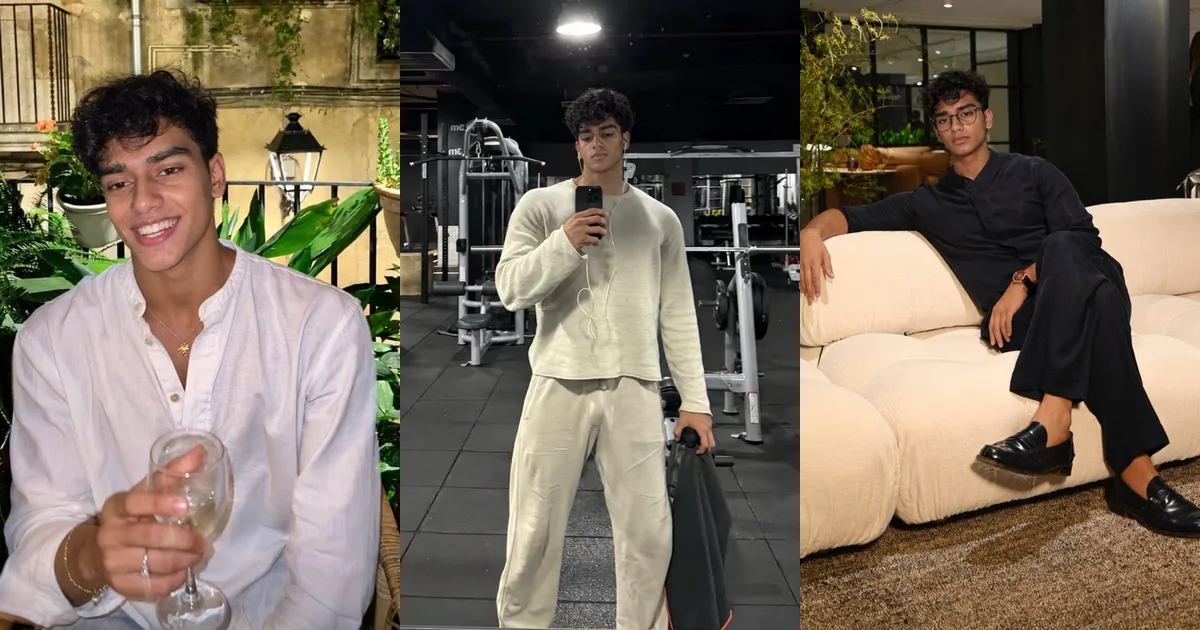
Yes, AI photos are allowed on dating apps as long as they truthfully show you. None of Tinder, Hinge or Bumble bans AI images as such. What all three ban is misrepresentation: fake identities, someone else's likeness, or photos altered so much that nobody can tell they're you. Hinge says so outright, banning AI-generated content used to mislead others. Each app also runs selfie checks that compare your face with your profile photos, and those checks are increasingly mandatory.
- Hinge's rules (checked November 2026) ban using "fake identities or AI-generated content to mislead others". The key words are "to mislead", and its AI principles let you include generative AI images as long as they don't misrepresent you.
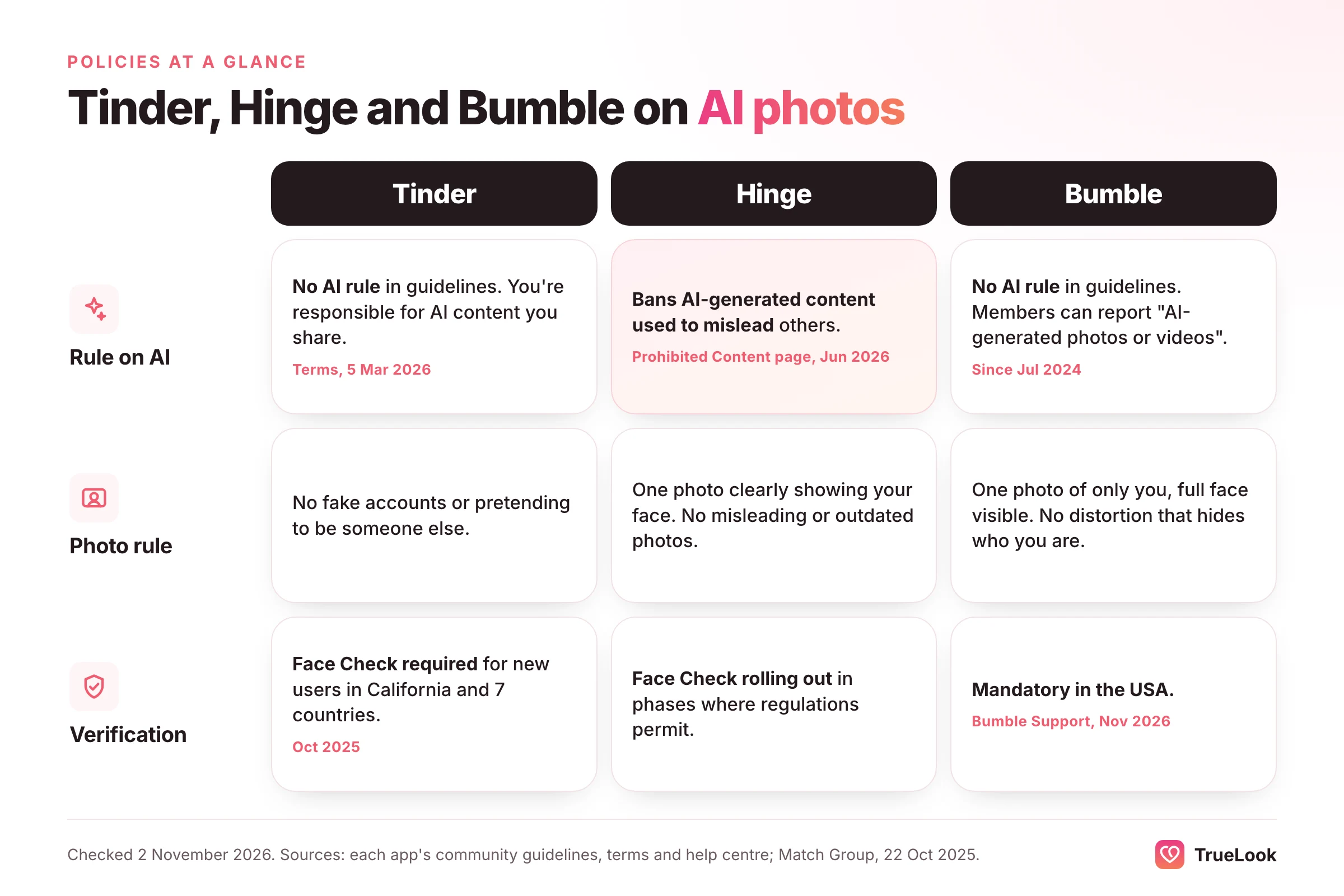
- Tinder's community guidelines don't mention AI. They ban fake accounts and pretending to be someone you're not, and its March 2026 terms make you responsible for the accuracy of any AI content you share.
- Bumble requires at least one photo that shows only you with your full face visible. It bans photos so distorted, or so full of unnatural digital effects, that it can't be clearly determined that you're the person in them.
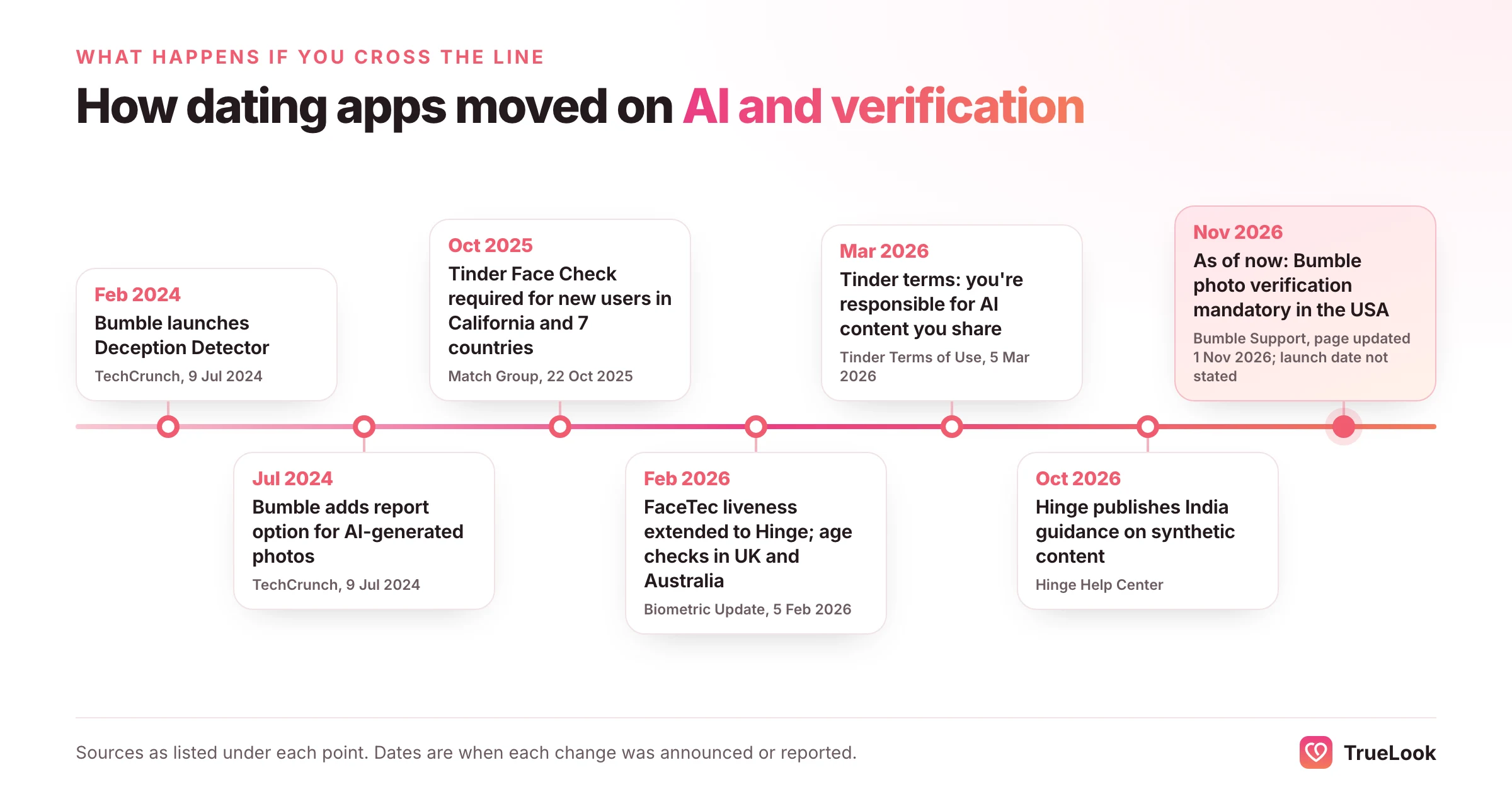
- Verification is moving from optional to required. Bumble's photo verification is mandatory in the USA. Tinder's Face Check is required for new users in California and seven countries. Hinge is rolling out Face Check in phases.
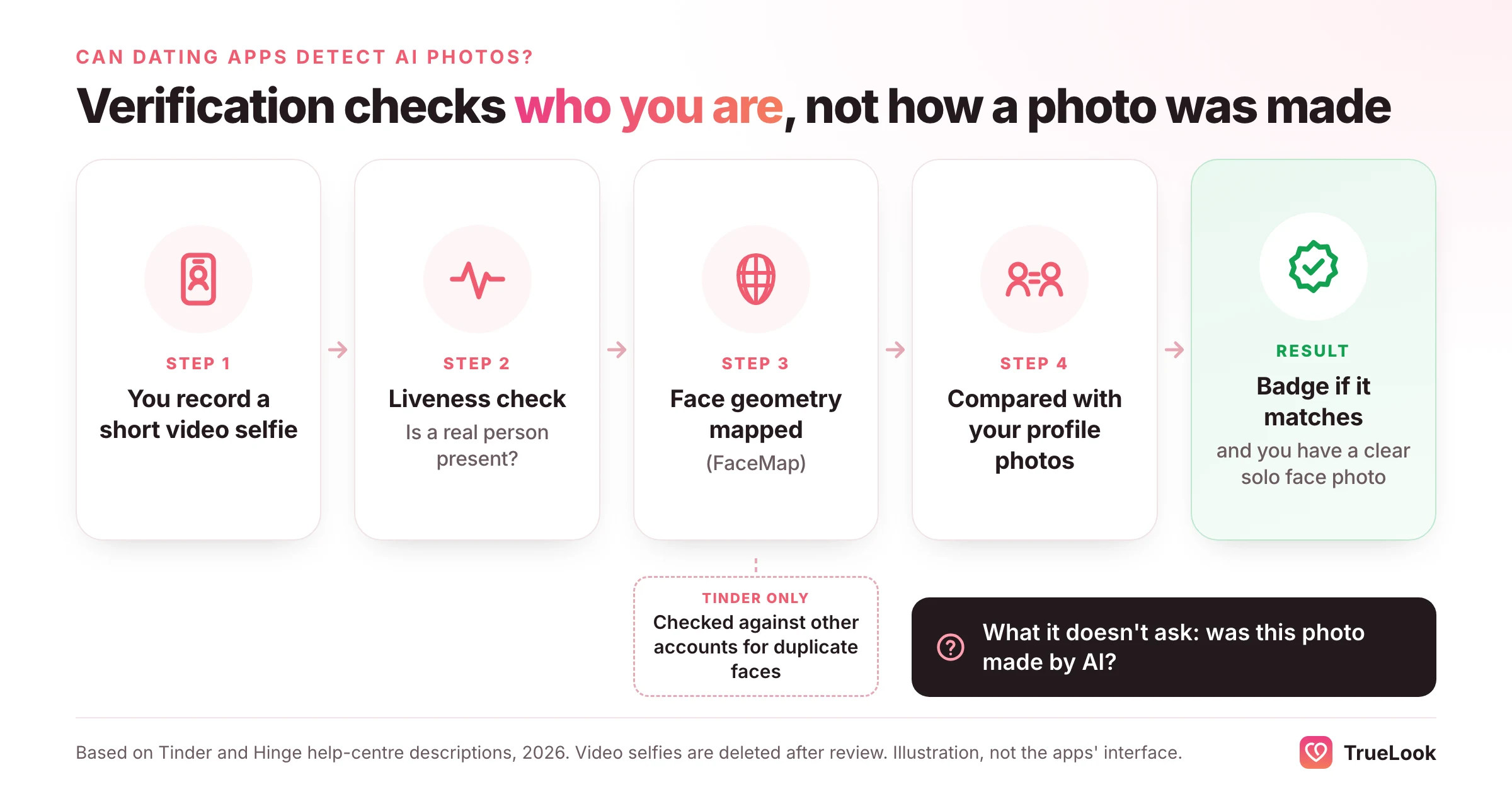
- These systems check whether the face in your photos matches a live video selfie. They aren't AI-image detectors, partly because people can't reliably tell AI faces from real ones.
- Bumble has let members report profiles for "using AI-generated photos or videos" since July 2024, so other members are part of enforcement too.
- The safe line: AI may change the setting, light and outfit. It must never change your face, body, age or identity.
This guide quotes or paraphrases each app's own policy pages and help centres, with the date we checked them, then covers how verification works, where the line sits, and a step-by-step way to use AI photos without putting your account at risk. Policies change often, so treat the dates as part of the answer. This is general guidance, not legal advice.
The short answer: the rules are about honesty, not tools
When people ask whether AI photos are allowed, they usually picture one thing. In practice, "AI photo" covers at least five very different kinds of image, and the apps' rules treat them very differently. The rule that runs through every policy below is simple: your photos must show you, as you are.
| Type of image | What it is | Where it sits under app rules |
|---|---|---|
| Light corrections | Brightness, color, crop, noise reduction on a real photo | Normal practice. Tinder's own Photo Enhance tool does this, and Hinge's India guidance names routine enhancements as generally not synthetic content. |
| AI photo built from your own face | You, recognizably, in a new setting, outfit or light | Consistent with the rules when it looks like you. Hinge explicitly allows generative AI images that don't misrepresent you. |
| Heavy AI beautification | Reshaped jaw, smoother and younger skin, slimmer body, fuller hair | Risky. It starts as you but can become misleading, and it can fail a face match. |
| Distorted or effects-heavy image | Strong filters or effects that hide who you are | Against Bumble's rules if it can't be clearly determined that it's you. |
| Generated stranger or someone else's likeness | A face that isn't yours | Prohibited everywhere as impersonation, a fake identity or catfishing. |
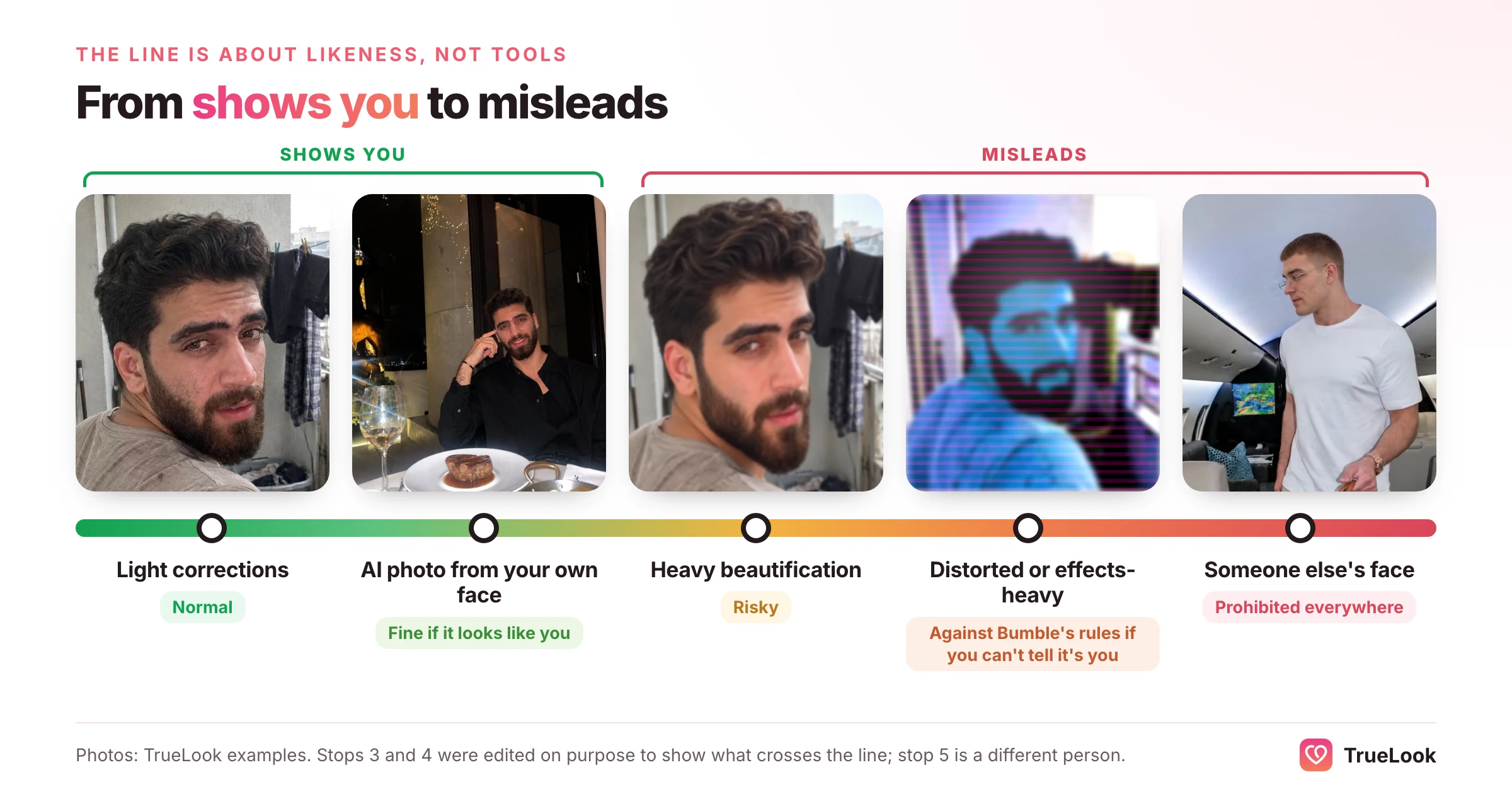
So the useful question isn't "was AI involved?" It's "would a match recognize me from this photo when I walk in?" If the answer is yes, you're inside every policy we found. If the answer is "sort of" or "on a good day with a filter", you're in the zone where profiles get reported, verification fails and accounts get removed.
Policies at a glance: Tinder, Hinge and Bumble
Here is what each app's own pages said when we checked them on 2 November 2026. Wording is quoted where marked and paraphrased otherwise.
| Tinder | Hinge | Bumble | |
|---|---|---|---|
| Mentions AI in profile rules? | Not in its community guidelines. The terms make you responsible for AI content you share. | Yes: no "AI-generated content to mislead others" | Not in its community guidelines. Members can report "AI-generated photos or videos". |
| Core photo rule | No fake accounts; don't pretend to be someone you're not | One photo that clearly shows your face; no misleading or outdated photos | At least one photo of only you, full face visible; no heavy distortion |
| Verification | Optional Photo Verification; Face Check required for new users in some regions | Optional Selfie Verification; Face Check required in phased regions | Photo verification mandatory in the USA, optional elsewhere unless requested |
| What verification compares | Video selfie vs profile photos, plus duplicate-face check | Video selfie vs profile photos | Selfie vs profile photos, automated plus human review |
| App's own AI photo tools | Photo Enhance, which fixes blur and lighting | Optional AI features to improve your profile | AI photo feedback in the US, launched February 2026 |
Are AI photos allowed on Tinder?
What Tinder's rules say
Tinder's community guidelines don't mention AI at all. They are written around authenticity: they tell members not to create a fake account or pretend to be someone they're not, "even if it's just for fun", and to post their own content. The tone is clear from a short line on the page: people want to meet the real you, "not your fake persona."
Tinder's Terms of Use, revised 5 March 2026, go a step further. They forbid misrepresenting your identity or age. They also say Tinder may offer its own AI features that generate or enhance content from your photos, and that you are "solely responsible" for anything such AI produces that you upload or share, including its accuracy. Separately, the terms bar content that includes another person's image or likeness without consent.
Read together, Tinder's position is that the tool doesn't matter, but the accuracy does, and the responsibility is yours. Put yourself in a new place with AI and the result is still your content, and still yours to answer for. An AI face that isn't yours is pretending to be someone you're not.
Tinder's own AI photo tools
Tinder isn't hostile to AI-assisted photos. It builds them. Its Photo Enhance feature, in testing in select markets, fixes blur, brightness and clarity in your profile photos. The help article notes that an automatic check confirms the enhanced photo "still looks like you", and you can revert to the original at any time. That one safeguard sums up the whole policy landscape: improving a photo is fine, changing the person in it is not.
How Tinder checks your photos
Tinder runs two related checks, and both compare faces rather than hunting for AI.
- Photo Verification is the optional check that earns a blue checkmark. According to Tinder's article on how Photo Verification works, you record a short video selfie. Tinder confirms a real, live person recorded it and that it wasn't digitally altered. It then maps your facial geometry (a "FaceMap") and checks whether you appear to be the same person as in your profile photos. A badge requires passing the liveness check and having a clear solo face photo that matches.
- Face Check is the mandatory version. In an October 22, 2025 announcement, Match Group said Face Check was required for all new Tinder users in seven countries and California, with more US states to follow. It checks that you're physically present, that your face matches your profile photos, and whether the same face appears on multiple accounts.
Match Group reported an over 60% decrease in exposure to potential bad actors and an over 40% drop in bad actor reports, but attributed those figures to Face Check combined with other safety work, so they don't measure Face Check alone. The video selfie is deleted shortly after review. Tinder keeps an encrypted face map and face vector for the life of the account, used to verify new photos, detect fraud and stop duplicate accounts.
Two practical details matter for anyone using AI photos. First, Tinder's Photo Verification article lists a mismatch between the person in the video and the person in the profile photos as a common rejection reason. Second, new photos you upload after verifying are subject to continued verification, and deleting photos may mean verifying again. A set of AI photos that drifts away from your real face is therefore a problem every time you edit your profile, not only on day one. If a check has already gone wrong, our guide to Tinder photo verification failures covers the usual causes and fixes.
Are AI photos allowed on Hinge?
What Hinge's rules say
Hinge has the most explicit AI wording of the three. Its Prohibited Content and Behavior page, updated June 2026, lists using "fake identities or AI-generated content to mislead others" as banned, alongside posting someone else's photo or likeness. It also states that what you share "should be real, personal, and current." The operative words are "to mislead": the rule targets deception, not the technology.
Hinge's Community Guidelines, updated October 2026, add two concrete photo rules. Every dater must have one photo that clearly shows their face. Posting misleading or outdated photos is described as misaligned with Hinge's values and unfair to the community.
The clearest statement is in Hinge's AI principles. They say that if you decide to include generative AI images, audio or video in your profile, it should not be used to misrepresent yourself or your intentions. The same page explains that Hinge uses a mix of AI-based moderation tools and human moderators, and offers optional AI features to help you improve your profile.
The India rules: a glimpse of where regulation is heading
In October 2026 Hinge published a page for India users about synthetically generated information, citing India's IT Rules as amended in 2026. It describes synthetic content as material that is artificially created or altered and could be mistaken for reality. Put simply, AI that fabricates or significantly changes how a person looks is likely to count. Routine enhancements such as brightness, color adjustment and noise reduction generally don't. Unlawful synthetic content may lead to content removal, suspension or a permanent ban.
The page doesn't require Indian users to label AI photos. Still, it is the most precise statement any of these apps has published about where enhancement ends and fabrication begins, and it draws the line in the same place as everything else in this guide.
How Hinge checks your photos
Hinge offers optional Selfie Verification, which compares a short video selfie with your profile photos using facial recognition and adds a badge. Two details stand out. Changing your photos after verifying can cost you the badge. And Hinge's support team says it cannot manually verify a photo for you, so if the automated match fails, the fix is to adjust your photos and retry.
Hinge's Face Check scan is the mandatory version, rolling out in phases where local regulations permit. If you're required to complete it and don't, you can't use Discover, send likes or use many core features. A Selfie Verified badge needs both a successful video selfie and "a clear, solo face photo" on your profile that matches it. Biometric Update reported on 5 February 2026 that Match Group had extended FaceTec liveness detection to Hinge, that US users already had to complete Face Check, and that users in the UK and Australia also faced facial age estimation.
Hinge has one more feature that matters for AI photos: people like and comment on individual pictures. A generated scene you can't talk about, such as a sailing photo when you've never sailed, tends to fall apart the moment someone asks about it. For more on choosing tools for this app, see our guide to the best AI photo generators for Hinge.
Are AI photos allowed on Bumble?
What Bumble's rules say
Bumble's community guidelines open the photo section by saying the app wants profiles to celebrate your authentic self. They then set three rules that apply directly to AI photos:
- At least one profile photo must show only you and clearly show your full face.
- Photos that are heavily distorted or carry exaggerated or unnatural digital effects are not allowed when it can no longer be clearly determined that you're the person in them.
- Impersonation and misrepresentation are banned, including catfishing, which Bumble defines as creating an online persona that isn't you, and falsely stating facts such as your age.
Notice that the second rule doesn't ban digital effects. It bans effects that hide who you are. That is the same test as everywhere else, stated in visual terms.
Bumble's approach to AI-generated profiles
Bumble has been the most public about AI fakes. In July 2024, TechCrunch reported that members could now report a profile as fake and choose "Using AI-generated photos or videos" as the reason. Bumble's vice president of product said removing anything "misleading or dangerous" was essential. The same report noted Bumble's Deception Detector, launched in February 2024 to catch fake, spam and scam profiles with AI and human moderators. Bumble said member reports of spam, scams and fake profiles fell 45% afterwards, which is a company figure rather than an independent measurement.
The reporting option matters for how you think about risk. On Bumble, enforcement isn't only automated. Any member who thinks your photos look artificial or don't match you can flag them. A photo that is technically you but looks overprocessed invites exactly that report.
How Bumble checks your photos
According to Bumble's support article on verifying your photos, updated 1 November 2026, photo verification is mandatory in the USA and can't be skipped. Elsewhere it's optional unless Bumble requests it for safety reasons. You take a selfie when prompted, and Bumble uses automated checks and human review to compare it with your profile photos, usually confirming within minutes. Bumble may also ask for verification later, for example to check that a profile isn't fake.
Can dating apps detect AI photos?
Not in the way most people imagine, and that is by design. None of the help centres we reviewed describes a tool that labels or rejects an image just because AI made it. What they describe is identity checking: is a real person present, does their face match the profile photos, and is that face being used on another account?
There's a good reason for that approach. In a 2022 study in the Proceedings of the National Academy of Sciences, Sophie Nightingale and Hany Farid found that AI-synthesized faces were indistinguishable from real ones to human participants, and were rated as more trustworthy. If people can't reliably spot a generated face, asking "is this AI?" is a weak defence. Asking "is this the person holding the phone?" is a much stronger one.
| What verification checks | What it doesn't check |
|---|---|
| That a live person, not a photo or replayed video, is in front of the camera | Whether a profile photo was made by a camera or by AI |
| That the selfie face matches the face in your profile photos | Whether you've actually been to the beach in the background |
| Whether the same face is used on other accounts (Tinder) | Whether every single photo is unedited |
| That you have a clear, solo face photo (Tinder, Hinge, Bumble) | Whether your matches will think the photos look like you in person |
That last row is the one people forget. Passing a face match isn't the whole test. A photo can be close enough for software and still disappoint a person across the table, which is how misrepresentation reports start. The real standard is human recognition, and verification is just the floor.
Are there dating apps without face verification?
Yes, but there are fewer every year, and the direction of travel is clear. Within Match Group alone, Face Check now appears on Tinder, Hinge and OkCupid. OkCupid's Face Check FAQ, updated September 2026, describes the same phased rollout "where local regulations permit", and says you may have to complete it if you move your profile location into a region where it's required. Bumble already requires verification in the USA. Plenty of apps and regions still make verification optional, and some smaller apps don't offer it.
Two things are worth knowing if you're searching for an app without verification:
- The rules still apply. No app we reviewed allows impersonation or fake identities just because it doesn't scan faces. Profiles can be reported by members and removed, and Bumble can require a reported member to verify before using the app again.
- The badge works in your favour. A verification badge is one of the few signals a stranger has that your profile is real. Many people are wary of profiles without one. If your photos honestly look like you, verifying costs you a minute and earns trust.
If you find yourself looking for an app specifically because your photos wouldn't pass a face match, that is a sign the photos are the problem, not the app.
What gets AI photos flagged, and what's fine
Based on the rules above, here is how common AI choices map onto risk. Use it as a checklist before you upload anything.
| Factor | Likely to cause problems | Fine |
|---|---|---|
| Whose face | A stranger, a celebrity, a generated face | Yours, built from your own selfies |
| Facial features | Reshaped jaw, nose or eyes; changed skin tone | The same features as in a recent unedited photo |
| Age | Visibly younger than you are now | Your current age |
| Body and build | Slimmer, more muscular or taller than real life | Your real build |
| Hair | Fuller hairline or different hair than you have | Your current hair, beard and glasses |
| Style | Painterly, cinematic or "AI glow" looks | Natural, camera-like photography |
| Face visibility | Sunglasses, heavy shadow or masks in every photo | At least one clear, solo, front-facing shot |
| Scenes | A lifestyle you don't have and can't talk about | Places and activities that fit your real life |
| Consistency | Photos that don't look like the same person | A set that clearly shows one person throughout |
Myths and facts
| Myth | Fact |
|---|---|
| "Dating apps ban AI photos." | None of the three bans them outright. Hinge's AI principles explicitly allow generative AI images that don't misrepresent you. |
| "Apps scan every photo for AI." | Their published checks compare your face with a live selfie. They test identity, not how the image was made. |
| "If it passes verification, it's allowed." | Verification is a minimum. Photos can still be reported and removed as misleading, and outdated or heavily altered photos break the rules even if a face match succeeds. |
| "Edited photos are just as bad as AI fakes." | Routine corrections are normal. Tinder offers its own enhancement tool, and Hinge's India guidance treats routine enhancements as generally not synthetic. |
| "Using AI photos is catfishing." | Bumble defines catfishing as creating an online persona that isn't you. Accurate photos of you aren't that; a generated stranger is. |
The likeness test: a five-step check before you upload
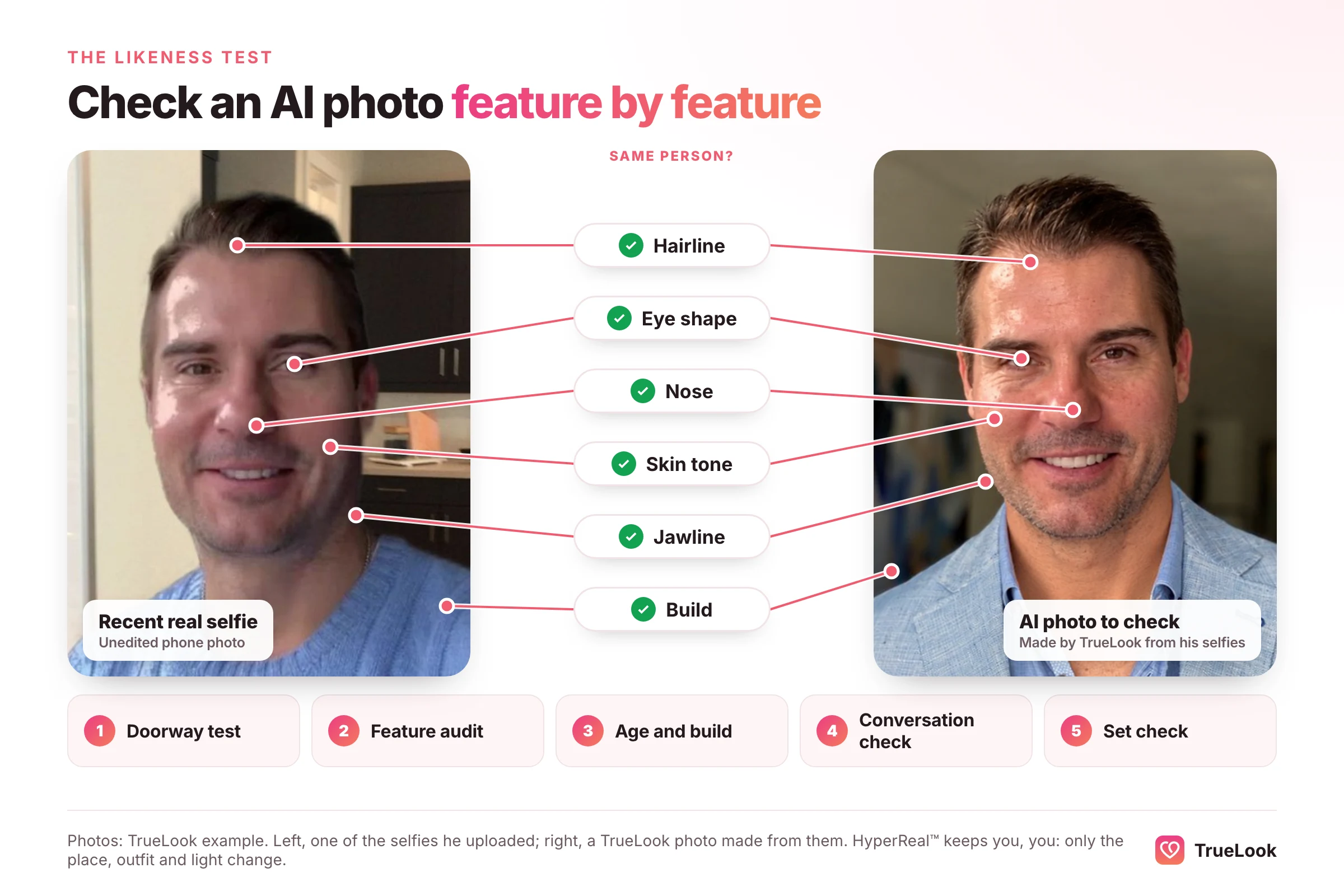
The rules all come down to one question, but it helps to break it into steps you can actually run. We call this the likeness test. Do it for every AI photo, and do it next to a recent unedited photo of yourself.
- The doorway test. Imagine walking into a bar to meet someone who has only seen this photo. Would they recognize you within a second, without hesitation? If not, drop the photo.
- The feature audit. Compare jawline, nose, eye shape, eyebrows, ears, hairline, skin tone and teeth with your real photo. Any feature that looks "improved" counts as changed.
- The age and build check. Does it make you look younger, slimmer, more muscular or taller? Dating apps ban misrepresenting your age, and a different body is a different person to a match.
- The conversation check. Could you answer three questions about the scene? "Where was this?" is easy if it's your local park, awkward if it's a yacht you've never been on.
- The set check. Lay your whole profile out together. Do all the photos look like the same person? Do you have one clear, solo, front-facing photo, as Hinge and Bumble require and Tinder's badge needs?

How to use AI photos without breaking the rules
If you've decided AI photos make sense for you, this order of steps keeps you on the right side of every policy above.
- Choose a tool that works from your own face. Generators that invent a face or work from a vague description produce someone who looks a bit like you, which is the worst case for a face match. Our roundup of the best AI dating photo generators covers what to compare.
- Give it good input. Use recent, sharp selfies in even light, with no sunglasses, filters or heavy beauty modes. Whatever is wrong in the input tends to show up in the output.
- Check the privacy terms. Find out whether the service trains models on your photos and how to delete them. TrueLook, for example, never uses customer photos for AI training.
- Run the likeness test on every result. Keep fewer, better photos rather than a full set with a few that don't quite look like you.
- Mix in at least one recent real photo. It anchors the set and gives verification an easy match.
- Verify on each app. Do the selfie in good, even light, looking the way you look in your photos: same glasses, similar hair.
- Re-check after every photo change. Tinder and Hinge both say changing photos can affect your verification status.
For a broader view of when AI photos beat a photoshoot and when they don't, see our comparison of a dating profile photographer vs AI. And if you're building a set from scratch, our guide to dating profile pictures for guys explains which six photos to aim for.
Should you tell matches your photos are AI?
None of the policies we reviewed requires you to label AI photos, including Hinge's India guidance. Whether to mention it is a personal choice, but a few principles help:
- If the photos are accurate, there's little to disclose. They show what you look like, much as a photographer's edited portrait does.
- If you'd feel uneasy being asked, that's a signal. The discomfort usually means a photo crossed from "a good photo of me" into "a better version of me".
- Be ready to answer honestly. If a match asks where a photo was taken and the answer is "it's AI", say so lightly. People are far more forgiving of a well-made photo than of a dodged question.
- Don't build stories on generated scenes. Claiming you were somewhere you weren't turns a photo choice into a lie about your life.
What happens if you cross the line
The consequences are spelled out more clearly than most people realize.
| App | What its own pages say can happen |
|---|---|
| Tinder | A face mismatch means no verification badge. Required Face Check blocks new accounts that don't pass. Verification results are kept for a year if an account is banned. |
| Hinge | Profiles with prohibited content are removed, and violations may lead to immediate suspension or termination. Failing a required Face Check blocks core features. |
| Bumble | Profiles can be reported for AI-generated photos. Reported fake, scam or spam profiles can be required to pass verification before using Bumble again. |
Then there's the outcome no policy page mentions: a first date with someone who expected a different face. Even if a misleading photo survives every check, it fails at the one moment it was meant to help.
The honest limits of this answer
Three caveats are worth keeping in mind. First, policies change, sometimes monthly. Every page cited here showed an update in 2026, several in the weeks before we checked. Second, rules vary by region. Face Check, age checks and synthetic-media rules depend on local law, so what's required in California or the UK may not apply where you are. Third, no photo service, including ours, decides whether you pass. Each app runs its own checks with its own thresholds and makes its own decisions. The best you can do is give those checks an honest match to find.
Frequently asked questions
Are AI photos allowed on dating apps?
Generally yes, if they genuinely show you. Tinder, Hinge and Bumble don't ban AI images outright. They ban impersonation, fake identities and misleading photos. Hinge goes furthest, naming AI content meant to deceive as banned, and its AI principles allow generative AI images that don't misrepresent you.
Are AI photos allowed on Tinder?
Tinder's community guidelines don't mention AI. They ban fake accounts and pretending to be someone you're not. Its March 2026 terms ban misrepresenting your identity or age and make you responsible for the accuracy of AI content you share. Accurate AI photos of your own face fit those rules.
Can Tinder, Hinge or Bumble detect AI photos?
Their published systems don't label photos as AI. They check identity: a live video selfie is compared with your profile photos, and Tinder also checks whether your face appears on other accounts. Photos that keep your real features give that comparison an honest match. Bumble members can also report suspected AI-generated photos.
Is face verification required on dating apps?
Increasingly, yes. Bumble's photo verification is mandatory in the USA. Tinder's Face Check was required for new users in California and seven countries as of October 2025, with more US states planned. Hinge and OkCupid are rolling out Face Check in phases where local regulations permit.
Is using AI photos on a dating app catfishing?
Not if the photos accurately show you. Bumble defines catfishing as creating an online persona that isn't you. Using a generated stranger, someone else's likeness, or altering your face, age or body so you wouldn't be recognized is misleading and against every major app's rules.
Will AI photos pass face verification?
Each app decides, so no photo tool can guarantee it. Verification compares your profile photos with a live selfie, so photos that preserve your real face shape, features and skin tone give the check an accurate match. Keep at least one clear, solo, front-facing photo, and re-verify after changing photos.
Are there dating apps without face verification?
Yes, verification is still optional on many apps and in many regions, though it's spreading fast. The rules against impersonation and misleading photos apply either way, profiles can still be reported, and a verified badge is a useful trust signal if your photos look like you.
Do I have to disclose that my dating photos are AI?
None of the Tinder, Hinge or Bumble policies we reviewed requires a label. If the photos accurately show you, there's little to disclose, but answer honestly if a match asks, and don't claim experiences or places from generated scenes as real.
Sources
- Community Guidelines, Tinder (checked 2 November 2026). https://policies.tinder.com/community-guidelines/intl/en
- Terms of Use, Tinder (revised 5 March 2026). https://policies.tinder.com/terms/us/en
- How Does Photo Verification Work?, Tinder Help Center (updated 2026). https://www.help.tinder.com/hc/en-us/articles/4422771431309-How-Does-Photo-Verification-Work
- Photo Enhance, Tinder Help Center (updated 2026). https://www.help.tinder.com/hc/en-us/articles/45822968057357-Photo-Enhance
- Tinder to Expand Facial Verification Feature Across the U.S., Setting a New Standard for Dating Safety, Match Group (2025). https://ir.mtch.com/investor-relations/news-events/news-events/news-details/2025/Tinder-to-Expand-Facial-Verification-Feature-Across-the-U-S--Setting-a-New-Standard-for-Dating-Safety/default.aspx
- Bumble debuts AI guidance to optimize user bios and photo selection, Dataconomy (2026). https://dataconomy.com/2026/02/27/bumble-debuts-ai-guidance-to-optimize-user-bios-and-photo-selection/
- Prohibited Content & Behavior, Hinge Help Center (updated 2026). https://help.hinge.co/hc/en-us/articles/42464295207187-Prohibited-Content-Behavior
- Community Guidelines, Hinge Help Center (updated 2026). https://help.hinge.co/hc/en-us/articles/43072641158547-Community-Guidelines
- AI Principles, Hinge (checked 2 November 2026). https://hinge.co/ai-principles
- Information for India Users about Synthetically Generated Information (SGI), Hinge Help Center (2026). https://help.hinge.co/hc/en-us/articles/55944090974227-Information-for-India-Users-about-Synthetically-Generated-Information-SGI
- What is Selfie Verification?, Hinge Help Center (updated 2026). https://help.hinge.co/hc/en-us/articles/10303221435539-What-is-Selfie-Verification
- Face Check Scan, Hinge Help Center (updated 2026). https://help.hinge.co/hc/en-us/articles/45715796564243-Face-Check-Scan
- Match Group extends FaceTec liveness to Hinge, adds age verification for UK, Oz users, Biometric Update (2026). https://www.biometricupdate.com/202602/match-group-extends-facetec-liveness-to-hinge-adds-age-verification-for-uk-oz-users
- Community Guidelines, Bumble (checked 2 November 2026). https://bumble.com/en/guidelines
- Verifying your photos, Bumble Support (updated 2026). https://support.bumble.com/hc/en-us/articles/28949738572829-Verifying-your-photos
- Bumble users can now report profiles that use AI-generated photos, TechCrunch (2024). https://techcrunch.com/2024/07/09/bumble-reporting-option-ai-generated-profiles/
- AI-synthesized faces are indistinguishable from real faces and more trustworthy, Nightingale and Farid, Proceedings of the National Academy of Sciences (2022). https://pubmed.ncbi.nlm.nih.gov/35165187/
- Face Check FAQ, OkCupid Help Center (updated 2026). https://okcupid-app.zendesk.com/hc/en-us/articles/51602258614171-Face-Check-FAQ
Get better dating photos from your own selfies
TrueLook’s HyperReal™ method turns 4 selfies into hyperrealistic photos of you for Tinder, Hinge and Bumble.
TrueLook compared with other AI photo tools
Written by the TrueLook Team
TrueLook makes hyperrealistic dating photos from your own selfies. Our articles cover dating profile photos, the apps and how to get noticed.