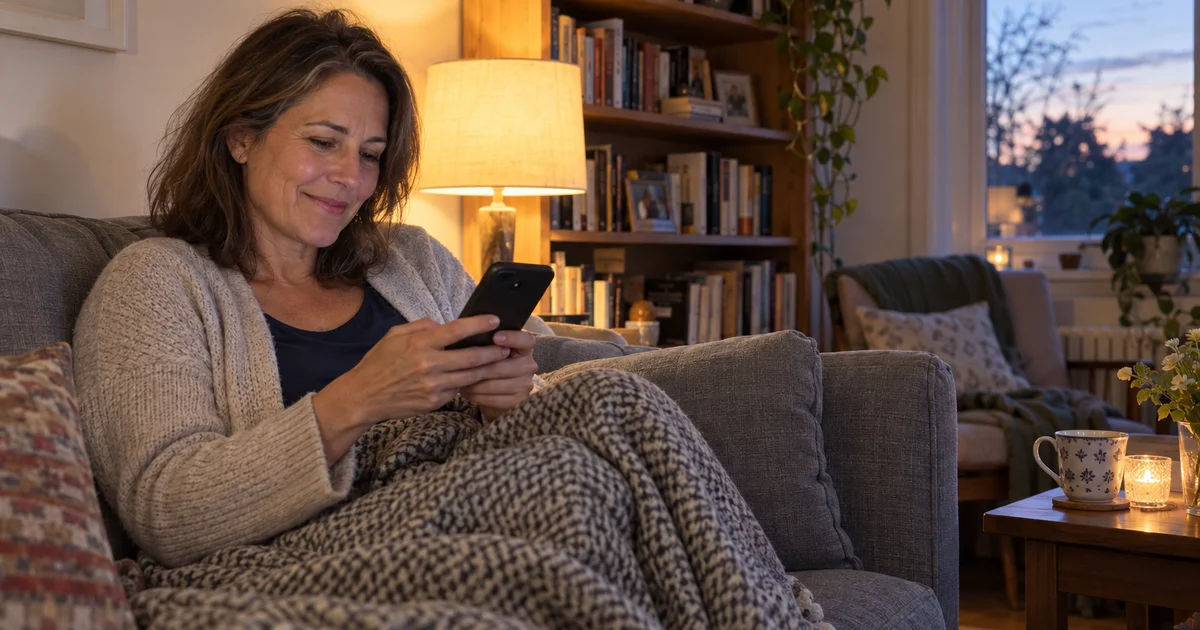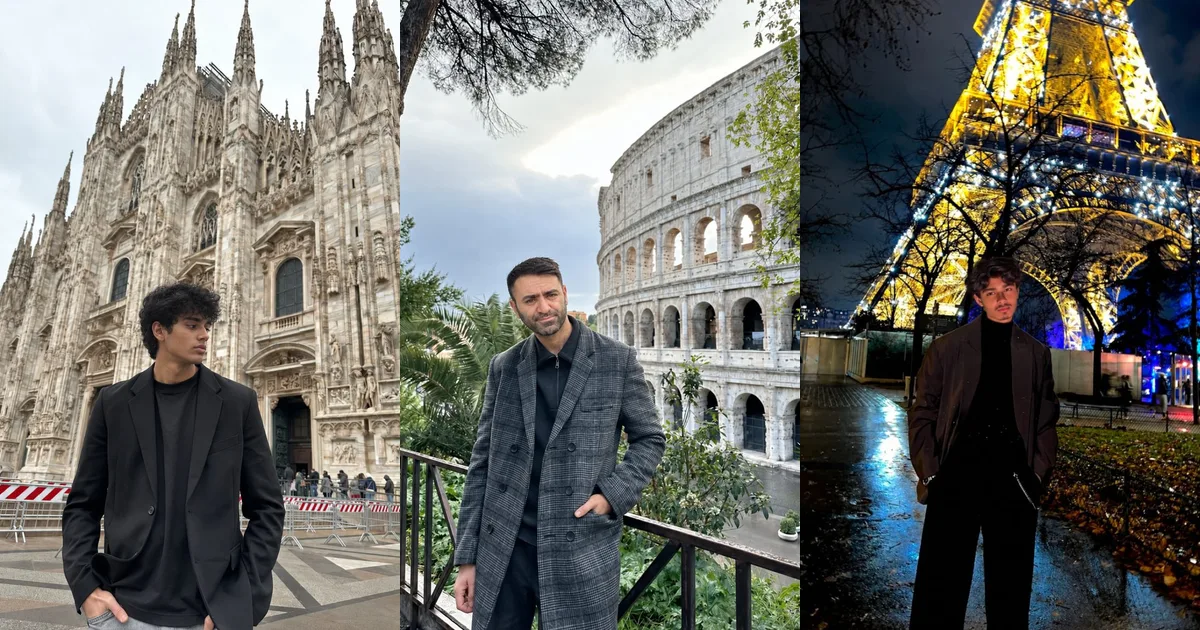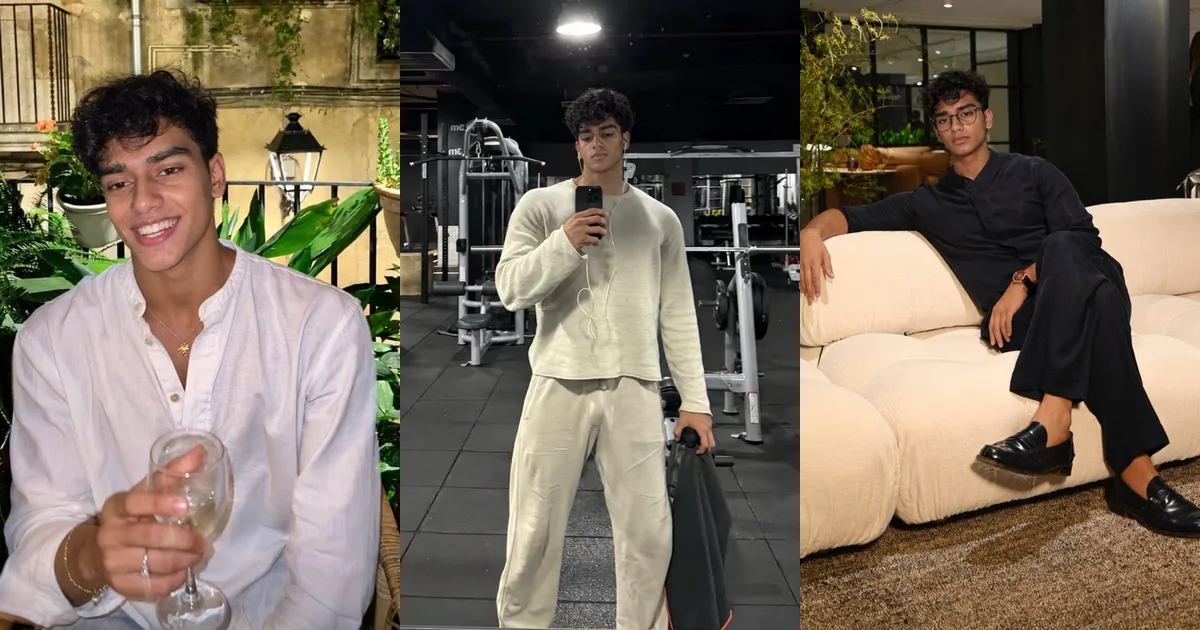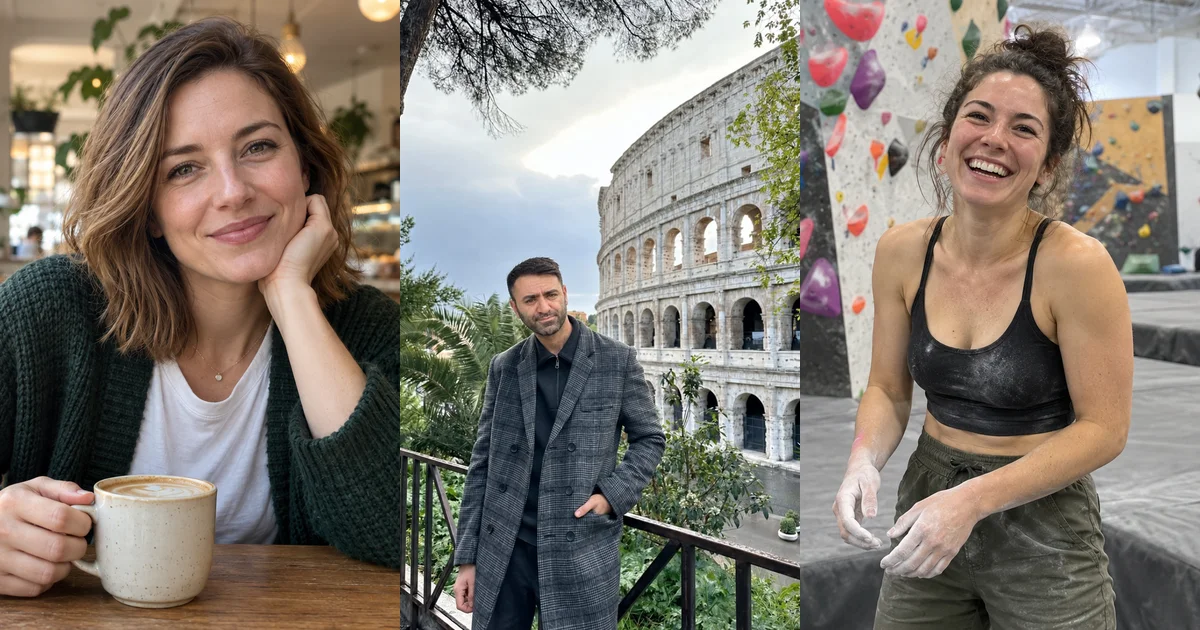
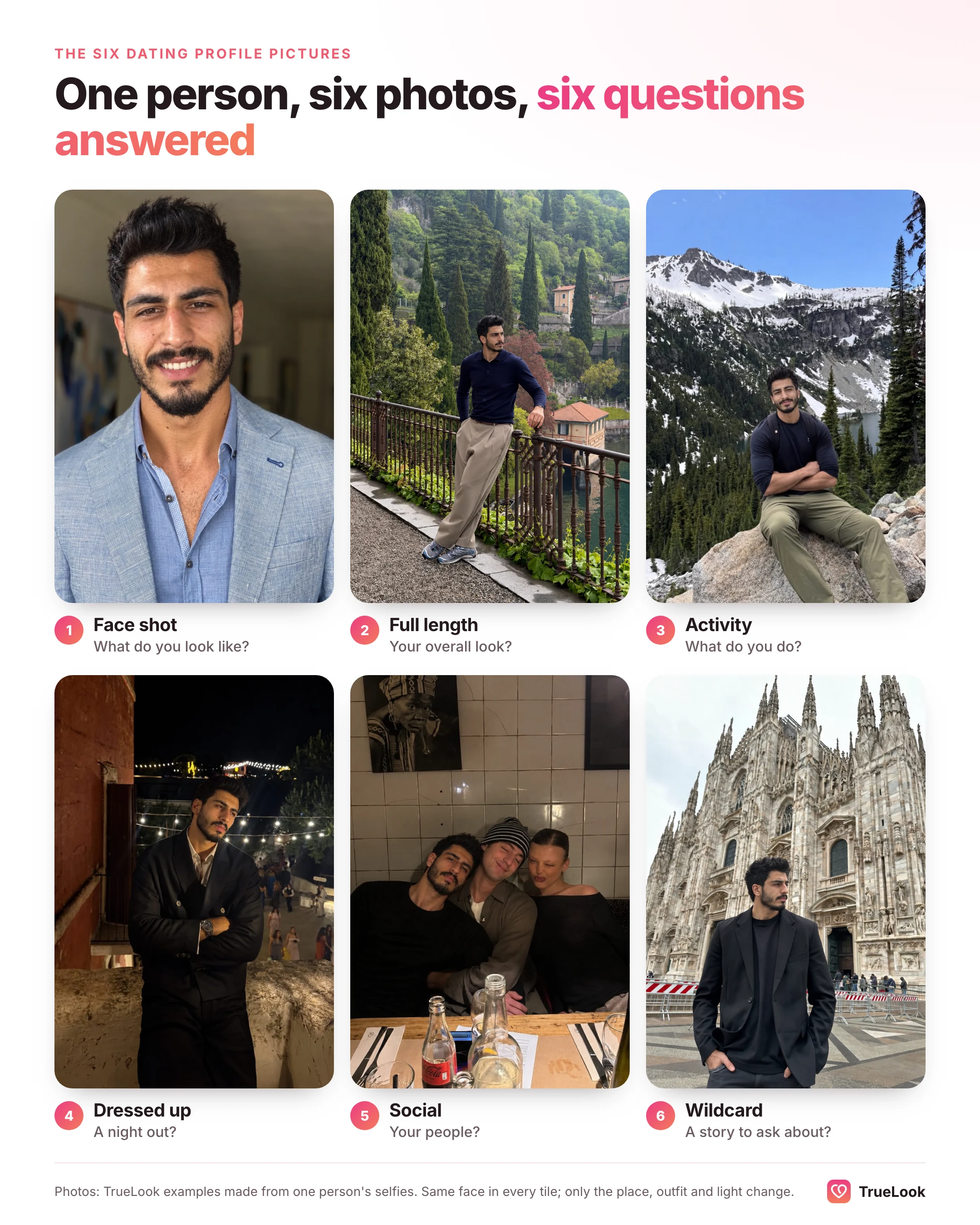
Good dating profile pictures are recent, sharp and lit by soft daylight, and as a set they show clearly what you look like and how you spend your time. Aim for six photos that each do a different job: a clear, smiling face shot first, then a full-length photo, an activity, a dressed-up look, one social photo where you are easy to spot, and one picture with a story behind it. Leave out sunglasses, heavy filters, group shots in the lead slot and anything that no longer looks like you.
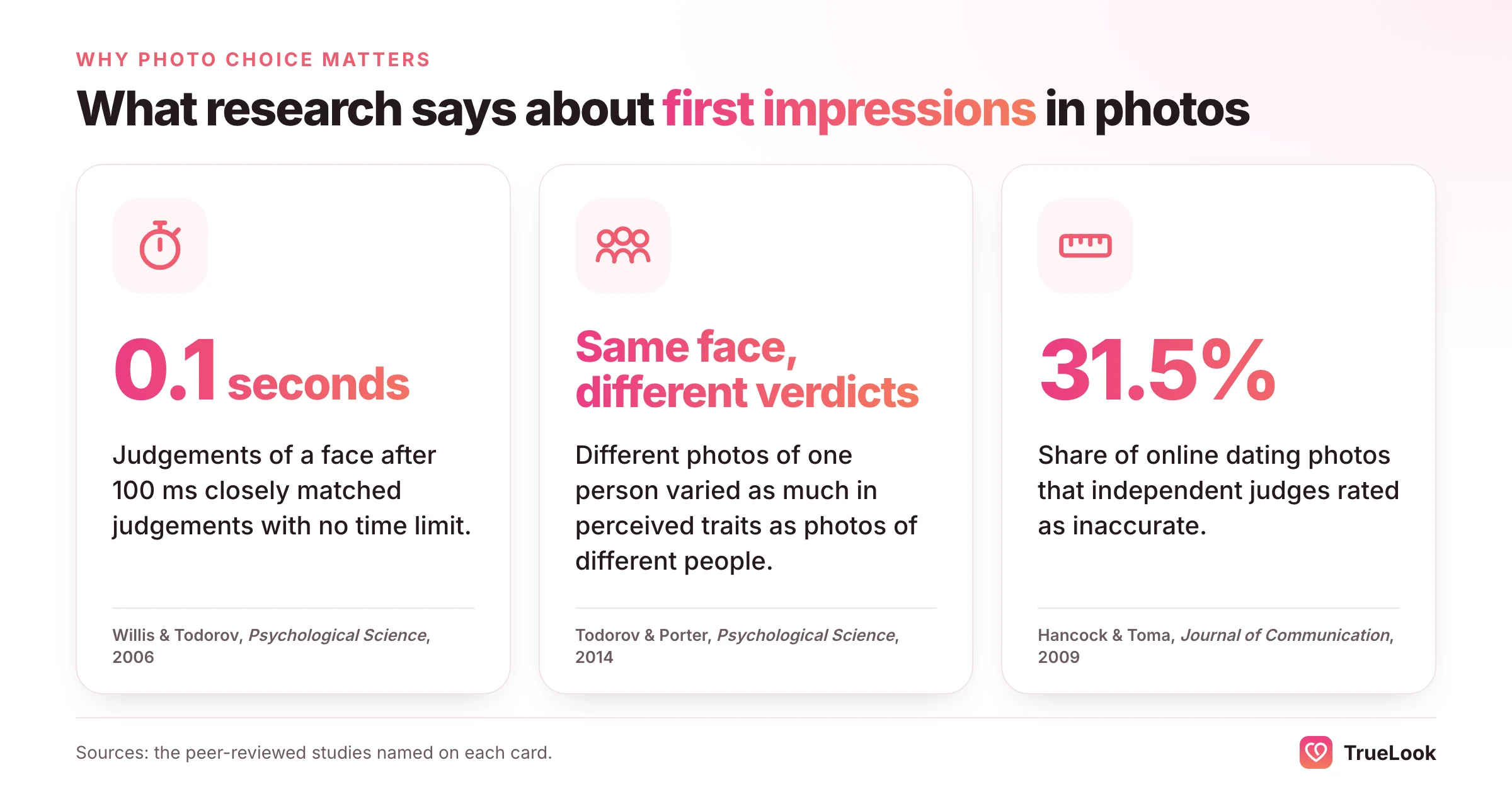
- Impressions form fast. In a Princeton study, people's judgements of a face after a tenth of a second closely matched their judgements with unlimited time, so your first photo does most of the work.
- The same face can read very differently. Research shows that different photos of one person can vary in perceived attractiveness as much as photos of different people. Choosing well matters more than looks.
- Six photos, six jobs. Face, full length, activity, dressed up, social and a wildcard. If two photos answer the same question, replace one.
- Distance and angle change your face. A modelling study found that a selfie taken about 30 cm from the face makes the nose look roughly 30% larger. Step back and zoom in instead.
- Stay recent and recognisable. Bumble suggests photos from the last six months if possible. In one study, independent judges rated nearly a third of dating photos as inaccurate.
- Edit the light, not the face. Brightness, crop and colour are fine. Smoothing, slimming and reshaping are the edits that make people feel misled.
- Let someone else pick. A 2017 study found that photos chosen by other people made better impressions than photos people chose for themselves.
Why your dating profile pictures matter so much
Profiles have bios, prompts and details about jobs and height, but photos are what people see first, and research on faces explains why they carry so much weight.
A tenth of a second is enough
In a set of experiments published in 2006, Janine Willis and Alexander Todorov showed people unfamiliar faces for different lengths of time and asked them to judge traits such as attractiveness, likeability, trustworthiness and competence. As their Psychological Science paper reports, judgements made after 100 milliseconds correlated highly with judgements made with no time limit. Extra time mostly made people more confident rather than changing their verdicts much. On a dating app, the decision to keep looking often happens just as fast.
You have many faces, not one
The encouraging part comes from a later study by Todorov and Jenny Porter. They found that different images of the same person could produce impressions as varied as images of different people, and that viewers preferred different photos of one person for different purposes, such as a dating profile versus a political campaign. The Association for Psychological Science's summary notes that the photos in the study differed only by small, natural changes in expression. In other words, the photo you choose can shift how people see you more than your features do.
Photos sit inside a crowded, cautious market
Pew Research Center's 2023 survey found that 30% of US adults have used a dating site or app, rising to 53% of those under 30. It also found a sharp split in experience: 64% of men who were current or recent users had felt insecure about receiving too few messages, while 54% of women had felt overwhelmed by how many they received. Whichever side you're on, a clear, honest set of photos helps the right people make a quick, confident decision.
What makes a good dating profile picture: the CLEAR check
Almost every piece of solid photo advice fits into five qualities. We call it the CLEAR check, and any photo that fails one of the five is the first candidate to replace.
| Letter | Quality | What it means in practice | Quick fail sign |
|---|---|---|---|
| C | Clear face | Eyes visible, face in focus, nothing covering it | Sunglasses, a cap brim, hair across the eyes, motion blur |
| L | Light | Soft daylight from the front or side | One overhead bulb, harsh noon sun, flash in a dark room |
| E | Expression | Relaxed and genuine, often a real smile or laugh | Forced grin, blank stare, heavy pout |
| A | Accurate | Recent, unfiltered, matches how you look now | Old haircut, different weight, beauty filter |
| R | Range | Each photo adds something the others don't | Three selfies in the same car seat |
Notice what is not on the list: being conventionally attractive. Most weak profiles fail on light, angle or variety, all of which are fixable in an afternoon.
The six dating profile pictures every profile needs
Think of your profile as a short visual introduction. Each photo should answer a question a stranger has about you, and no two should answer the same one.
| Slot | Photo type | The question it answers | Easiest way to get it |
|---|---|---|---|
| 1 | Solo face shot with a real smile | "What do you look like?" | A friend across a café table, or a self-timer by a window |
| 2 | Full length | "What's your overall look and build?" | A friend on a walk, or a tripod in a park |
| 3 | Activity or hobby | "What do you do with your time?" | Ask whoever you do the hobby with |
| 4 | Dressed up | "What are you like on a night out?" | Weddings, birthdays, dinners: crop a solo version |
| 5 | One social photo | "Do you have people in your life?" | Your camera roll; pick two or three people, not ten |
| 6 | Wildcard: pet, travel or candid | "What's a story I could ask about?" | Your own dog, a recent trip, a candid laugh |
Six fits the photo grid on most apps and is the number Bumble asks you to fill. One of Bumble's own articles says profiles with four or more photos receive the most matches, though it doesn't publish the underlying study. Fewer than four leaves people guessing. More than six only helps if every extra photo is strong.
Dating profile picture examples for each type
The examples below are AI-generated illustrations, made to show each photo type clearly. Photos of your friends and animals should always be genuine.
Face shot
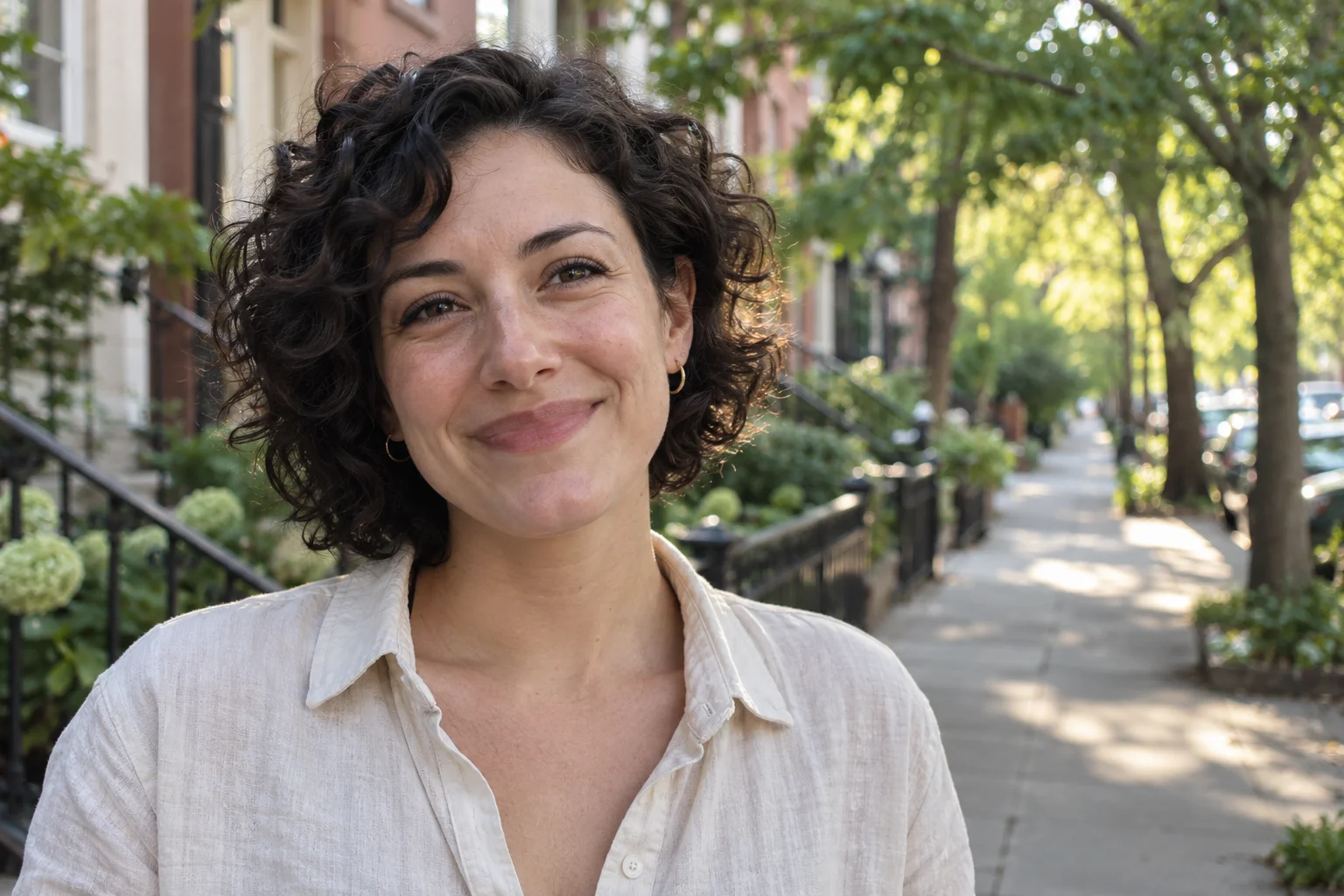
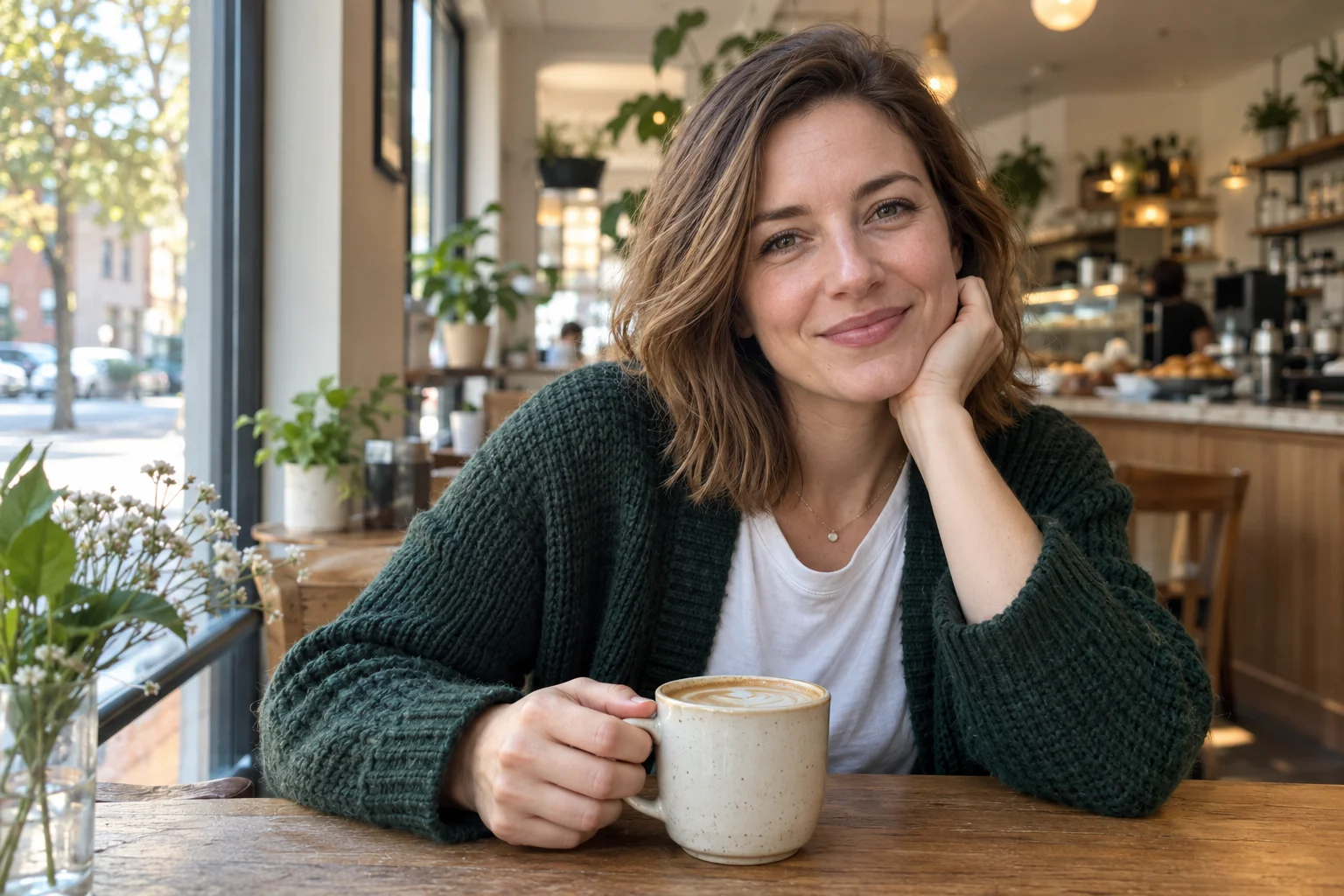
This is the photo people decide on, so it goes first. Head and shoulders, just you, looking at or near the camera. Taken by someone across a table, it avoids the distortion of an arm's-length selfie. A recognisable but calm background, such as a café or a leafy street, keeps the attention on your face.
Full length
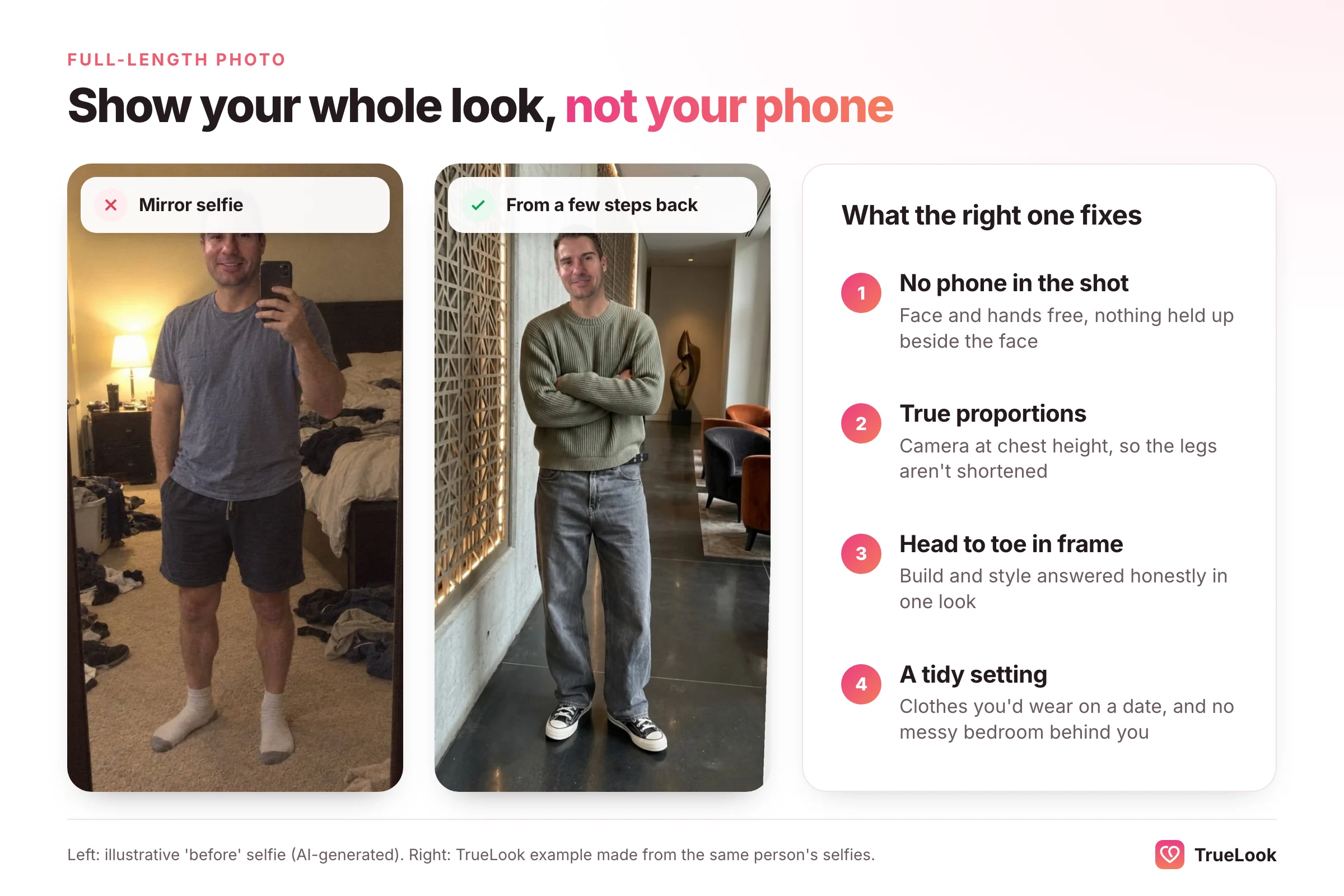
A full-length photo answers a question people will wonder about anyway, and answering it honestly builds trust. Walking towards or across the frame looks natural. Avoid mirror selfies, where the phone covers part of your face and the angle shortens your legs.
Activity or hobby
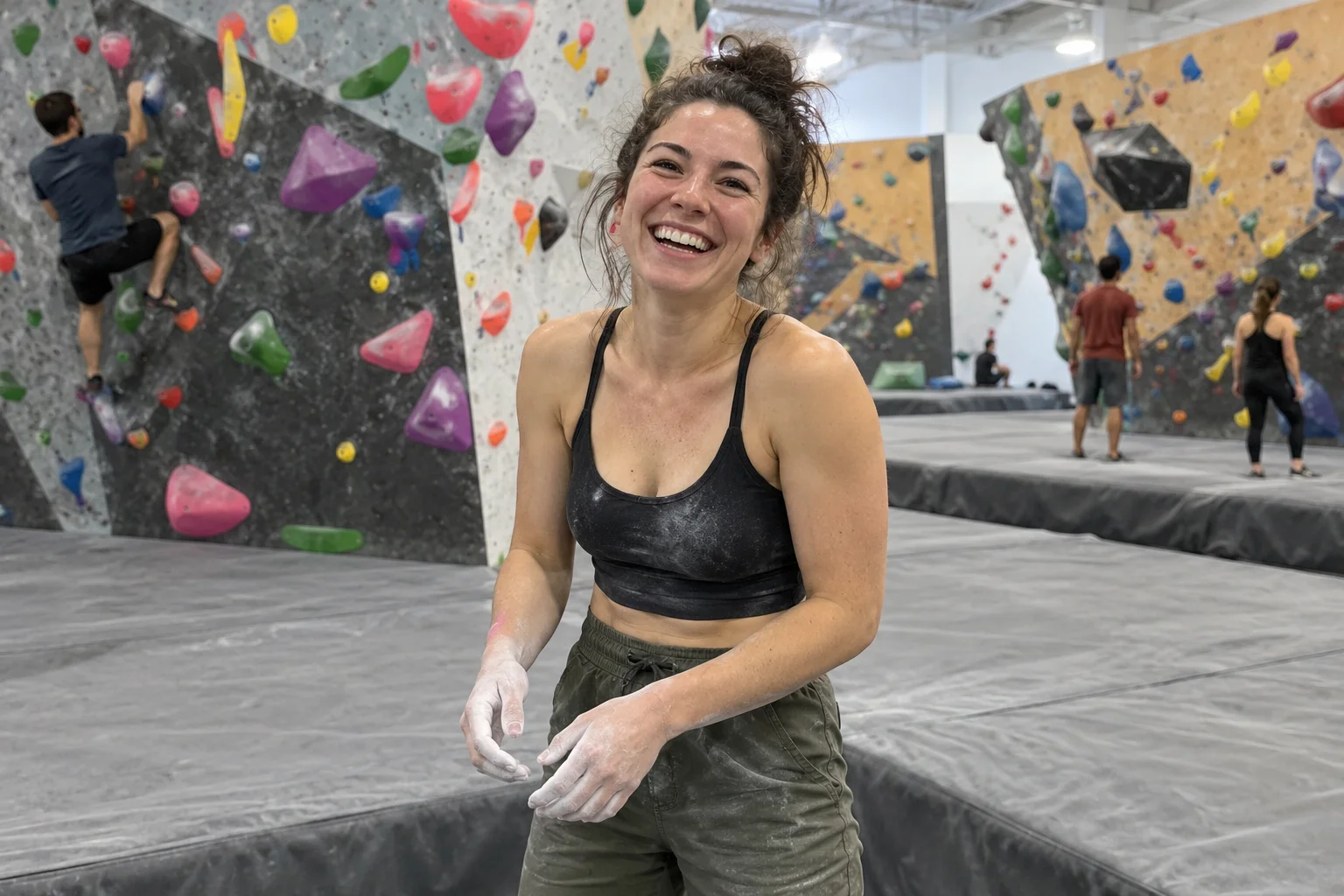
The best activity photos are specific. "At a climbing gym with chalk on your hands" gives someone an opener. "Standing in front of some mountains" doesn't. Get close enough that your face is clear; a tiny figure on a summit could be anyone.
Dressed up
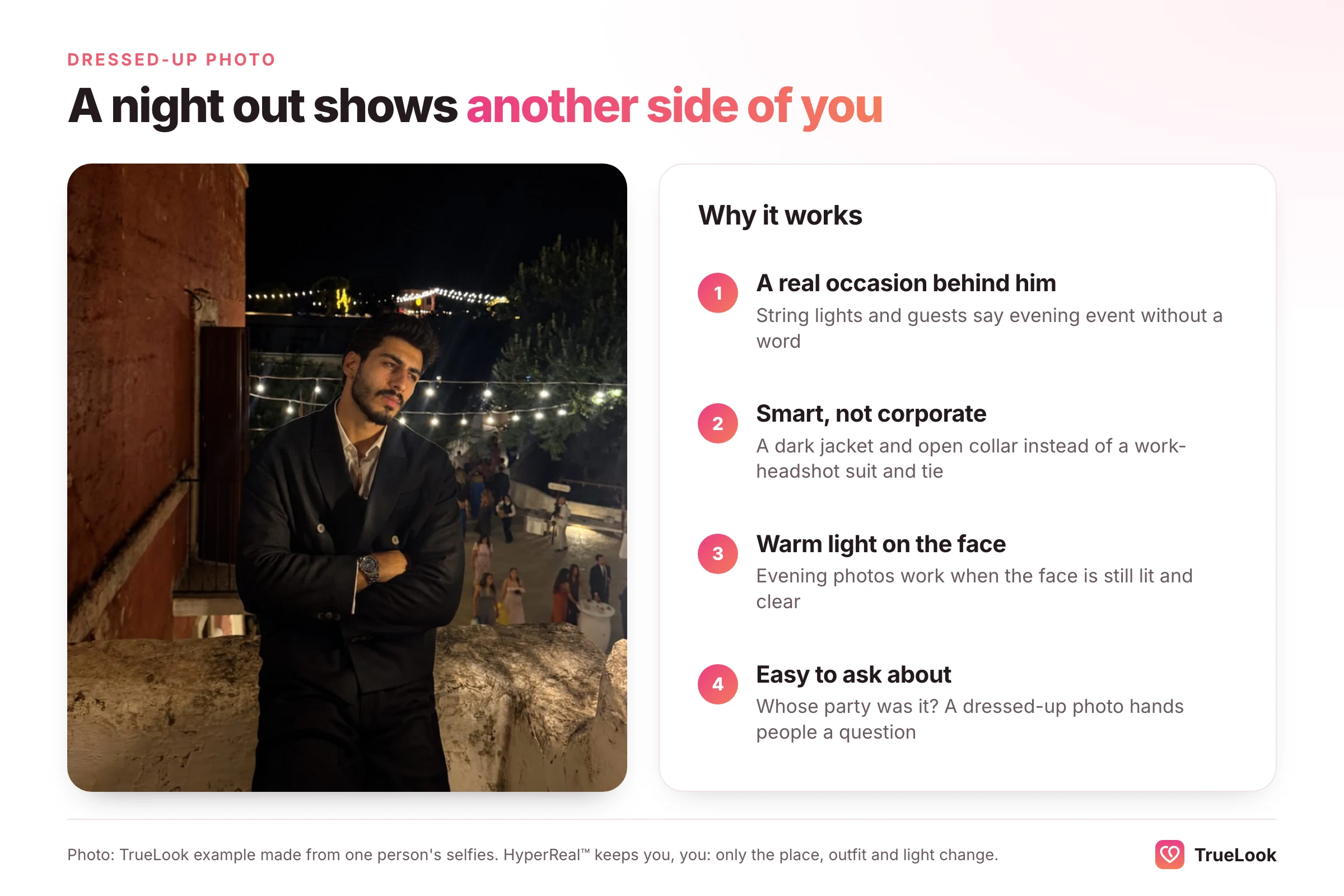
A wedding, a birthday dinner or a night out shows another side of you. If the only good photo from an event has someone else's arm around you, ask whoever took it for a solo frame, or crop carefully so nobody looks cut out.
One social photo
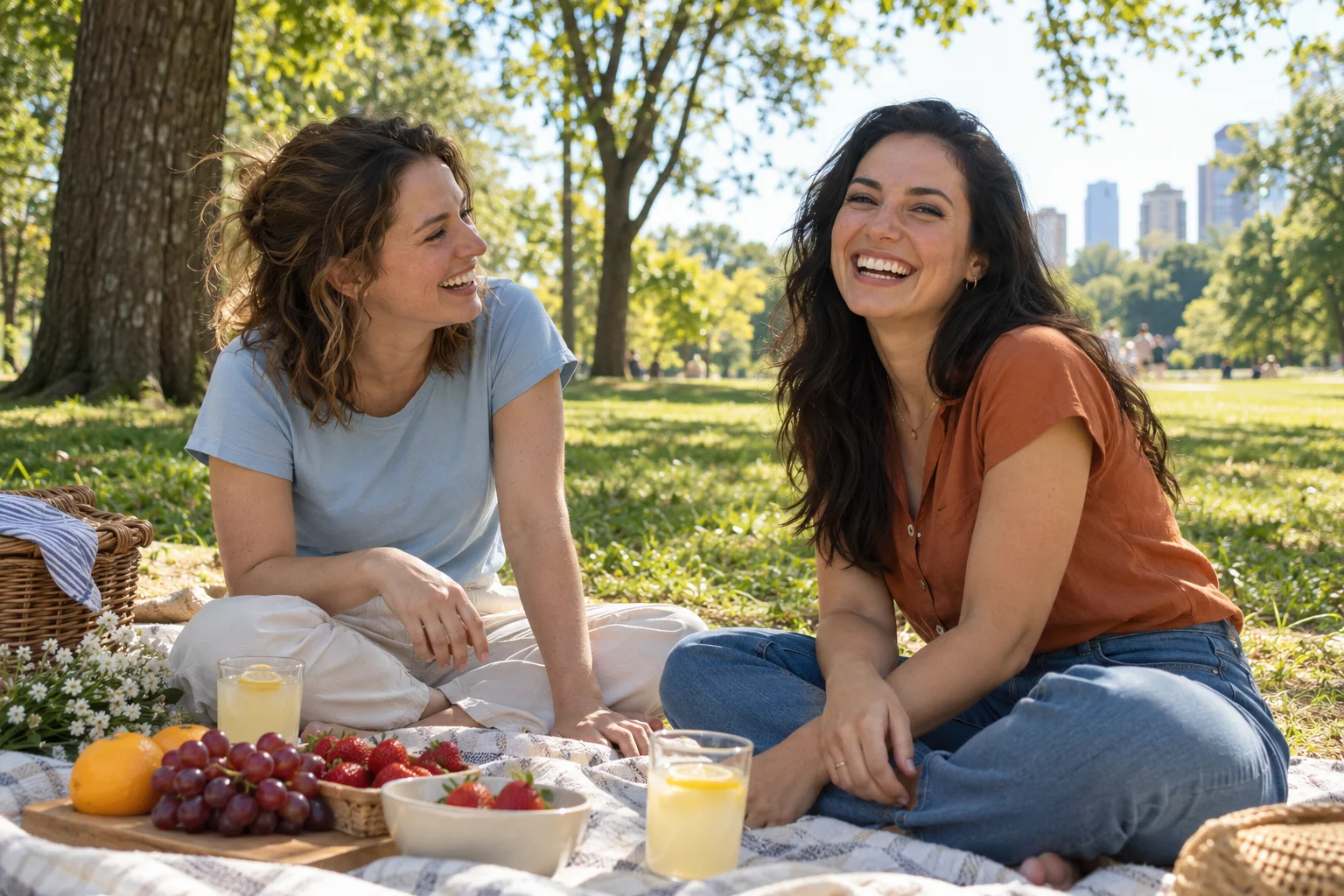
One photo with friends or family shows you have people around you. Keep it small, keep yourself easy to identify, and never lead with it. Tinder's Photo Selector, which launched in the US in July 2024, picks group photos less often for exactly this reason: TechCrunch reported that they can confuse people about whose profile they're looking at.
Candid

Research by Alixandra Barasch at NYU Stern found that people were more interested in dating someone shown in a candid photo than a posed one, because candid shots seemed more genuine. NYU's summary of the research also notes that the advantage shrank when viewers knew the person was aware of the camera, so "candid" has to look caught, not staged.
Pet
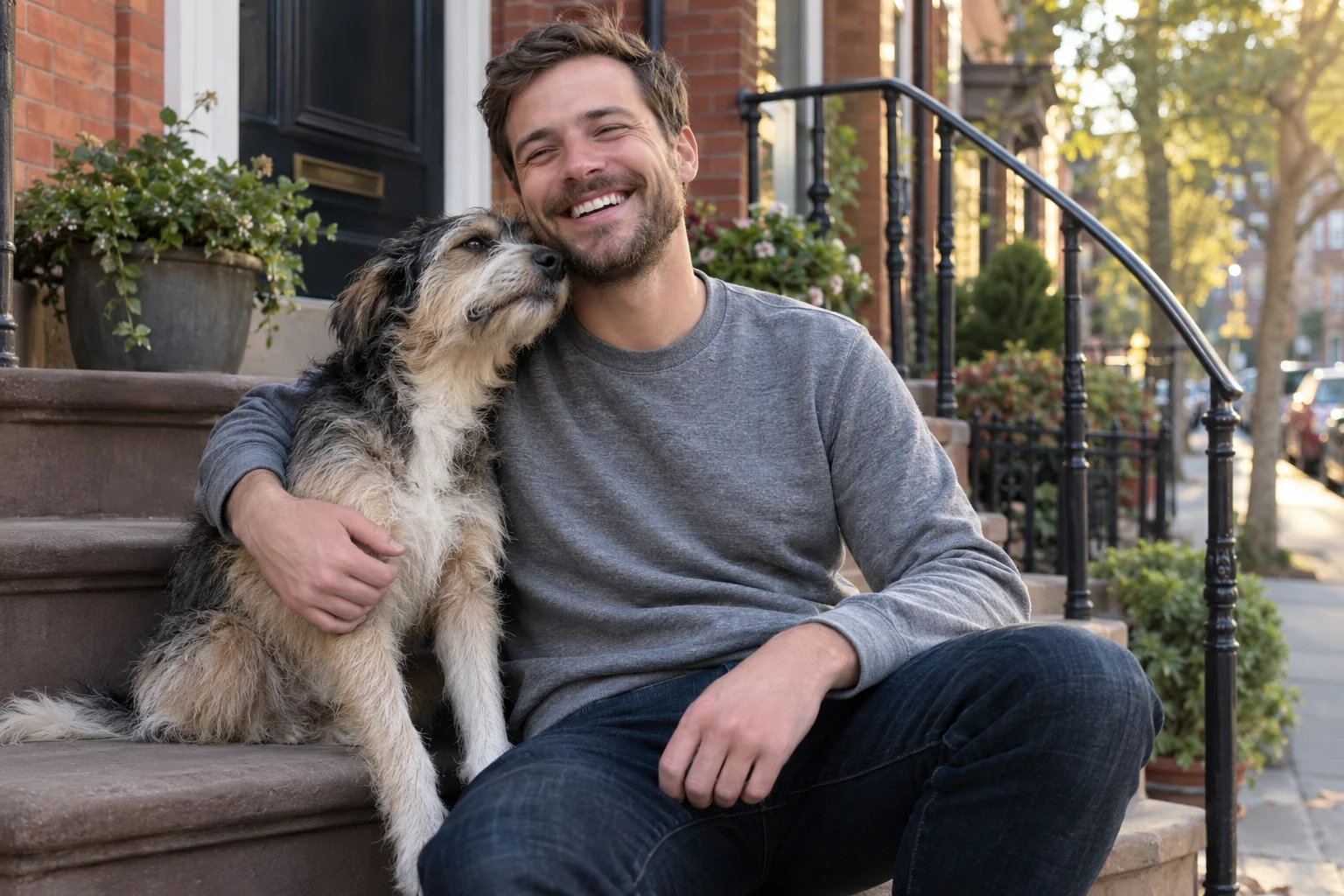
Only use your own animal, and make sure you're in the photo too. Bumble's tips say pets should appear with you, and that photos without people may be removed from its dating mode.
Travel
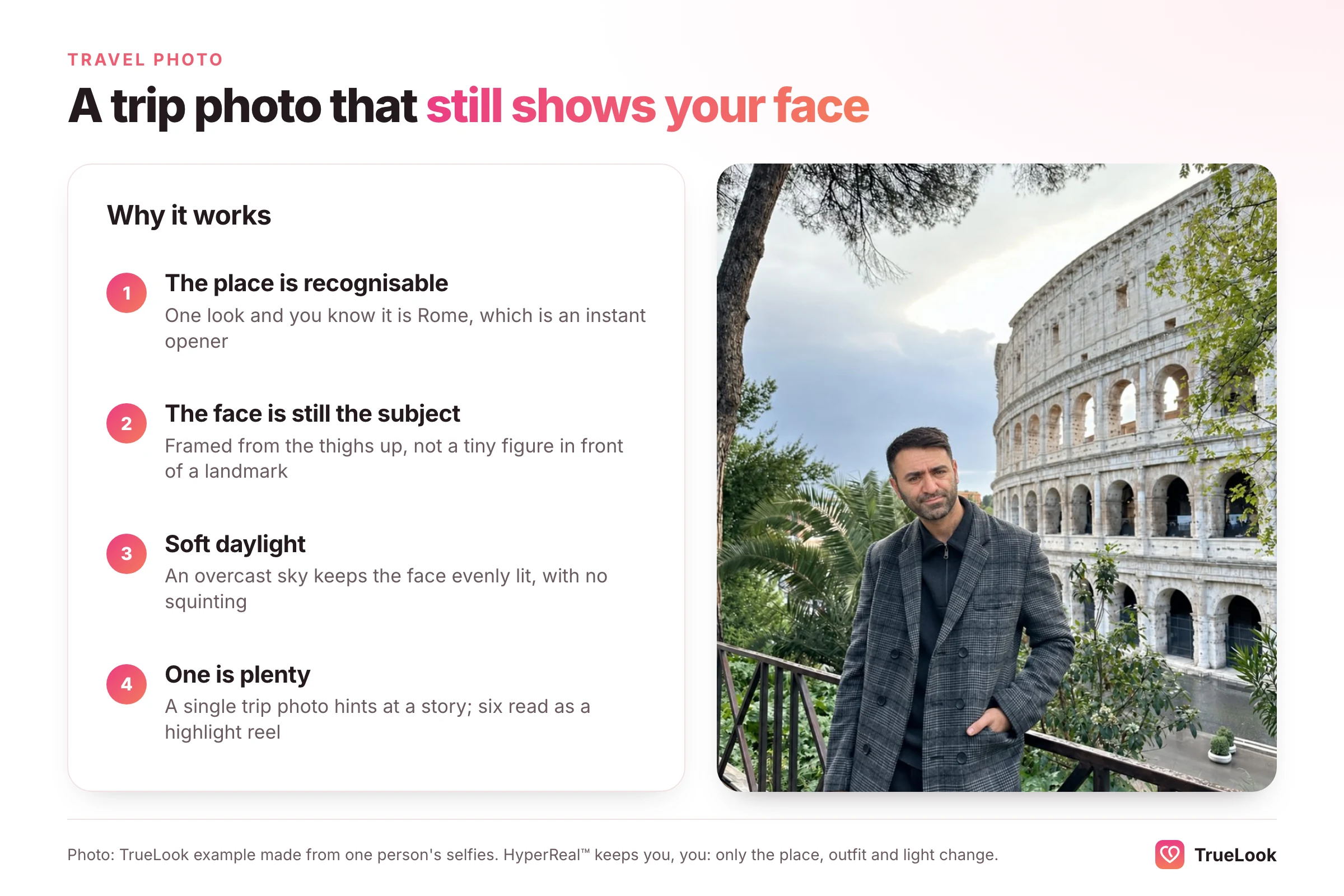
A travel photo works when it hints at a story without turning into a landscape shot. One is plenty. A profile made entirely of trips can read as a highlight reel rather than a life.
For app-by-app advice on order and slot limits, see our guides to Bumble profile pictures, Hinge profile pictures and the best photos for Tinder.
How to order your photos
Order matters because each photo is seen in the context of the one before it. A simple rule of thumb works on every app:
- Face shot first. Solo, smiling, eyes visible. Bumble's guidelines require at least one photo that shows only you with your full face, and its tips say to lead with a solo photo.
- Full length second. It completes the picture straight away.
- Activity third. It turns "attractive" into "interesting".
- Dressed up, social and wildcard after that, in whatever order tells the best story.
Some apps reorder for you. Bumble's Best Photo feature tracks which of your first three photos gets the most right swipes and moves it to the top. That only helps if those three are genuinely different, so don't put three near-identical face shots in the first slots.
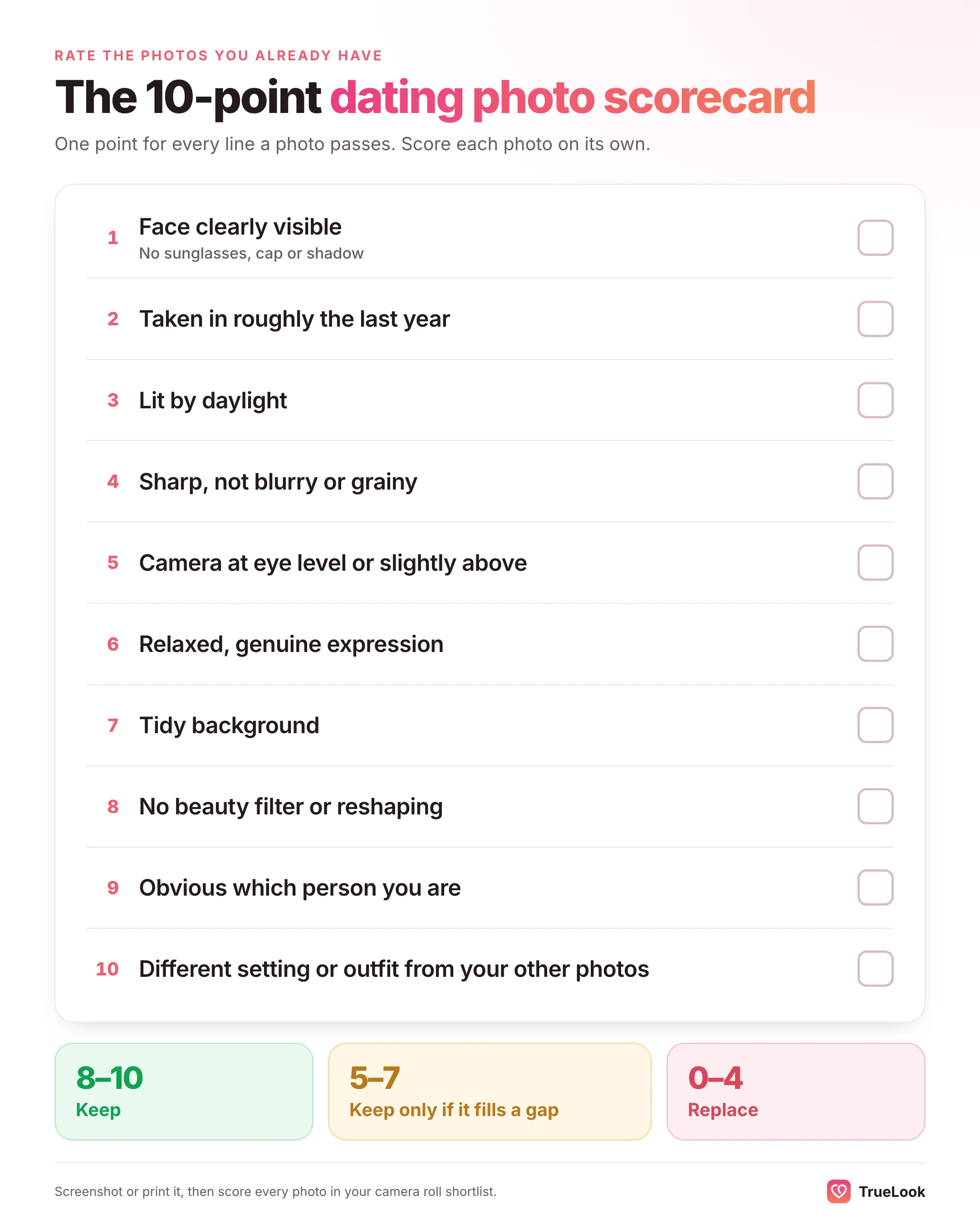
Rate the photos you already have: a 10-point checklist
Before taking anything new, audit your camera roll. Award a photo one point for each statement below that holds true.
- My face is clearly visible: no sunglasses, cap brim or shadow over my eyes.
- It was taken in roughly the last year, and I look the same now.
- It's lit by daylight, from a window or outdoors.
- It's sharp, not blurry, grainy or heavily zoomed.
- The camera was at eye level or slightly above, not below my chin.
- My expression is relaxed and real.
- The background is tidy: no unmade bed, laundry or bathroom mirror.
- There's no beauty filter, face smoothing or reshaping.
- It's obvious which person I am.
- It shows a different setting or outfit from my other photos.
| Score | Verdict | What to do |
|---|---|---|
| 8 to 10 | Keep | Consider it for slots 1 to 3 |
| 5 to 7 | Conditional | Keep it only when it covers a gap in your six |
| 0 to 4 | Replace | Retake, or drop it entirely |
Worked example
Illustrative profile: a 38-year-old teacher with five photos. Her car selfie scores 5 (fails light, angle, background, range and it's from three years ago). Her friend's wedding photo scores 7 but has three people in it. Her hiking photo scores 9. Her dog photo scores 8. Her bathroom mirror shot scores 4.
Verdict: keep the hike and the dog, crop the wedding to a solo frame, replace the car selfie with a window-lit face shot from a friend, and replace the mirror shot with a full-length photo on a walk. Two new photos and one crop turn a weak profile into a complete one, with no full reshoot.
What the research says about expressions, poses and settings
A lot of dating photo advice is repeated without evidence. Here is what published research and the better-documented industry studies actually show, along with their limits.
Smiling
Photofeeler, a photo-rating service, analysed more than 60,000 ratings of 800 profile photos. Its write-up reports that a smile showing teeth raised perceived likability more than any other factor it tested, while a closed-mouth smile had about half the effect. A laughing smile raised likability a little further. These were general profile photos rated for likability, competence and influence, not dating outcomes, and the study comes from a company that sells photo feedback.
The picture is more nuanced for attraction. A 2011 study in Emotion by Jessica Tracy and Alec Beall found that women rated smiling men as less sexually attractive than men showing pride, while men found smiling women the most attractive. ScienceDaily's summary stresses the caveat: the study measured first-impression sexual attraction, not who people would want as a partner. Photofeeler also tried to replicate an old OkCupid claim that men do better without smiling, and reported that smiling made no significant difference for men, except that no smile combined with no eye contact hurt.
What to do: lead with a genuine smile, and include one relaxed, confident photo without a big grin. Variety covers both kinds of first impression.
Eyes and the "squinch"
Photofeeler's same analysis found that sunglasses lowered likability, and that a slight narrowing of the lower eyelids, sometimes called a squinch, nudged up ratings of competence and likability. Wide, startled eyes are rarely flattering; a slight squint with a smile usually looks more natural.
Posture
A 2016 PNAS study by Tanya Vacharkulksemsuk and colleagues found that open, expansive postures (arms away from the body, torso stretched rather than hunched) drew more positive responses in speed dating and in a small dating-app experiment. ScienceAlert's report notes the app test used only six volunteers and that experts offered different explanations, such as a general preference for openness. The practical version: stand or sit as if you're comfortable, not folded in on yourself.
Group photos
The "cheerleader effect" is real but small. In a 2013 study, Drew Walker and Edward Vul found that people were rated slightly more attractive in a group photo than alone, by about two percentile points, for both men and women. That tiny boost is outweighed by the cost of a viewer not knowing which person you are, which is why group shots belong later in the profile.
Selfies and camera distance
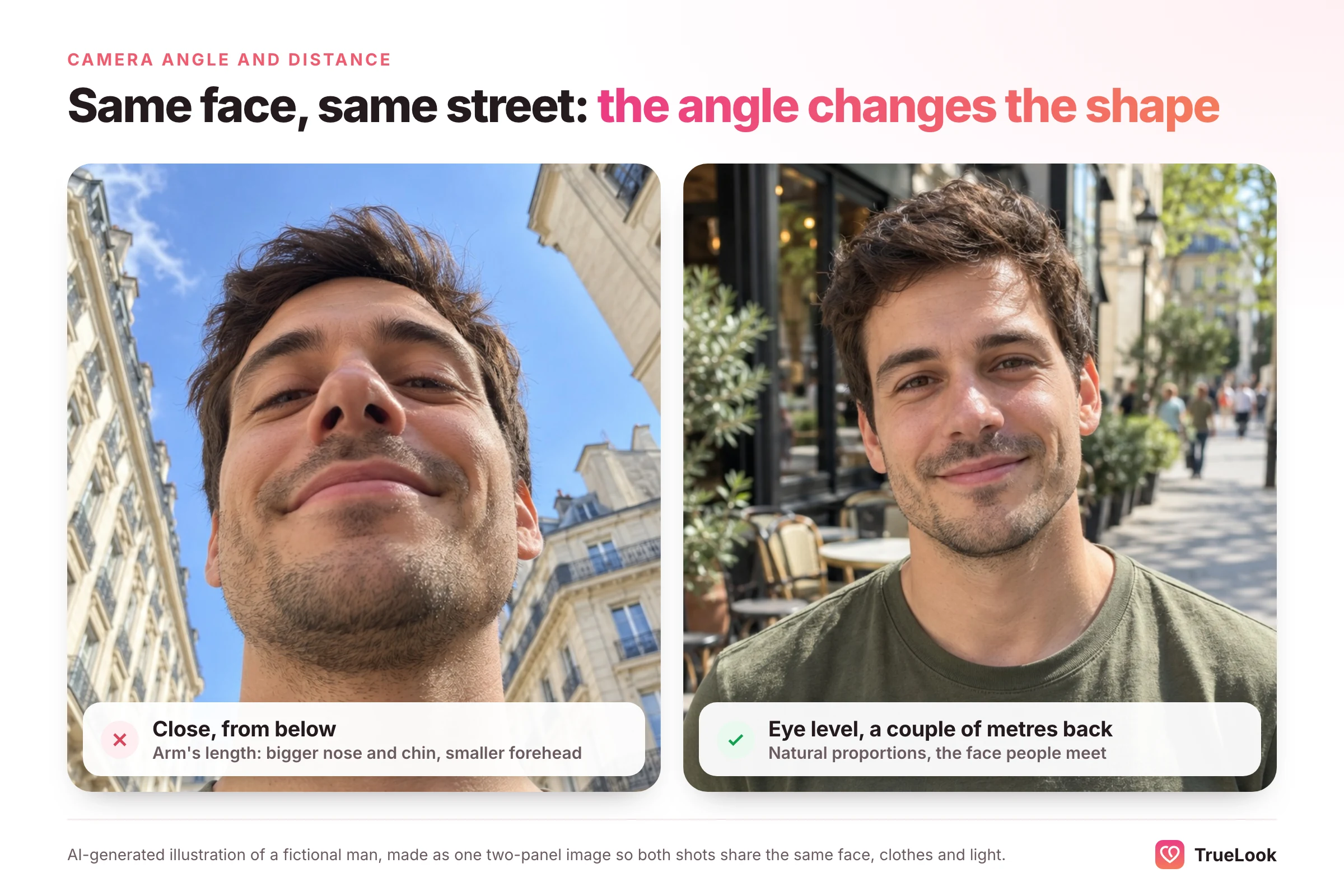
Phone cameras held at arm's length distort faces. A 2018 paper in JAMA Facial Plastic Surgery by Brittany Ward and colleagues modelled how camera distance changes facial proportions and showed that close-range photos make the nose look larger. As ZME Science reported, at about 30 cm (12 inches) the nose appears roughly 30% larger relative to the rest of the face. Shooting from further back with a little zoom gives truer proportions.
Background
Photofeeler's analysis found no significant effect of the background itself. What a background does do is give context: a market, a kitchen or a trail tells a story; a messy bedroom tells a different one. Choose settings for what they say, and keep them uncluttered.
Myths vs facts
| Myth | What the evidence suggests |
|---|---|
| You need to be very attractive for photos to work. | Different photos of the same person vary as much as photos of different people. Choice and quality matter a great deal. |
| Men should never smile. | Evidence is mixed. Smiling raises likability; one study found it lowered sexual attraction ratings of men. Use both kinds of photo. |
| Group photos make you look more popular, so lead with one. | The attractiveness boost is tiny, and confusion about who you are costs more. Use one, later. |
| Selfies show your face most accurately. | Close-range selfies distort proportions, especially the nose. |
| Professional-looking photos always win. | Candid photos were seen as more genuine in dating contexts; polished, posed shots did better for hiring. |
| You know which of your photos is best. | People choose less flattering photos of themselves than strangers choose for them. |
Common mistakes, and the fix for each
| Mistake | Why it hurts | Fix |
|---|---|---|
| Leading with a group photo | Viewers don't know who you are | Solo face shot first; one group photo later |
| Sunglasses or caps in most photos | Hides your eyes, lowers likability | Eyes visible in at least your first three |
| All selfies | Distorted proportions, little context | One selfie at most; ask a friend or use a timer |
| Bathroom mirror shots | Phone hides your face; cluttered setting | Full-length photo outdoors |
| Old photos | Mismatch on the first date erodes trust | Photos from roughly the last year |
| Heavy filters | Changes your face; reads as misleading | Edit light and colour only |
| Six photos from one afternoon | Same outfit and light; no range | Different outfits and settings per photo |
| Landscape with a tiny you | Could be anyone | Get closer; face clearly visible |
| Dark, overhead-lit indoor shots | Shadows under the eyes | Face a window or go outside |
| A borrowed dog or a car that isn't yours | Invites questions you can't answer honestly | Only show things from your real life |
How preferences differ across audiences
Most photo advice applies to everyone, but research does show some differences worth knowing. Most of these studies used heterosexual samples, often students, so treat them as tendencies rather than rules, and know that research on LGBTQ+ daters' photo preferences is thinner.
- Filters were judged differently by gender. A 2025 experiment in Frontiers in Communication by Minhao Dai and Shilin Xia found that a beautified selfie improved ratings of women's profiles but made no difference to ratings of men's. Richer visuals overall predicted better outcomes.
- Expectations about accuracy are higher for some details. In Hancock and Toma's study of dating photos, the discrepancies that most lowered perceived accuracy were weight, hair and age, with retouching also counting against women's photos.
- Smiling may carry different signals. As covered above, one study found smiling raised men's attraction to women but lowered women's sexual-attraction ratings of men in a first impression.
- The pressure is different, too. Pew's data on men feeling insecure about too few messages and women feeling overwhelmed suggests that men's photos often need to earn attention, while women's photos often need to help filter it.
For a deeper breakdown for men, with outfits and poses, see dating profile photos for men. If you're dating later in life, our guide to the best dating apps for over 40 covers which apps suit which goals.
Where to get dating profile pictures: five options compared
Most people's problem isn't knowing what photos they need. It's not having them. Here's how the realistic routes compare.
| Option | Cost | Time | Typical result | Best for |
|---|---|---|---|---|
| Your camera roll | Free | About half an hour | One or two usable photos, often the social or travel shot | Finding real moments you already have |
| Self-timer and tripod | A small tripod | An hour or two | Good if you plan the light | Shooting alone |
| A friend with a phone | Free, plus a coffee | An afternoon | Natural candids; depends on the friend | Activity and candid shots |
| Dating photographer | A paid session; varies widely by city | Booking plus editing, often weeks | Consistently polished, with posing help | People who want real photos and guidance |
| AI photos from your selfies | Varies by tool | Minutes to hours | Fills gaps in light, framing and setting | Missing photo types, no time to shoot |
A mixed approach is often fastest: take the social photo and pet photo from your camera roll, spend an hour with a friend on the activity and full-length shots, and fill any remaining gaps another way. If you're choosing between a shoot and software, our comparison of a dating profile photographer vs AI covers cost, time and quality.
How to take good dating profile pictures on your own
A recent phone and a free hour are enough. Work through these steps in order.
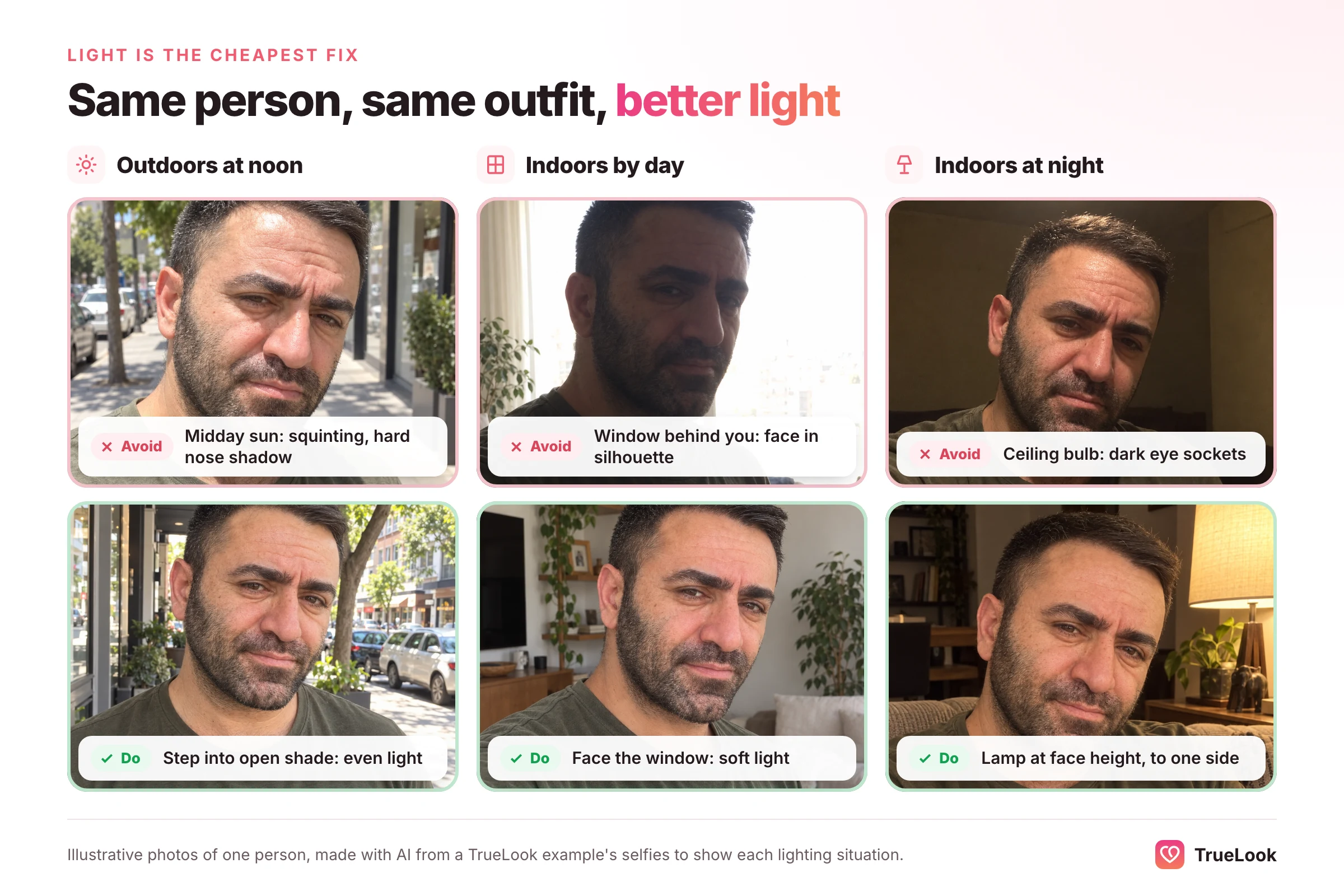
- Choose the light first. Outdoors, shoot in open shade, under bright cloud, or in the last hour of sun. Inside, face a big window. Avoid noon sun and overhead bulbs.
- Use the rear camera. It's usually sharper than the front one. Wipe the lens.
- Step back and zoom in a little. If your phone has a 2x lens, use it from a few steps further away. This avoids the close-range distortion described above.
- Put the lens at eye level or slightly above. Low angles exaggerate the chin and nose.
- Turn on the grid and use the rule of thirds. Line yourself up with one of the upright grid lines, roughly two-thirds across the frame, rather than dead centre.
- Use burst mode or a self-timer with interval shots. Take 20 to 30 frames per setup. Move between them: walk, turn, laugh at something.
- Stay open. Shoulders relaxed, arms away from your body, weight on one leg.
- Switch outfits and places between photo types, so the set doesn't look like one afternoon.
- Review on a big screen. Check focus on your eyes and look for anything distracting in the background.
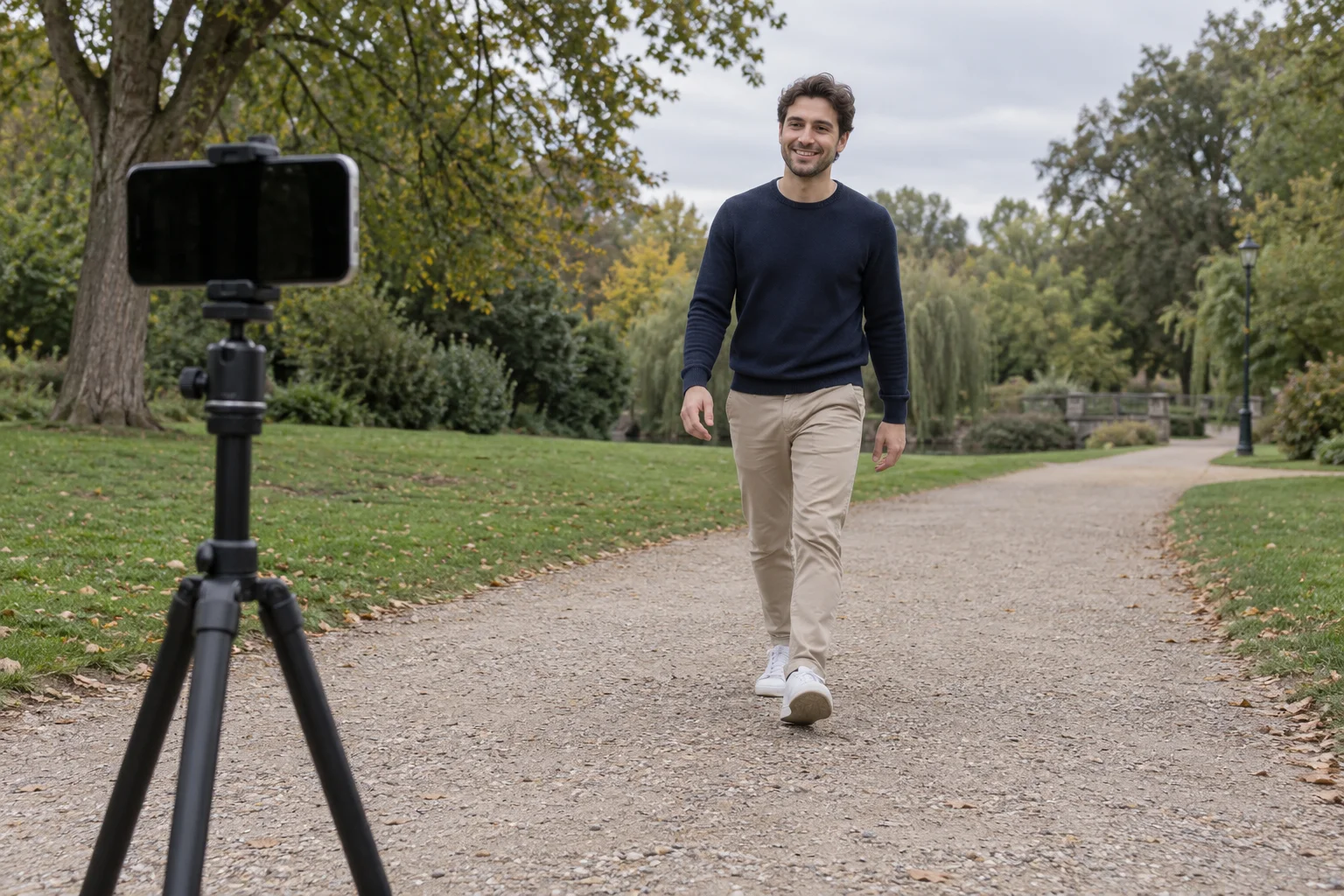
Bumble's own photo tips make the same case for self-timers: prop your phone upright, take lots of shots, and skip mirror selfies.
Light by situation
| If you're… | Do this | Avoid this |
|---|---|---|
| Outdoors at midday | Move into open shade under a tree or building edge | Direct sun on your face: squinting and hard shadows |
| Outdoors late afternoon | Face the low sun at an angle for warm, soft light | Sun directly behind you without fill: dark face |
| Indoors by day | Face a large window, a step or two back from it | Window behind you: silhouette |
| Indoors at night | Use a lamp at face height, off to one side | A single ceiling light: shadows under your eyes |
| At a restaurant or bar | Sit near candles or warm wall lights | Phone flash in a dark room |
What to wear in dating profile pictures
- Fit first. Well-fitting everyday clothes beat expensive ones that don't fit.
- Solid colours and simple textures. They photograph better than busy prints or large logos near your face.
- A different outfit per photo. It signals that the photos come from different days in your life.
- One step up for the dressed-up shot. Whatever "dressed up" means for you: a suit, a dress, a good jacket.
- Dress for the setting. Activity clothes for the activity, casual for the café.
- Wear what you'd actually wear on a date. The photos should match the person who turns up.
How recent should your dating profile pictures be?
As a rule, keep every photo within roughly the last year and your lead photo within the last six months. Bumble's tips suggest the same: ideally from the last six months, and at least from the last year. It also advises looking basically the same in every photo, because a very different look across photos makes people suspicious.
Old photos are one of the most common ways dating photos drift from reality. In Hancock and Toma's 2009 study, women's profile photos had been taken an average of 17 months before the study and men's 6 months before. Independent judges rated 31.5% of all the photos as inaccurate, with weight, hair and age the biggest problems.
Replace a photo sooner if any of these have changed since it was taken:
- hair length, colour or style, or facial hair;
- a visible change in weight, up or down;
- everyday glasses you didn't wear back then;
- the way you generally dress.
Recency also matters for verification. Tinder's Face Check, for example, asks new users in some markets for a short video selfie and checks that their face matches their profile photos, according to Tinder's October 2025 announcement. Photos that look like you today make any check simpler. If one has already failed, see our guide to what to do when Tinder photo verification fails.
Filters and edits: where to draw the line
The line is simple: edit the light, not the face. Apps draw the same line in their rules. Bumble's Community Guidelines don't allow photos with exaggerated or unnatural digital effects to the point where it can't be clearly determined that you're the person in them.
| Edit | Verdict | Why |
|---|---|---|
| Brightness, contrast, white balance | Fine | Corrects the camera, not you |
| Cropping and straightening | Fine | Improves framing |
| Removing a temporary spot or stray hair | Fine | Something you wouldn't have on a good day anyway |
| Background blur or tidying clutter | Usually fine | Changes the setting, not your appearance |
| Skin smoothing and beauty filters | Avoid | Retouching lowered perceived accuracy in Hancock and Toma's study |
| Slimming, reshaping jaw or eyes | Avoid | Changes the person who turns up to the date |
| Novelty face filters (ears, sparkles) | Avoid | Hides your face and looks unserious |
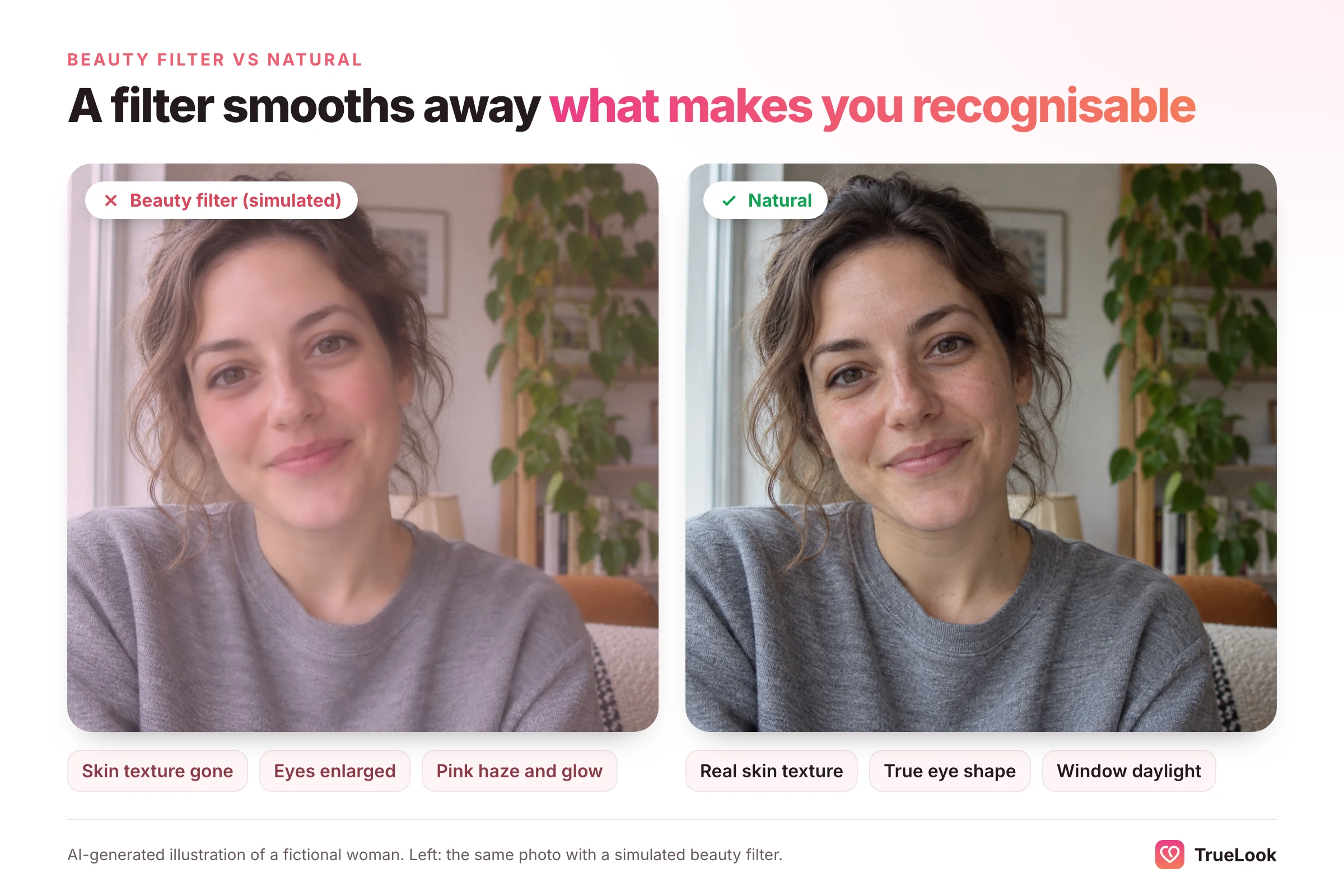
One honest complication: Dai and Xia's experiment found that a beautified selfie did improve ratings of women's profiles. A filter may win a swipe, but it sets up a gap that every first date then has to close. The test we suggest: if you'd feel uncomfortable with a match seeing the original next to the edit, the edit has gone too far.
When AI dating photos are a sensible option
AI photo tools can fill a real gap. Plenty of people own usable selfies yet lack a sharp full-length photo, an evening-out shot or anything taken in good daylight, and have nobody free to help take them. Used well, they change the setting, light and outfit while keeping your face, which is the part people already accept being improved in a good photo.
Used badly, they do exactly what filters do: smooth, slim and de-age, creating the mismatch this whole guide is about avoiding. Each app sets its own rules; our guide to whether AI photos are allowed on dating apps covers Tinder, Hinge and Bumble.
A sensible split between AI and real photos
| Photo type | AI is reasonable for… | Keep it real for… |
|---|---|---|
| Face shot | A sharp, well-lit version of your actual face | Anything that changes your features |
| Full length | When you have nobody to take one | Your actual build: never slimmed or bulked |
| Dressed up | When there's no recent event | Clothes you would actually wear |
| Activity | Settings for things you really do | Hobbies you don't actually have |
| Social | Never | Your real friends |
| Pet | Never | Your real animal |
TrueLook is one option for this. It makes AI dating photos from four of your own selfies using its HyperReal™ method, aiming to keep your face recognisable rather than idealised, at about a minute per photo, and it never uses your photos for AI training. It can't guarantee matches, and each app makes its own decisions on verification.
Let someone else make the final cut
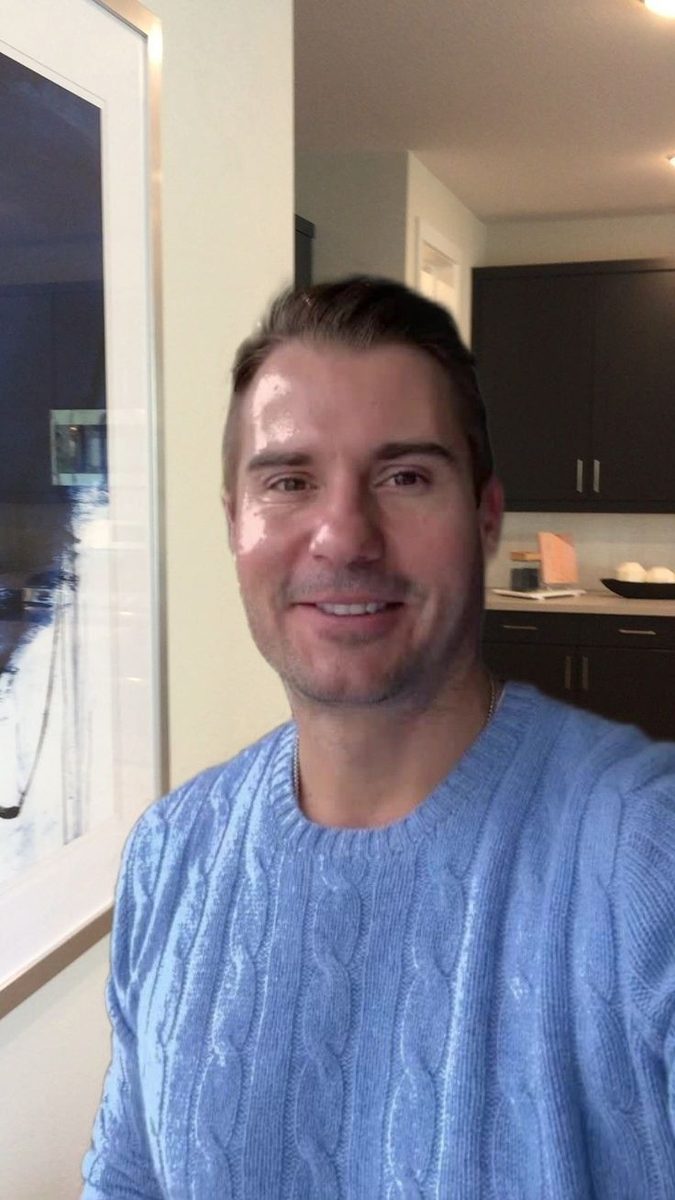
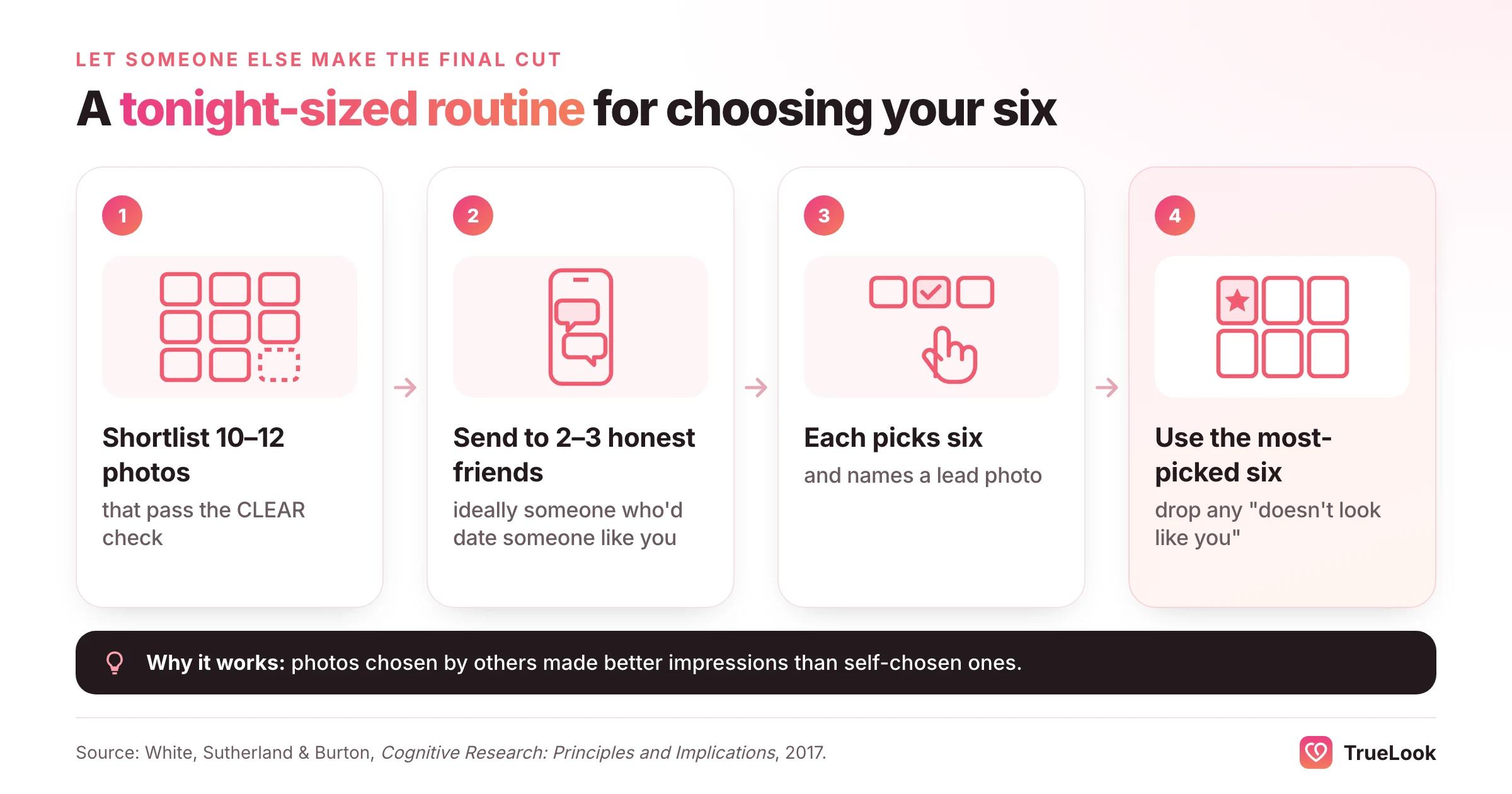
This may be the most useful step and the most skipped. David White, Clare Sutherland and Amy Burton asked people to choose their own most and least flattering profile photos, then had strangers rate them. Their 2017 study found that photos chosen by other people made more favourable impressions than photos people picked for themselves, and concluded that it may be wise to let others choose for us.
A simple way to do it:
- Pick a shortlist of 10 to 12 photos that pass the CLEAR check.
- Send them to two or three people who will be honest, ideally including someone who would date someone like you.
- Ask each to choose six and name their lead photo.
- Use the photos that appear most often. Lead with the most popular face shot.
- Drop any photo that anyone says doesn't look like you.
Several apps now offer the same help with software: Tinder's Photo Selector suggests photos from your camera roll, and Bumble's Best Photo tests your first three. Treat both as a second opinion, not the final word.
The honest limits of photo advice
- Photos start conversations; they don't finish them. A great set with an empty bio or flat prompts still stalls.
- Much of the research is narrow. Many studies use students, short exposures or heterosexual samples. Use the findings as direction, not law.
- Industry studies have interests. Photo-rating services and dating apps publish useful data, but they also sell products. We've flagged where a number comes from one.
- Taste varies. What works in one city, age group or app may not in another. If your photos aren't working after a few weeks, change two at a time and compare.
Frequently asked questions
What kind of pictures should you put on a dating profile?
Use six photos that each show something different: a solo face shot with a real smile, a full-length photo, an activity or hobby, something dressed up, a single photo with friends in which nobody has to hunt for you, and a wildcard like your own pet, a trip or a candid laugh. Put the face shot first, and keep group photos out of the lead slot.
How many photos should a dating profile have?
Aim for six strong, varied photos. Bumble lets you add six and one of its articles says profiles with four or more photos get the most matches. Fewer than four leaves people guessing, and weak extra photos can hurt more than they help.
What is the 2/3 rule in photography?
It's another name for the rule of thirds: instead of standing in the middle of the frame, you sit on one of the lines that split the picture into thirds. Switch on the grid in your camera settings and stand where an upright line falls; the result usually feels more relaxed and less like a passport photo.
How old should dating profile pictures be?
Keep every photo within roughly the last year and your lead photo within the last six months, as Bumble's own tips suggest. Swap a photo out sooner if your hairstyle, beard, weight or glasses are different now.
What should you wear in dating profile photos?
Well-fitting clothes you'd actually wear, in solid colours or simple textures, with a different outfit in each photo. Include one dressed-up look and avoid busy patterns or big logos near your face.
Can you use selfies as dating profile pictures?
A single good selfie is fine; a profile built mostly of selfies isn't. Selfies taken at arm's length distort facial proportions, especially the nose, and they show little of your life. For most photos, use the rear camera from a few steps back, handed to a friend or set on a timer.
Should you smile in dating profile pictures?
Yes, at least in your lead photo. Photofeeler's analysis found a smile with teeth raised perceived likability more than any other factor it tested. One study found smiling lowered women's first-impression sexual attraction ratings of men, so it's worth including one relaxed, confident photo without a big grin as well.
Is it okay to use AI photos on a dating profile?
It depends on the app's rules and on the photos. AI photos that keep your real face and only change the setting, light and outfit are very different from ones that smooth, slim or de-age you. Keep pets and friends real, make sure every photo still looks like you, and check each app's guidelines.
Sources
- First impressions: making up your mind after a 100-ms exposure to a face, Psychological Science (2006), Willis and Todorov, via PubMed. https://pubmed.ncbi.nlm.nih.gov/16866745/
- Misleading first impressions: different for different facial images of the same person, Psychological Science (2014), Todorov and Porter, via PubMed. https://pubmed.ncbi.nlm.nih.gov/24866921/
- Same face, many first impressions, Association for Psychological Science (2014). https://www.psychologicalscience.org/news/releases/same-face-many-first-impressions.html
- Key findings about online dating in the U.S., Pew Research Center (2023). https://www.pewresearch.org/internet/2023/02/02/key-findings-about-online-dating-in-the-u-s/
- 10 ways your photos can help you get better matches, Bumble (n.d.). https://bumble.com/the-buzz/10-ways-profile-photos-get-better-matches
- Tinder's AI photo selection feature launches, TechCrunch (2024). https://techcrunch.com/2024/07/17/tinder-ai-photo-selection-feature-launches
- A candid advantage? The social benefits of candid photos, NYU Stern School of Business (2019). https://www.stern.nyu.edu/experience-stern/faculty-research/candid-online-photos-improve-social-status-and-dating-prospects-alixandra-barasch
- How to use Bumble's Best Photo feature, Bumble (n.d.). https://bumble.com/the-buzz/how-to-use-bumble-best-photo-feature
- New research study breaks down "the perfect profile photo", Photofeeler (2023). https://blog.photofeeler.com/perfect-photo/
- Happy guys finish last: sexual attraction study, ScienceDaily (2011), on Tracy and Beall, Emotion. https://www.sciencedaily.com/releases/2011/05/110524070310.htm
- OkCupid is wrong about men's dating photos, and we replicated their study to prove it, Photofeeler (n.d.). https://blog.photofeeler.com/okcupid-is-wrong-about-smiling-eye-contact-mens-dating-profile-photos/
- Study shows an expansive posture can make you more attractive to others, ScienceAlert (2016), on Vacharkulksemsuk and colleagues, PNAS. https://www.sciencealert.com/study-shows-an-expansive-posture-can-make-you-more-attractive-to-others
- People seem more attractive in a group than they do apart, ScienceDaily (2013), on Walker and Vul, Psychological Science. https://sciencedaily.com/releases/2013/10/131029092028.htm
- Nasal distortion in short-distance photographs: the selfie effect, JAMA Facial Plastic Surgery (2018), Ward and colleagues, via PubMed. https://pubmed.ncbi.nlm.nih.gov/29494735/
- A new study has found that selfies make noses appear 30% larger, ZME Science (2018). https://zmescience.com/science/news-science/selfies-make-hate-nose-02032018
- The impacts of media richness, blurriness, and beautification of online dating profile visual elements on dating outcomes, Frontiers in Communication (2025), Dai and Xia. https://public-pages-files-2025.frontiersin.org/journals/communication/articles/10.3389/fcomm.2025.1572179/text
- Putting your best face forward: the accuracy of online dating photographs, Journal of Communication (2009), Hancock and Toma. https://socialmedialab.sites.stanford.edu/sites/g/files/sbiybj22976/files/media/file/hancock-cr-putting-your-best-face-forward.pdf
- How to take the best Bumble profile pics, Bumble (n.d.). https://bumble.com/the-buzz/best-bumble-profile-photo-tips
- Tinder to expand facial verification feature across the U.S., Tinder Newsroom (2025). https://www.tinderpressroom.com/2025-10-22-Tinder-to-Expand-Facial-Verification-Feature-Across-the-U-S-,-Setting-a-New-Standard-for-Dating-Safety
- Community Guidelines, Bumble (accessed 2026). https://bumble.com/en/guidelines
- Choosing face: the curse of self in profile image selection, Cognitive Research: Principles and Implications (2017), White, Sutherland and Burton, via PMC. https://pmc.ncbi.nlm.nih.gov/articles/PMC5391387
Get better dating photos from your own selfies
TrueLook’s HyperReal™ method turns 4 selfies into hyperrealistic photos of you for Tinder, Hinge and Bumble.
Hyperrealistic AI dating photos from your selfies
Written by the TrueLook Team
TrueLook makes hyperrealistic dating photos from your own selfies. Our articles cover dating profile photos, the apps and how to get noticed.