To get more matches on Tinder, rebuild your profile in this order: a lead photo that is clear, close and naturally lit; a set of five or six varied photos that other people helped choose; a short bio with one specific hook; a verified, fully filled-in profile; and then habits that match how Tinder recommends people, namely regular activity and selective swiping. Photos drive most of the gain, the bio converts the people who were undecided, and messaging decides whether matches turn into dates.
This is the positive playbook. If you are currently stuck at zero and suspect something is broken, such as a hidden profile or settings that hide you, start with our diagnosis of why you get no matches on Tinder, then come back here.
- Think in funnel stages: being seen, earning a like, matching, and starting a conversation. Each stage has its own lever and its own measure.
- Smiling helps men more than most expect. Photofeeler's 2026 analysis found an open-mouth smile raised men's trustworthiness ratings by 2.55 points out of 10 versus no smile, yet 54% of men's dating photos had none.
- Let others choose. A 2017 study found photos picked by strangers made better impressions than the photos people picked of themselves.
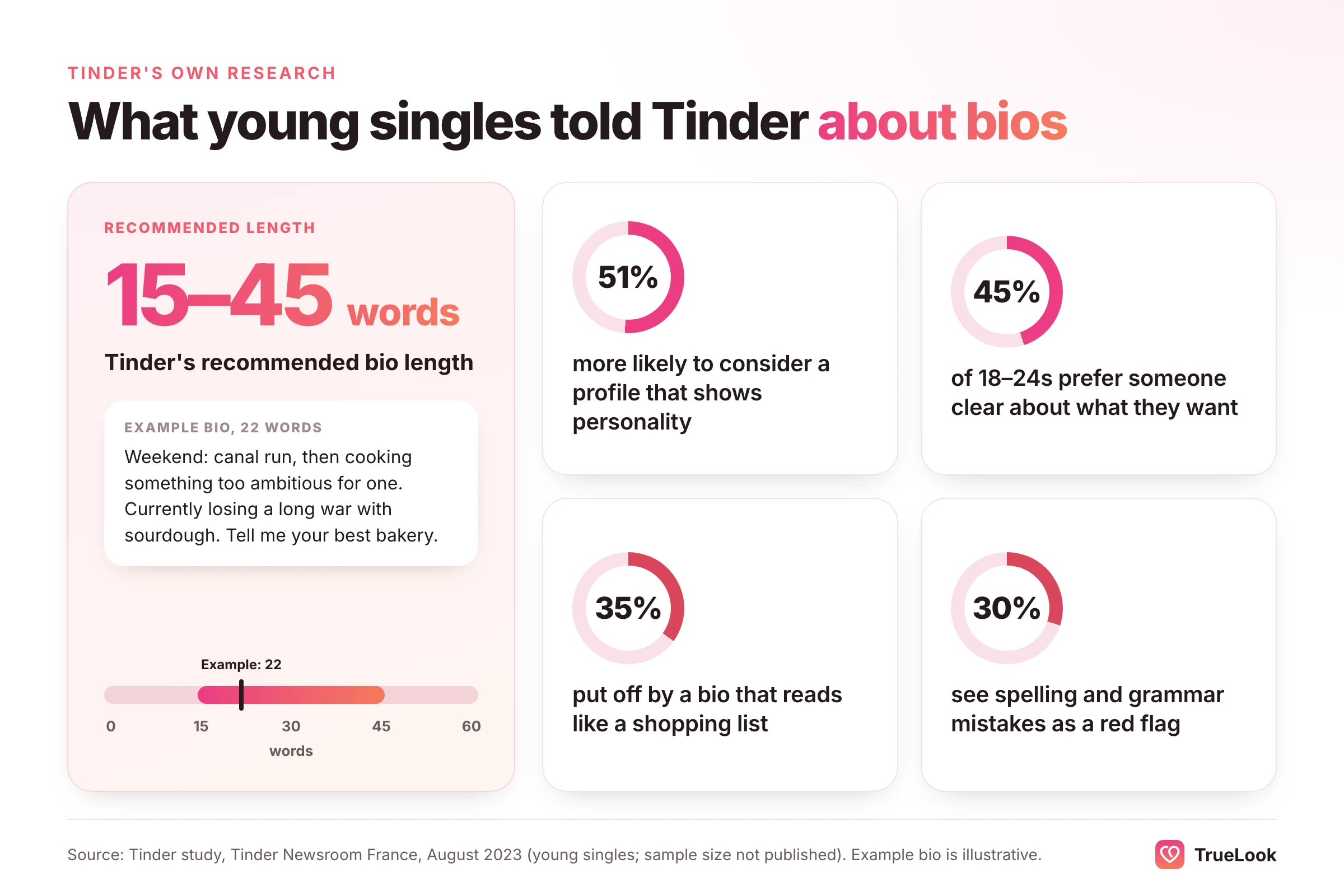
- Tinder's own 2023 research recommends a bio of 15 to 45 words; 51% of young singles said they are more likely to consider a profile that shows personality.
- A bio is not optional: in a 2016 experiment, male test profiles received about four times as many matches from women once a bio was added.
- Tinder says it prioritises people who are active at the same time. Short daily sessions beat one long weekly binge.
- Paid features amplify a working profile. Tinder says a Boost can lift profile views up to tenfold for 30 minutes, but it does not promise matches.
Think in funnels, not tips
Most advice about Tinder is a list of tips with no order. A more useful frame is a four-stage funnel. Every match you get passed through all four stages, and each stage has a different bottleneck.
| Stage | What has to happen | Main lever | How to measure it |
|---|---|---|---|
| 1. Seen | Tinder shows your card to people nearby who fit your filters | Activity, settings, a visible face photo | Are new profiles appearing for you? Is your profile hidden? |
| 2. Liked | Someone pauses on your first photo and swipes right | Lead photo, then the rest of the set | The likes count on your free account |
| 3. Matched | You and they both swiped right | Who you like, and how selectively | Matches per 100 likes you send |
| 4. Talking | Someone sends a first message and the other replies | Bio, prompts, your openers, reply speed | Share of matches that reach three or more messages |
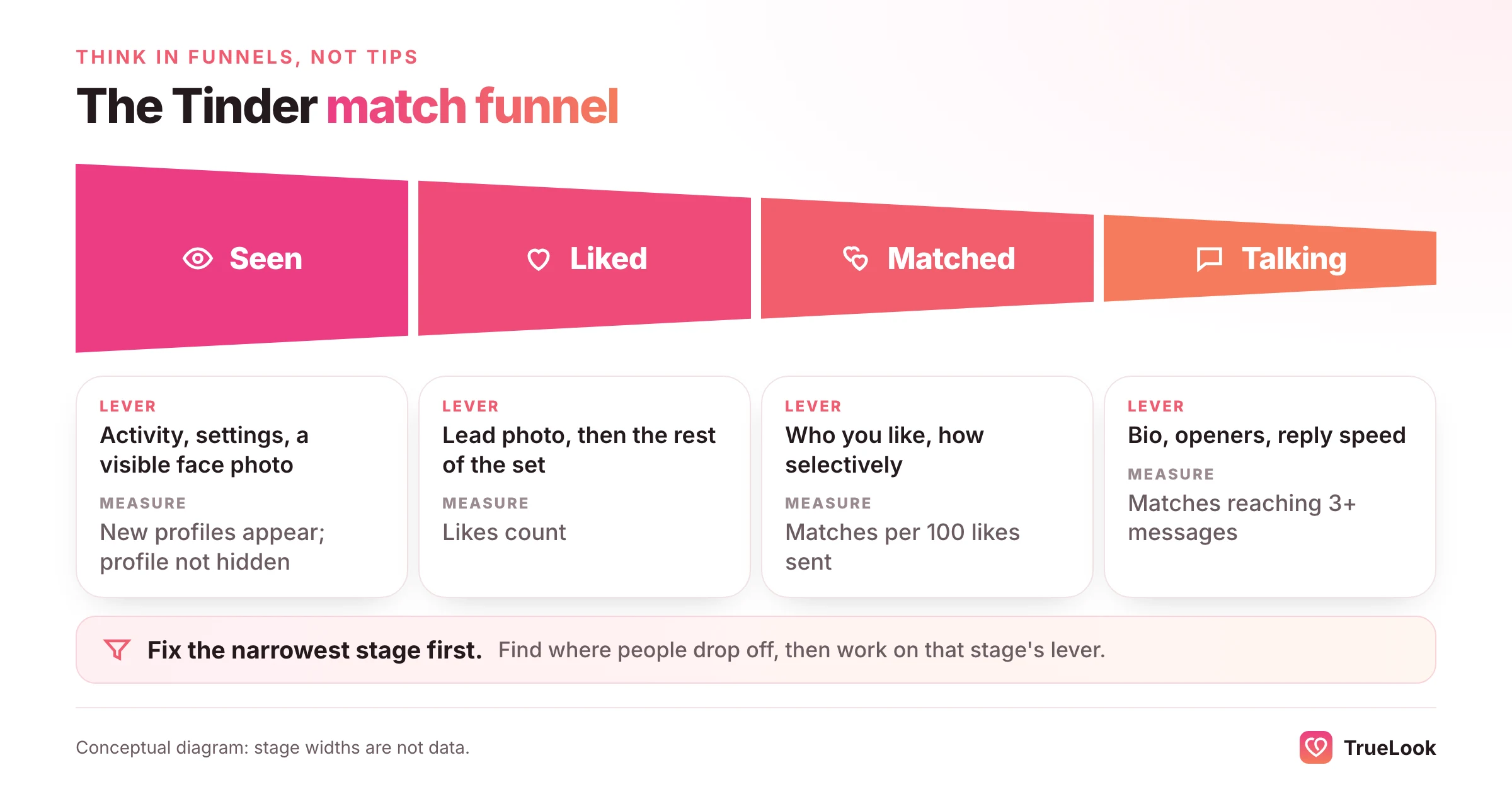
The funnel tells you where to spend effort. If your likes count barely moves, no bio rewrite will help; work on photos. If you get likes but few matches, look at who you are liking. If you match but never talk, the bio and your openers are the problem. The steps below follow the funnel from the top.
It also sets realistic expectations. The research is consistent that men face long odds on Tinder: in a 2016 measurement study, Tyson and colleagues found male test profiles matched with 0.6% of the people they liked, and SwipeStats' self-uploaded dataset puts the median man at 2.04%. Doubling a 2% rate is a big, achievable win. Expecting 20% is not.
Step 1: Build a lead photo that earns the pause
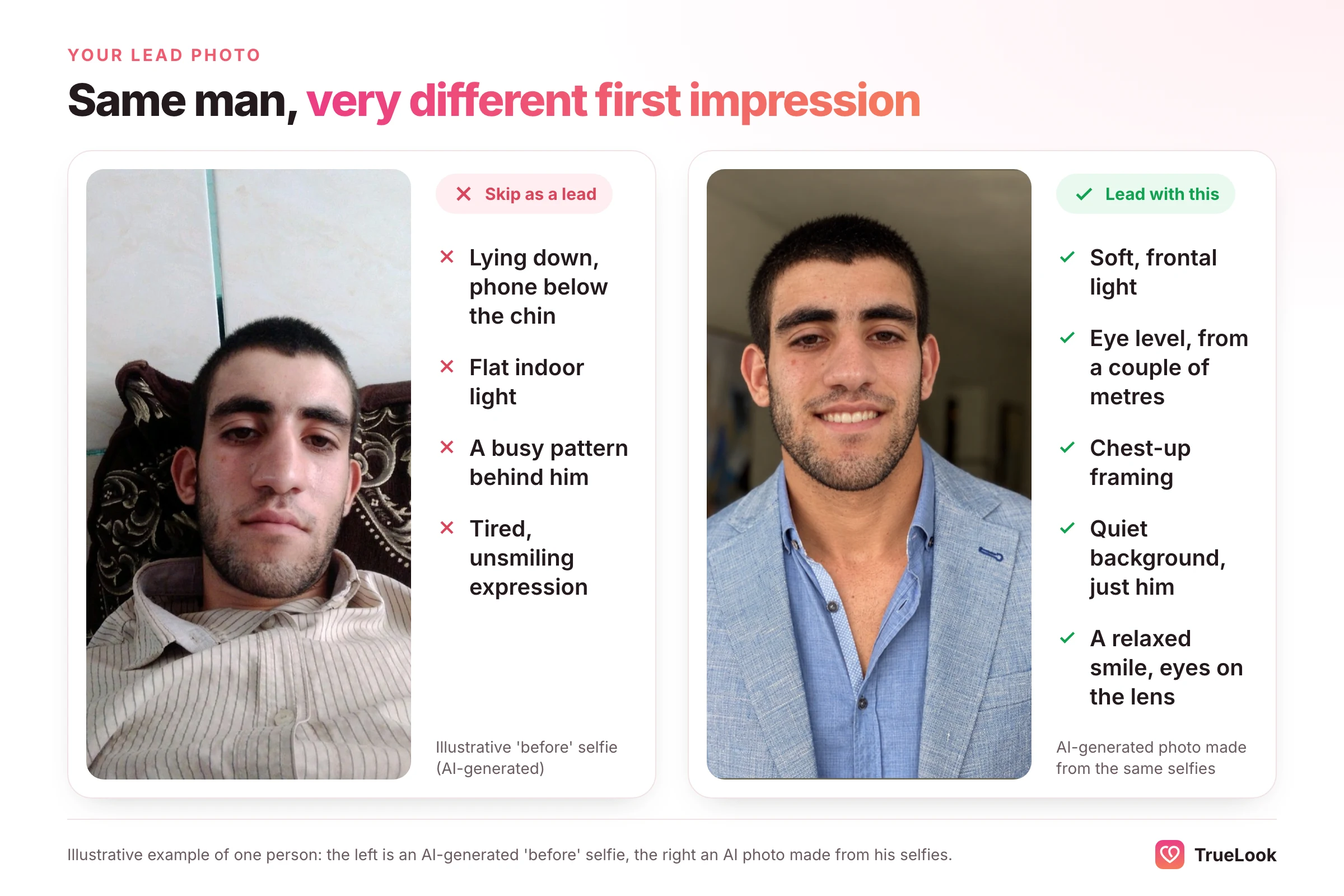
Your first photo is the only part of your profile that everyone sees. Impressions of faces form in a fraction of a second, so the job of this photo is narrow: show a stranger, instantly, what you look like and that you seem pleasant to be around.
What the research says about expression and eye contact
Smiling is the cheapest upgrade most men skip. Photofeeler, which collects crowd ratings of profile photos, published an analysis of smiles in 2026: for men's dating photos, an open-mouth smile raised trustworthiness ratings by 2.55 points on a 10-point scale compared with not smiling, and both open and closed smiles beat a neutral face on every trait it measured. Attractiveness itself barely moved, by under half a point, so the smile is not making you look different; it is making you look approachable. Despite that, 54% of men's dating photos in its data showed no smile. The analysis is correlational, as Photofeeler notes, but the direction is clear.
Eye contact matters too, particularly in combination. When Photofeeler replicated an old OkCupid study that had claimed men should not smile or look at the camera, it found smiling made no significant difference in that sample, but that eye contact without a smile was the one combination that hurt. A direct, unsmiling stare reads as cold. Look at the lens, and let your face relax into something friendly.
The technique checklist
- Soft, frontal light. Outdoors in the last hour before sunset or the first after sunrise, or on a bright overcast day. Adobe's guide to golden hour explains why: the low sun produces soft, even light that is forgiving on skin and hard to over- or underexpose. Indoors, face a large window.
- Distance and zoom. Have the photographer stand a couple of metres back and zoom in slightly rather than holding the phone close, which keeps your features in proportion.
- Eye-level camera. Not from below the chin, not from high above.
- Chest-up framing. Your face should be large enough to read on a small phone screen. Photofeeler's paired examples include a man whose attractiveness rating rose from 5.1 to 6.6 when the only change was a closer crop.
- Nothing over your face. No sunglasses, low caps or hands near the face in the lead photo.
- A quiet background. Pleasant but not competing: a park, a street with depth, a plain wall in good light.
- Solo. Nobody else in the frame, so there is no guessing.
How to shoot it without a photographer
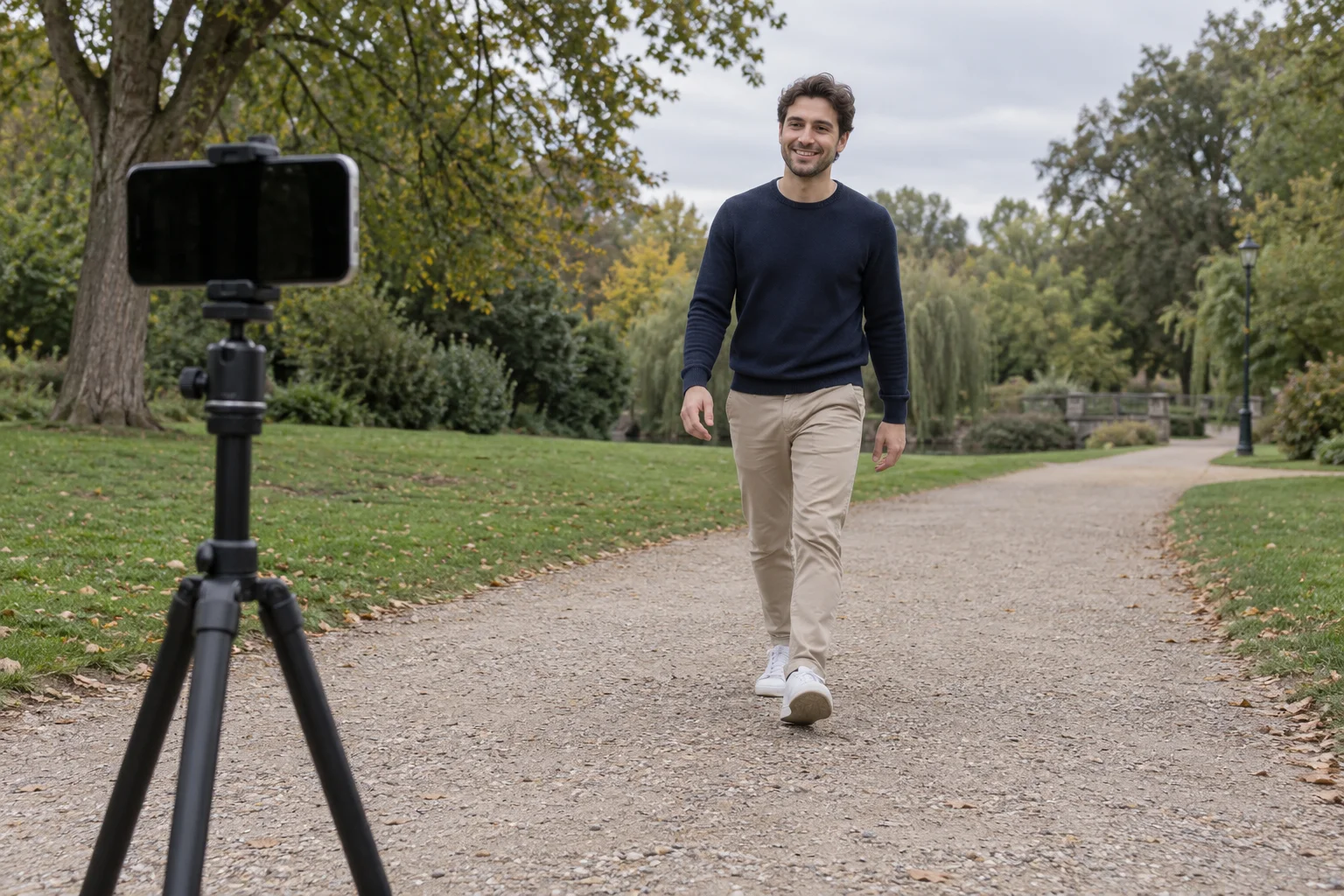
You do not need help to get a good lead photo. A cheap phone tripod, the rear camera and the timer or a Bluetooth remote are enough. Set the phone at eye level, step back two or three metres, take a burst of shots while you talk, laugh or walk slowly towards the camera, and repeat in a second spot. Moving and talking produces more natural expressions than holding a pose.
Step 2: Assemble a six-slot photo set
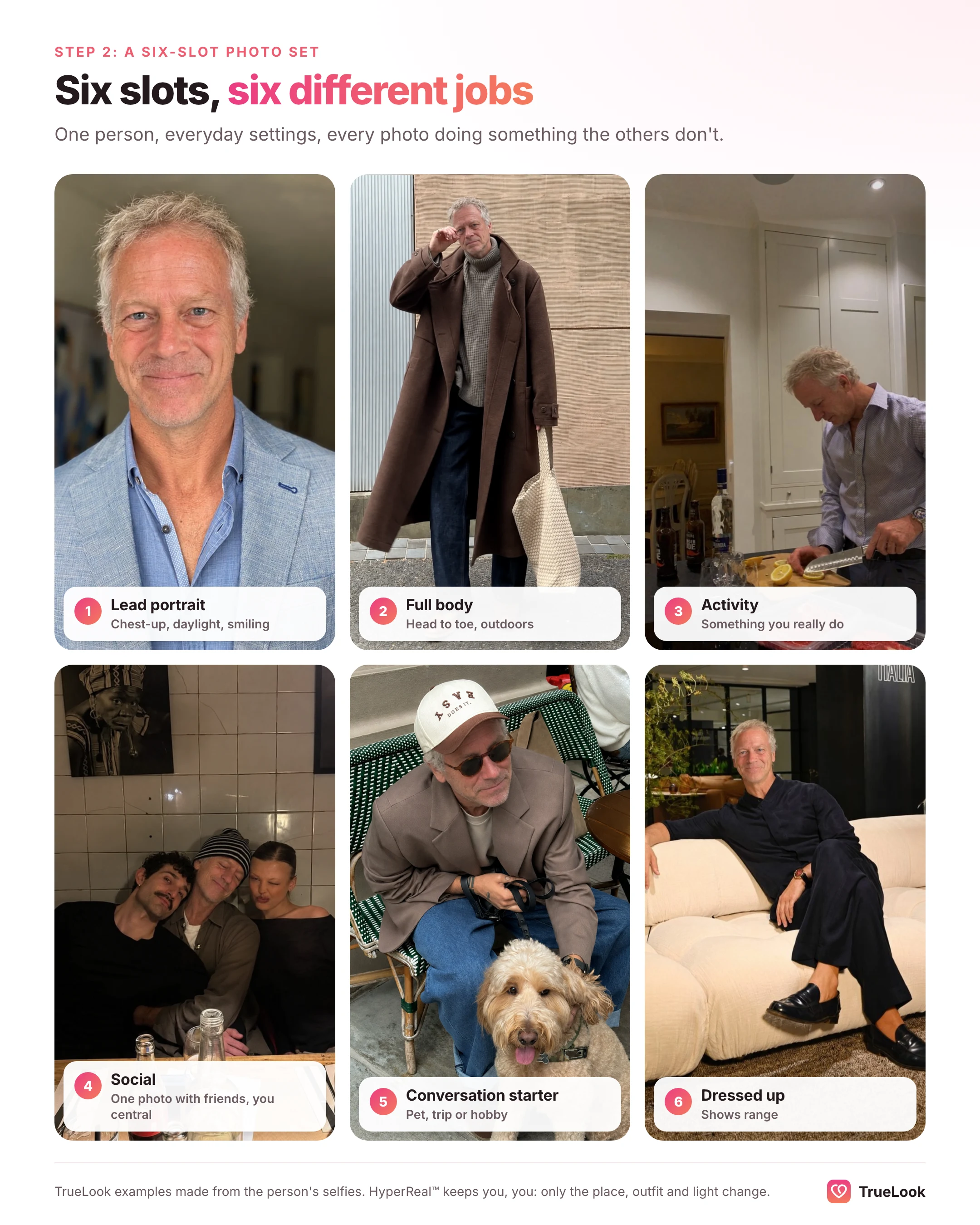
Once your first photo earns a pause, the rest of the set has to back it up. Variety is the point. In the Tyson study's experiment, a male test profile with three pictures collected 238 matches in four hours where the same setup with one picture collected 44. More photos only help if each one adds something new, so think of the set as six slots, each with a job.
| Slot | Its job | Good versions | Avoid |
|---|---|---|---|
| 1. Lead portrait | Show your face clearly and warmly | Chest-up, daylight, smiling, eye contact | Sunglasses, selfies from below, groups |
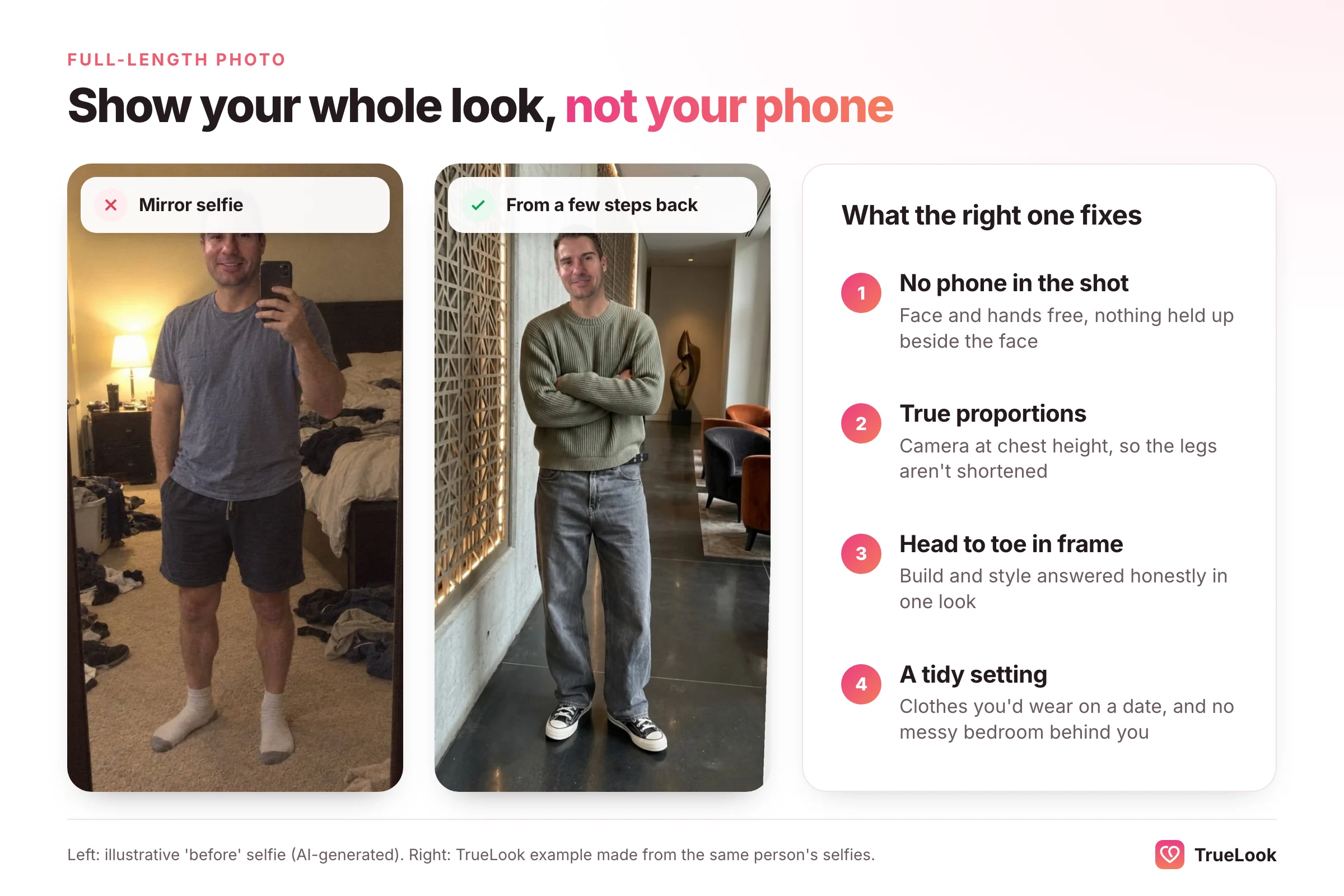
| 2. Full body | Show your build and style honestly | Standing or walking, outdoors, head to toe | Mirror selfies, heavy cropping |
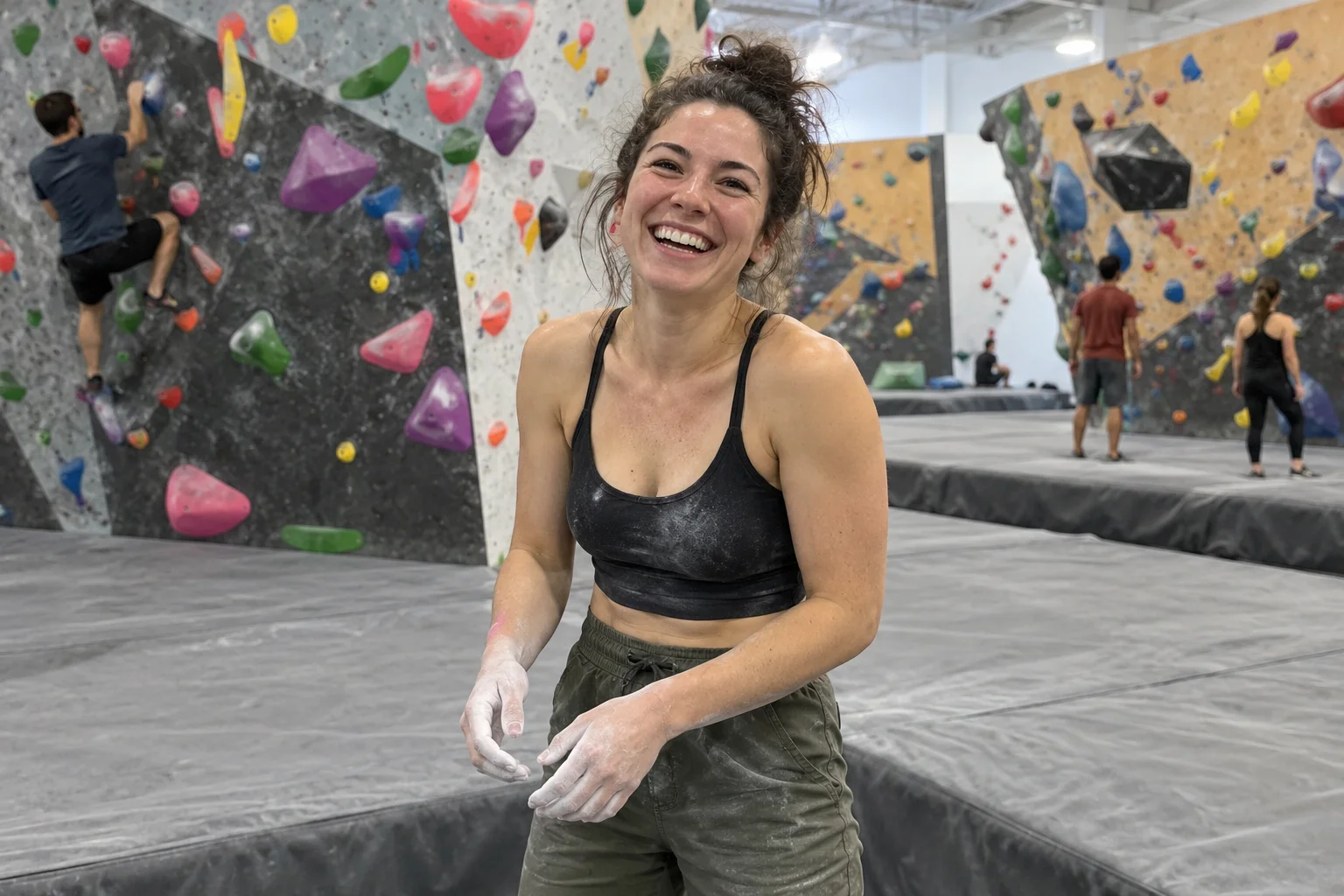
| 3. Activity | Show something you actually do | Cooking, climbing, playing music, a sport | Activities you did once for a photo |
| 4. Social | Show that people enjoy your company | One photo with friends where you are central and recognisable | More than one group photo; group shot first |
| 5. Conversation starter | Give people an easy first message | A pet, a trip, a hobby, a quirky detail | Generic landmarks with your face tiny in the frame |
| 6. Dressed up or second portrait | Show range | An event, a nicer outfit, a different setting | Another near-identical headshot |
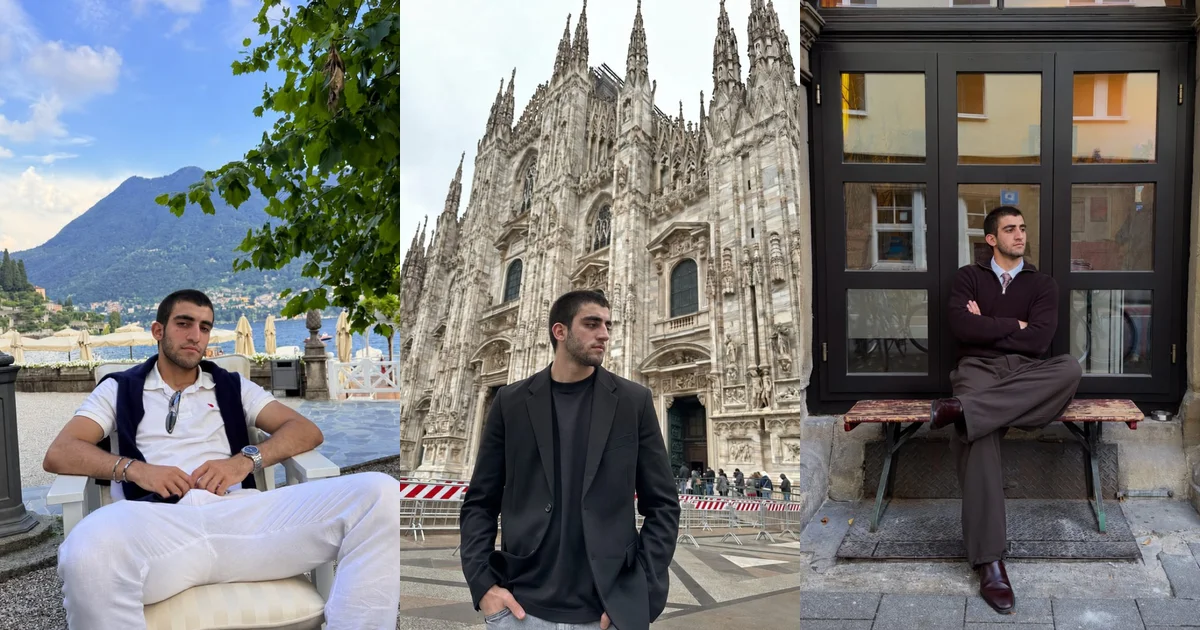
Spread the photos across different days, outfits and places. Six photos from one afternoon read as one photo repeated. All of them should be recent enough that a match would recognise you instantly. For examples of each slot and how to shoot them, see our guide to the best photos for Tinder.
If your camera roll is empty
Many people who want more matches simply do not have recent, well-lit photos of themselves. The options are a weekend shoot with a friend, a photographer, or an AI tool that builds photos from your own face. TrueLook is one of the AI options: it uses four of your selfies to create hyperrealistic photos of you in different styles and settings, about a minute per photo. See how it works on our page about AI Tinder photos created from your selfies.
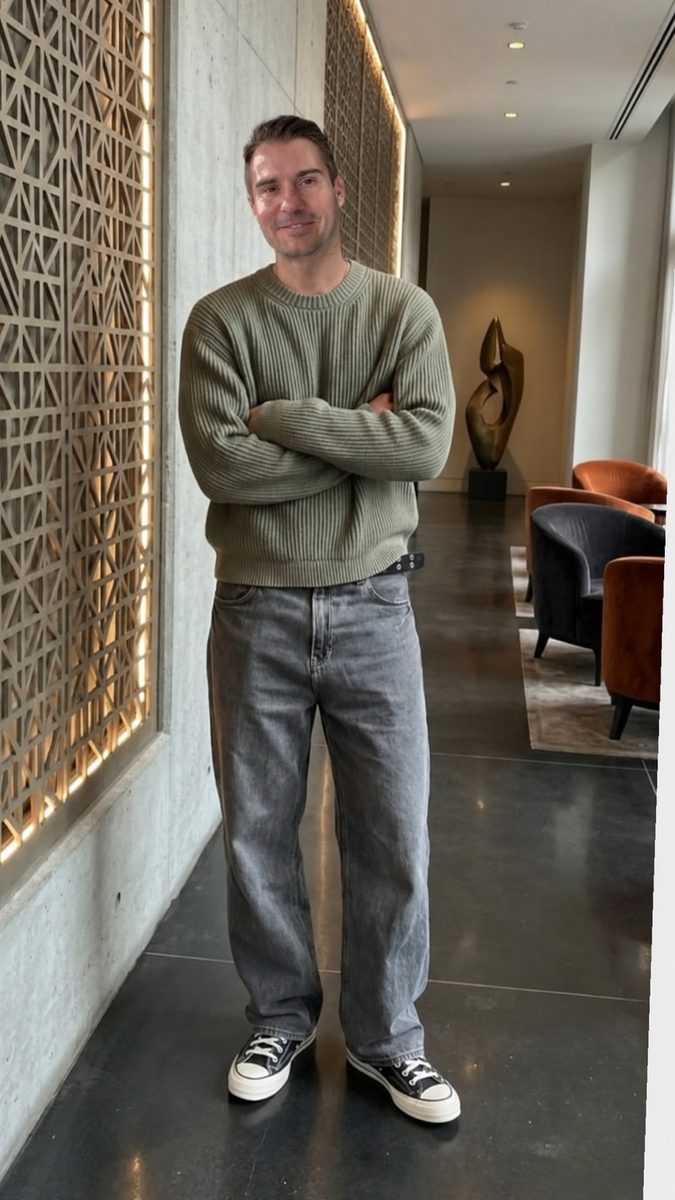
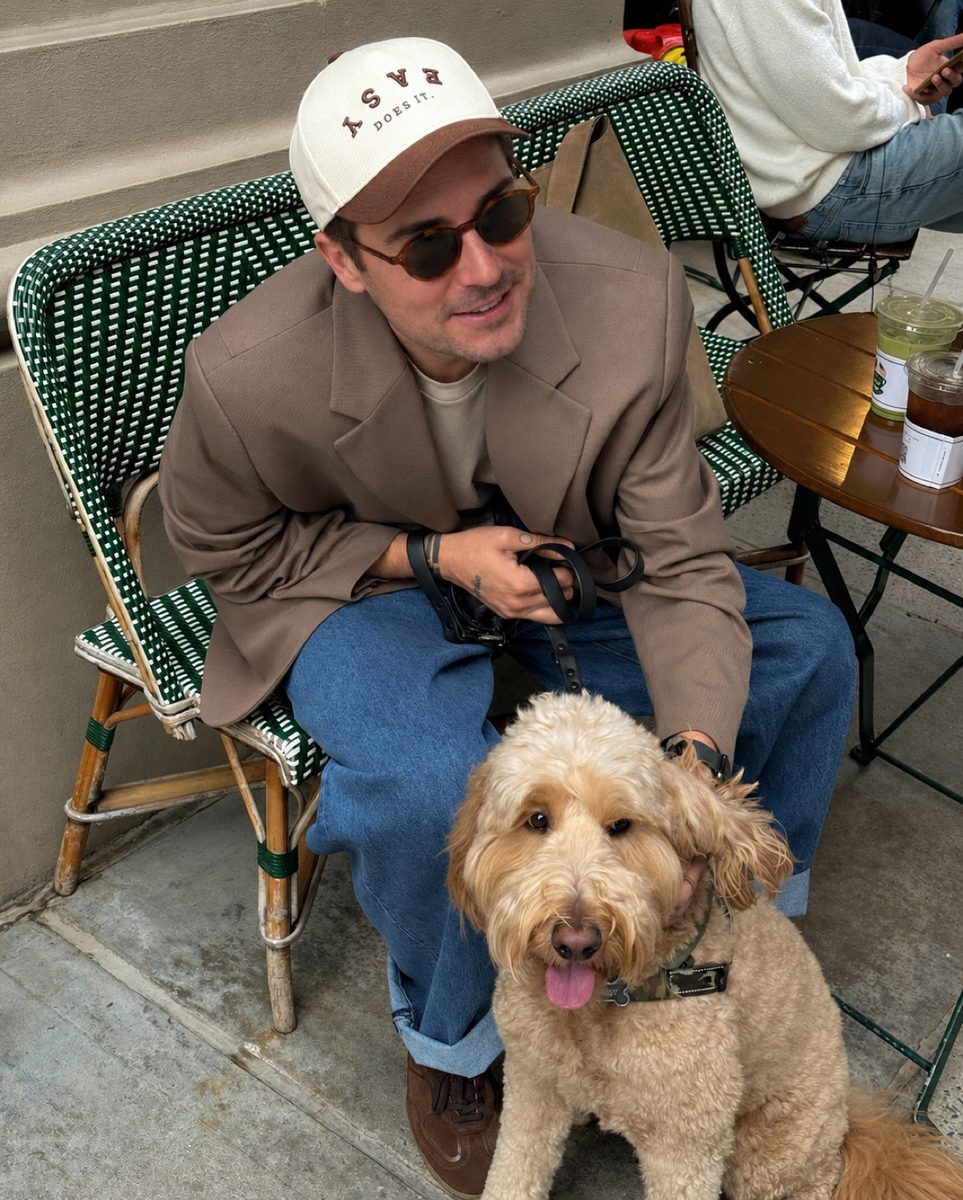
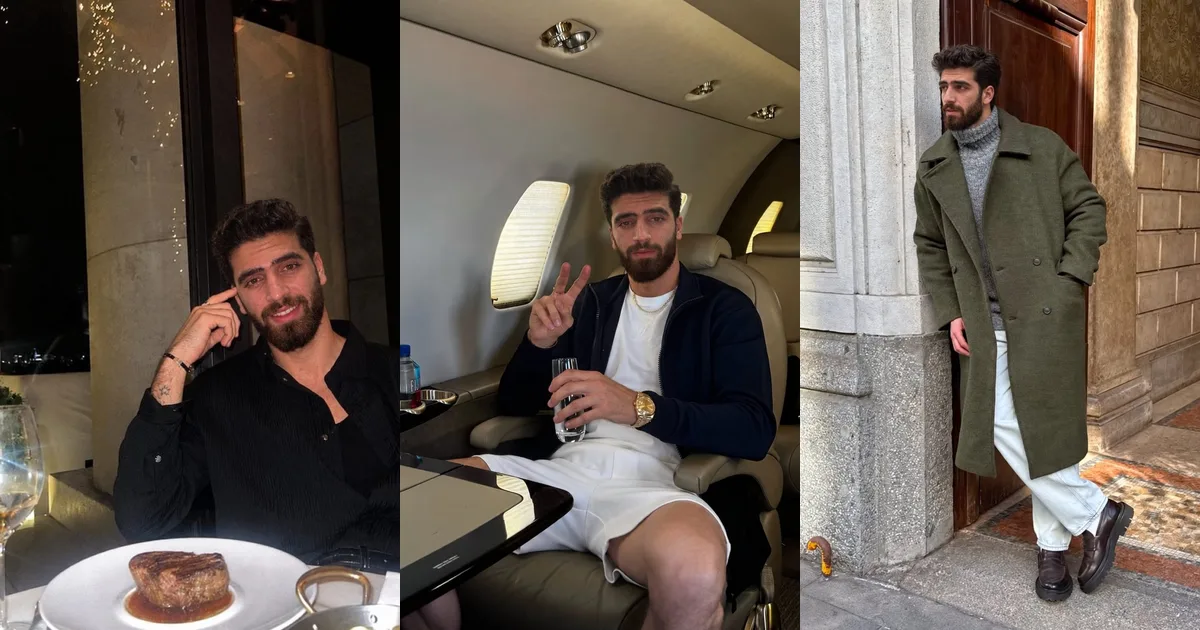
One honest rule applies whatever the source: pick scenes that match your real life. A yacht or a business-class seat may look impressive, but if your weekends are spent hiking and cooking, those are the photos that lead to good conversations and dates with people who like the real you. Photos should look like you on a good day, and whether any photo passes verification is always Tinder's decision. Our comparison of a dating photographer versus AI photos covers the trade-offs in more depth.
Step 3: Let other people choose your photos
This step sounds minor and is not. In a 2017 study in Cognitive Research: Principles and Implications, "Choosing face: The curse of self in profile image selection", 610 participants chose profile images of themselves and of unfamiliar people. The photos strangers selected created more favourable impressions than the ones people selected for themselves. We are attached to memories and blind to how we come across.
Three practical ways to borrow other people's judgment:
- The friend panel. Send ten candidate photos to three friends, including at least one person of the gender you hope to match with. Ask each to pick their top three and their least favourite, without discussing it. Photos that appear in several top-threes go in; any photo someone names as worst comes out.
- Tinder's Smart Photos. When Tinder launched it in 2016, TechCrunch reported that the feature rotates your photos to find which works best as the first one, and that Tinder's own testing showed up to a 12% increase in matches. The limitation, which Photofeeler (a company selling a competing rating service) points out, is that it learns from right swipes alone, which are scarce for most men, so it can take a long time to settle. Use it when you have two strong candidates, not to rescue a weak set.
- A manual A/B test. Use photo A as your lead for a week, note your likes count each day, then switch to photo B for a week under the same habits. It is slow, but it measures exactly what you care about: real people in your area.
Tinder has also added a camera-roll tool. Scripps News reports that Photo Selector asks for a selfie, scans your photo library and suggests a set of candidates for you to choose from; Tinder's survey behind it found more than half of respondents struggled to choose a profile photo. It is a shortlist, not a verdict, so still run the friend panel.
Step 4: Write a bio that converts the maybes
Photos decide most swipes. The bio decides the close calls, and it gives matches something to say. Several sources point the same way.
- In the Tyson study, adding a bio to male test profiles raised their average matches from women roughly fourfold, from 16 to 69.
- In SwipeStats' self-uploaded data, men with bios of 1 to 50 characters averaged a 6.87% match rate, higher than men with no bio (5.34%) or bios of 151 to 300 characters (3.97%).
- A 2023 Tinder study published by its French newsroom recommended 15 to 45 words, and reported that 51% of young singles are more likely to consider a profile that shows personality, 35% are put off by a bio that reads like a shopping list, 30% see spelling and grammar mistakes as a red flag, and 45% of 18 to 24 year olds prefer someone who is clear in their bio about what they want.
The three-part formula: detail, angle, hook
- Detail: one specific, true thing about your life. Not "I love food" but what you cook, where, for whom.
- Angle: a hint of personality: a mild opinion, a running joke, a small brag you can back up.
- Hook: a question or a choice that is easy to answer in one message.
Add a short, honest line about what you are looking for if you know. Tinder's research suggests clarity reads as attractive, especially to younger users.
Before and after rewrites
These are illustrative rewrites, not real profiles.
| Before | After | What changed |
|---|---|---|
| "Adventurous, laid-back, love to travel and try new food. Looking for my partner in crime." | "Back from three weeks walking in northern Spain, now trying to recreate the tortilla at home with mixed results. Tell me the best dish you have ever eaten on holiday." | Adjectives replaced by a scene; a question anyone can answer |
| "6'1. Engineer. Gym. Ask me anything." | "Engineer by day, terrible but committed five-a-side goalkeeper by night. Looking for something real, and someone to argue with about the best pizza in town." | Height moved to the basics; personality and intention added |
| "Not here for games. No hookups. If you can't hold a conversation, swipe left." | "Here to meet someone I would actually want to see again. Bonus points if you have a strong opinion on bookshops or brunch." | Same intention, framed as an invitation instead of a list of rules |
| (empty) | "Nurse on nights, gardener on days off. My tomatoes are winning. What are you growing, figuratively or otherwise?" | Something beats nothing; a playful, easy opener |
What to cut
- Lists of adjectives about yourself.
- Phrases every profile uses, such as "partner in crime", "love to laugh" or "just ask".
- Rules, demands and negativity about the app or past dates.
- Typos. Read it aloud before saving.
- Your entire CV. One detail beats five facts.
Step 5: Complete and verify your profile
The rest of the profile adds small signals that compound. Tinder's matching explainer, "Powering Tinder", says interests and lifestyle details members add are factored in so people can connect over shared interests. Fill in your interests with specific choices rather than the most popular ones, add your relationship goals and basics, and connect an anthem or a prompt if your version of the app offers it. Each one is another hook for a first message.
Then get the Photo Verified check. According to Tinder's Photo Verification help article, you tap the grey check mark beside your name and record a short video selfie, which is compared with your profile photos using facial recognition; processing usually takes a few minutes. Tinder's 2023 French study reported a 10% extra chance of meeting someone for members aged 18 to 25 with a verified photo. Common reasons for rejection, per the same help article, include a face that is not prominent in the frame, an obscured face, a non-neutral expression, a dark or unclear video, and a person who does not match the profile photos. If you run into trouble, our guide on fixing a failed Tinder photo verification walks through each one.
Step 6: Make sure you can be found
A brilliant profile that nobody sees gets nothing. Open Settings, scroll to Discovery and confirm three things: Enable Discovery is switched on, your location is current, and your distance and age range are wide enough to show you a steady stream of new profiles. Tinder's Discovery settings article also describes toggles under each slider that let it show you people slightly outside your ranges when you run out; leave those on unless the range is a genuine dealbreaker. If anything here looks wrong, the full checklist is in our no-matches diagnosis.
Step 7: Swipe like someone with a plan
Be selective, in both directions
In SwipeStats' data on about 6,200 men, those who swiped right on fewer than 30% of profiles averaged a 6.84% match rate, while those who liked 90% or more averaged 2.19%. Selective swipers may also have better profiles, so this is not proof of a penalty, but liking everyone clearly does not help. At the same time, do not only like the most sought-after profiles: a 2018 study in Science Advances, "Aspirational pursuit of mates in online dating markets", found people tend to contact others about 25% more desirable than themselves by the study's measure, and that reply rates fall as the gap grows. The sweet spot is liking people you would genuinely message, from a range that includes plenty of people whose lives overlap with yours.
Be active when others are
Tinder's matching explainer says it prioritises people who are active, and active at the same time. That favours a rhythm of short sessions most days over occasional marathons. Evenings and weekends are when most people have free time, and seasonal peaks exist too: Tinder calls the first Sunday of January "Dating Sunday", and NBC reported that on that day Tinder saw 22% more messages and 18% more likes than on a typical Sunday.
| Habit | A good default | Why |
|---|---|---|
| Session length | 10 to 15 minutes | Long enough to read profiles, short enough to stay selective |
| Frequency | Most days, some evenings | Tinder favours people active at the same time |
| Right swipes | People you would message | Indiscriminate liking correlates with lower match rates |
| Reading | Check the bio and second photo before deciding | Better matches and easier openers |
| Replies | Within a day of matching | Interest fades quickly |
Step 8: Turn matches into conversations
A match is not the goal; a conversation is. This is where many profiles leak. In SwipeStats' data, 43.4% of men's matches had zero or one message, and only about 15% reached eleven messages or more. The Tyson study found just 7% of matches with male test profiles sent a message, against 21% for female profiles. If you are a man, assume you will usually send the first message, and make it count.
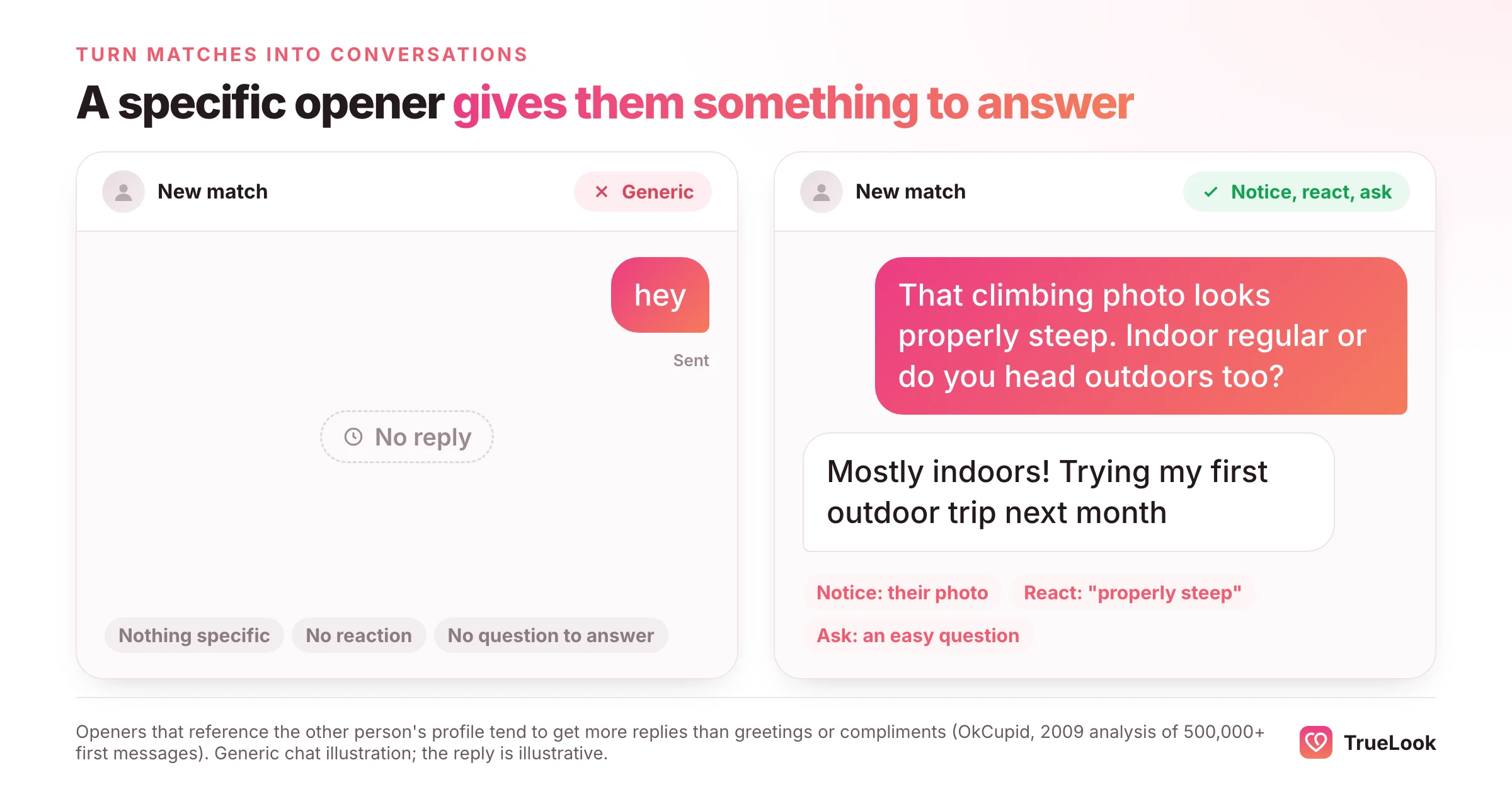
The best-known data on first messages comes from OkCupid's 2009 analysis of more than 500,000 first contacts, "Exactly What To Say In A First Message" (archived copy). It found physical compliments were poorly received, that mentioning specific interests did better, and that referring to something in the other person's profile worked better still. The app has changed; human nature has not.
A simple opener formula
- Notice: one specific thing from their photos or bio.
- React: a short, genuine reaction or a light joke.
- Ask: an easy, open question.
Illustrative examples: "That climbing photo looks properly steep. Indoor regular or do you head outdoors too?" or "Your bio says your tomatoes are winning. What are they beating, exactly?" Each takes ten seconds to write and is impossible to send to anyone else.
After that, keep messages short, ask about them as much as you talk about yourself, and suggest meeting or a call once you have had a real back-and-forth. Long pen-pal chains tend to fizzle.
Paid features: what they do and when they pay off
Paid features change how many people see you or how you are presented. They do not change how people react to your photos. That is why the order matters: fix the free basics first, then pay only to amplify something that already works.
| Feature | What Tinder says it does | Worth it when |
|---|---|---|
| Boost | Makes you one of the top profiles in your area for 30 minutes, with up to 10 times more profile views, according to Tinder's Boost help article | Your likes count already responds well to your current photos, and you use it in a busy evening slot |
| Super Boost | Up to 100 times more views, per Tinder's help page, which also says these features do not guarantee a match | Rarely; only on a proven profile at a peak time |
| Super Like | Lets someone know you liked them before they swipe; at launch in 2015, TechCrunch reported Tinder's Australian beta data showing three times the chance of a match | Sparingly, for profiles you have a genuine reason to message |
| Subscriptions | Features such as seeing who liked you and more likes; Gold and Platinum include a monthly Boost on longer plans | You already get likes and want to save time sorting them |
Features and prices change and vary by country, so check what your app shows before buying. A good rule of thumb: if your likes count would not impress you, a Boost will only show that same profile to more people in half an hour.
A fourteen-day plan
Here is the playbook as a schedule. It changes one thing at a time so you can see what worked. Keep a note of your likes count and matches each evening.
| Days | Focus | Actions | What to watch |
|---|---|---|---|
| Day 1 | Baseline and visibility | Note your current likes count; check Discovery, location and that you can send Likes | Starting numbers |
| Days 2 to 3 | Shoot | Two locations, two outfits, golden hour or overcast light; aim for 40 to 60 frames | Enough candidates for every slot |
| Day 4 | Choose | Run the friend panel; pick a lead photo and five supporting shots | Agreement between friends |
| Day 5 | New lead photo only | Swap in the new first photo; keep everything else the same | Likes count over the next days |
| Days 5 to 8 | Habits | Short daily sessions, selective likes, replies within a day | Likes per day versus baseline |
| Day 9 | Rest of the set | Replace the weakest supporting photos with the new ones | Matches per 100 likes sent |
| Day 10 | Bio and extras | Rewrite the bio with detail, angle and hook; fill in interests and goals; verify | Openers from matches |
| Days 11 to 14 | Conversations | Use the notice-react-ask opener on every new match | Share of matches reaching three or more messages |
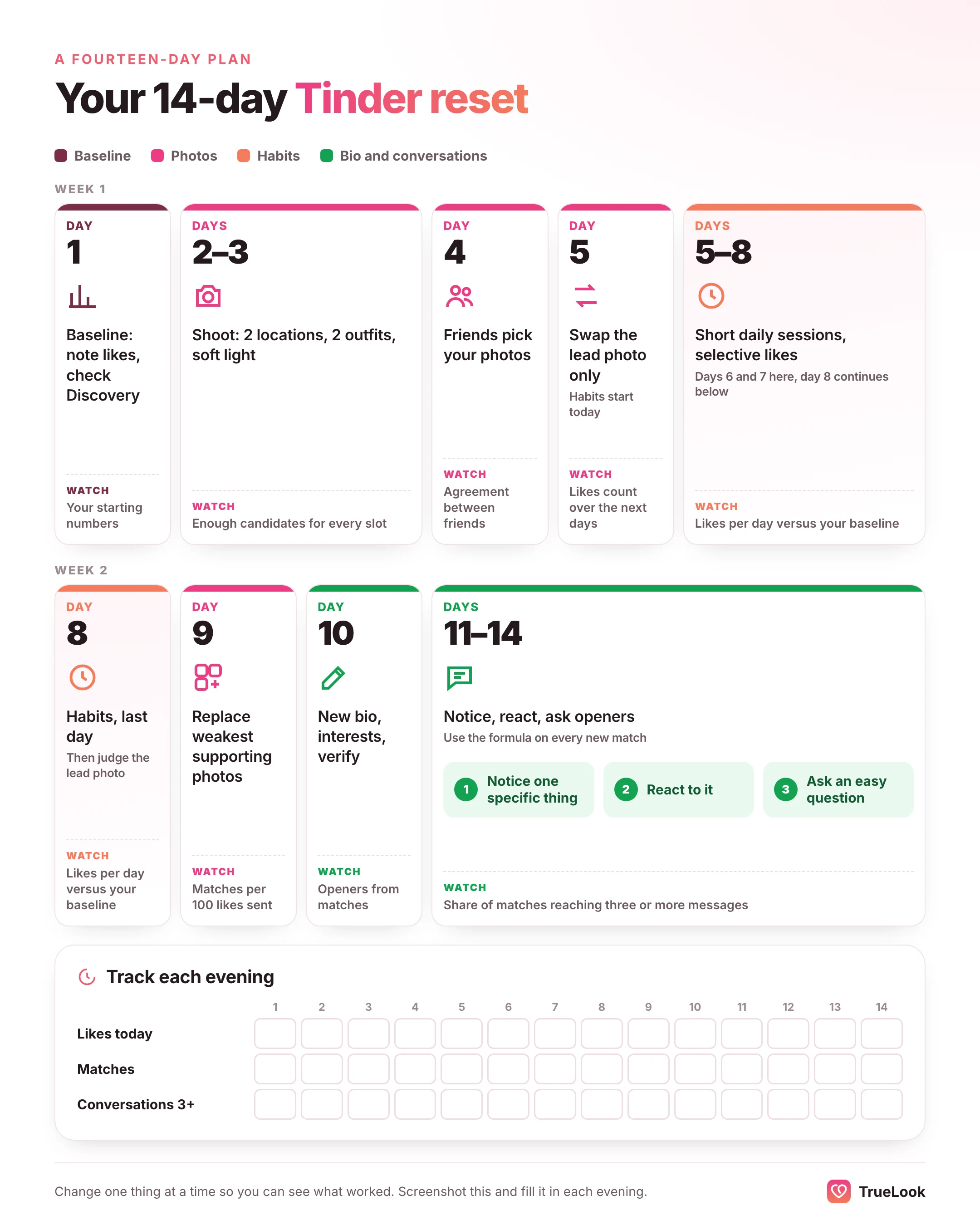
At the end of two weeks, compare your daily likes and your matches per 100 likes sent with day one. If one change clearly helped, keep going in that direction. If nothing moved after a much stronger lead photo, revisit the diagnosis, because something may be limiting who sees you.
Myths and facts about getting more matches
| Myth | What the evidence says |
|---|---|
| "Men should look serious and mysterious." | Photofeeler's 2026 data found smiling raised men's trustworthiness ratings on every measure, and unsmiling eye contact was the one combination that hurt in its replication study. |
| "More photos are always better." | Variety helps, as the Tyson experiment showed, but a weak extra photo dilutes a strong set. Six good photos beat nine mixed ones. |
| "A long bio shows effort." | Tinder recommends 15 to 45 words, and in SwipeStats' data men with short bios matched more often than men with long ones. |
| "Like everyone and filter later." | Indiscriminate swipers match at lower rates in self-reported data, and Tinder says your likes and nopes shape what it shows you. |
| "Paying is the fastest fix." | Tinder says Boosts raise views, not matches. More views of a profile people do not like produces more left swipes. |
| "Delete and restart to get a fresh boost." | Tinder does not document any reset benefit, and you lose your matches. Improve the profile you have; our no-matches guide covers when a restart might make sense. |
What this playbook cannot do
Good advice should say where it stops working.
- It cannot change the ratio. Pew's 2023 findings show men are somewhat more likely than women to have used dating apps (34% versus 27% of US adults), and 64% of men who used them recently said they had felt insecure about how few messages they received. Better photos improve your odds; they do not remove the imbalance.
- It cannot conjure a pool. In a small town, a great profile may still produce only a handful of matches a week because there are only so many people nearby.
- It cannot guarantee results on any one day. Swipe volume varies, and a week is the shortest fair test of any change.
- It cannot make an app fit you. If your age group or goals are poorly represented on Tinder, another app may suit you better. Our guides to the best Hinge profile pictures and the best dating apps for over 40 are good next stops.
What it can do is make sure that, every time someone in your area sees your card, they see the clearest, warmest and most honest version of you, with an easy reason to start talking. Over a few weeks, that is what moves the numbers.
Frequently asked questions
How do I get more matches on Tinder for free?
Replace your first photo with a clear, smiling, naturally lit solo portrait; build a varied set of five or six recent photos, chosen with help from friends; write a 15 to 45 word bio with one specific hook; verify your profile; and use the app in short, regular sessions while liking only people you would message. None of this costs anything.
How do I get matches on Tinder as a guy?
Start with photos: swap selfies and sunglasses for photos taken from a little distance in soft light, smile, and add a full-body shot and an activity photo. Then write a short, specific bio, swipe selectively, and send openers that reference something in her profile. Men typically match with around 1 to 2% of the profiles they like, so improvements show up as a gradual climb.
How many matches should a guy get on Tinder?
There is no official benchmark. A 2016 study measured a 0.6% match rate for male test profiles, and a self-uploaded dataset from 2020 to 2025 puts the median man at about 2% of profiles liked, so a few matches a week is common. Track your own matches per 100 likes and aim to improve that number rather than chase someone else's.
Does Tinder Boost actually work?
A Boost makes you one of the top profiles in your area for 30 minutes, and Tinder says it can bring up to ten times more profile views. Tinder also says it does not guarantee matches. It works best on a profile whose photos already earn likes, used at a busy time such as an evening.
What is the best time to use Tinder?
Tinder says it prioritises people who are active at the same time, so regular short sessions matter more than a perfect hour. Evenings and weekends are busy because that is when people have free time, and Tinder reports its busiest day is the first Sunday of January.
How many photos should I have on Tinder?
Five or six strong, varied photos is a good target: a lead portrait, a full-body shot, an activity, one social photo, a conversation starter and a dressed-up or second portrait. Add more only if each extra photo is as strong as the rest.
Does Photo Verification get you more matches?
Tinder's own 2023 research reported a 10% extra chance of meeting someone for members aged 18 to 25 with a verified photo. The badge shows people you match your photos, and verification takes only a few minutes, so it is worth doing.
What should I write in my Tinder bio?
Aim for 15 to 45 words with one specific detail about your life, a hint of personality and an easy question to reply to. Add what you are looking for if you know. Avoid lists of adjectives, clichés, rules and typos.
Sources
- A First Look at User Activity on Tinder, Tyson, Perta, Haddadi and Seto, arXiv (2016). https://arxiv.org/abs/1607.01952
- Tinder Statistics 2020-2025: The Complete Data Analysis, SwipeStats (2025, updated 2026). https://www.swipestats.io/blog/tinder-statistics
- The Science of Smiling in Photos: How Different Expressions Impact First Impressions, Photofeeler (2026). https://blog.photofeeler.com/the-science-of-smiles/
- OkCupid is Wrong About Men's Dating Photos, and We Replicated Their Study to Prove It, Photofeeler (2017, updated 2020). https://blog.photofeeler.com/?p=1904
- How Tiny Differences Can Affect Photofeeler Scores, Photofeeler (2024). https://blog.photofeeler.com/how-tiny-differences-can-affect-photofeeler-scores/
- What is golden hour?, Adobe. https://www.adobe.com/creativecloud/photography/discover/golden-hour
- Choosing face: The curse of self in profile image selection, White, Sutherland and Burton, Cognitive Research: Principles and Implications (2017). https://pubmed.ncbi.nlm.nih.gov/28470036/
- Tinder's new Smart Photos show just how well the app knows you, TechCrunch (2016). https://techcrunch.com/2016/10/13/tinders-new-smart-photos-show-just-how-well-the-app-knows-you/
- Should I Use Tinder Smart Photos? How Does It Work?, Photofeeler (2022). https://blog.photofeeler.com/tinder-smart-photos-photo-rating-ranking/
- Tinder's new AI tool helps users choose pictures that are most likely to get matches, Scripps News. https://www.scrippsnews.com/science-and-tech/artificial-intelligence/tinders-new-ai-tool-helps-users-choose-pictures-that-are-most-likely-to-get-matches
- Tinder study on the ideal bio (press release, in French), Tinder Newsroom France (2023). https://fr.tinderpressroom.com/news?item=122584
- Powering Tinder: The Method Behind Our Matching, Tinder Newsroom (2019, updated 2022). https://www.tinderpressroom.com/powering-tinder-r-the-method-behind-our-matching
- Photo Verification, Tinder Help Center. https://www.help.tinder.com/hc/en-us/articles/360034941812-Photo-Verification
- Update your Discovery preferences, Tinder Help Center. https://www.help.tinder.com/hc/en-us/articles/115003340963-Discovery-Settings
- Aspirational pursuit of mates in online dating markets, Bruch and Newman, Science Advances (2018). https://pubmed.ncbi.nlm.nih.gov/30101188/
- What is "Dating Sunday"? The busiest day of the year on dating apps, NBC (2025). https://www.nbcmiami.com/news/national-international/dating-sunday-busiest-day-dating-apps/3506620/
- Exactly What To Say In A First Message, OkCupid OkTrends (2009), archived copy. https://gwern.net/doc/psychology/okcupid/exactlywhattosayinafirstmessage.html
- What is Boost?, Tinder Help Center. https://www.help.tinder.com/hc/en-us/articles/115004506186
- Used Boost or Super Boost, and didn't get any new matches, Tinder Help Center. https://www.help.tinder.com/hc/en-us/articles/115003638126-Used-Boost-or-Super-Boost-and-didn-t-get-any-new-matches
- Tinder's Super Like rolls out globally, TechCrunch (2015). https://techcrunch.com/2015/10/01/tinders-super-like-rolls-out-globally/
- Key findings about online dating in the U.S., Pew Research Center (2023). https://www.pewresearch.org/short-reads/2023/02/02/key-findings-about-online-dating-in-the-u-s/
Get better dating photos from your own selfies
TrueLook’s HyperReal™ method turns 4 selfies into hyperrealistic photos of you for Tinder, Hinge and Bumble.
AI Tinder photos made from your selfies
Written by the TrueLook Team
TrueLook makes hyperrealistic dating photos from your own selfies. Our articles cover dating profile photos, the apps and how to get noticed.