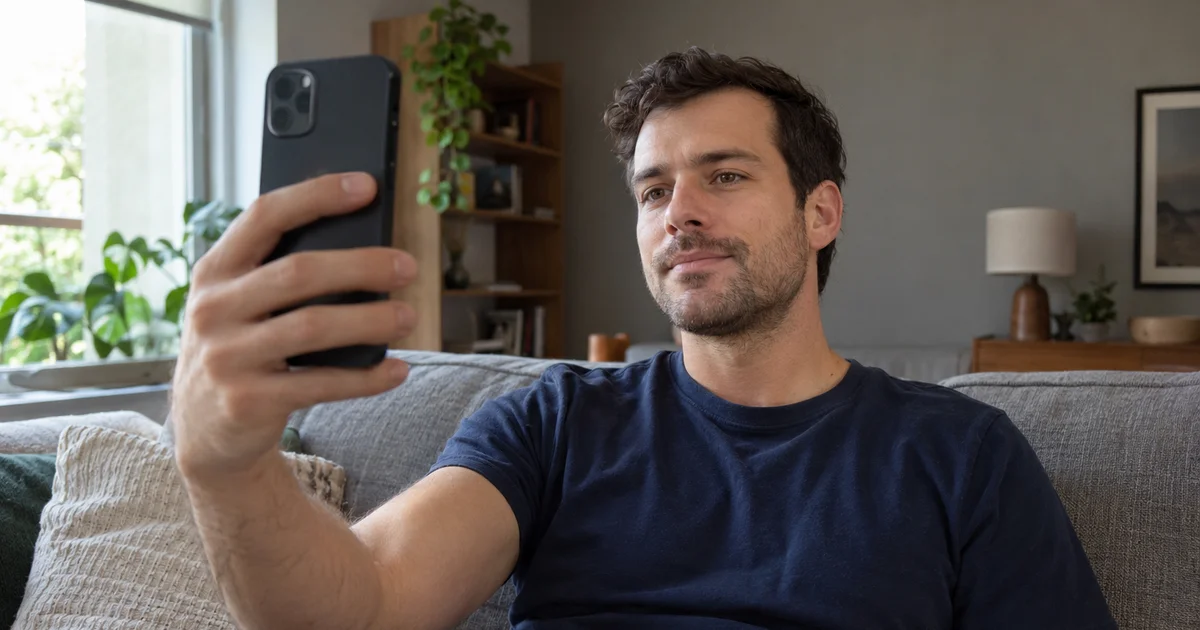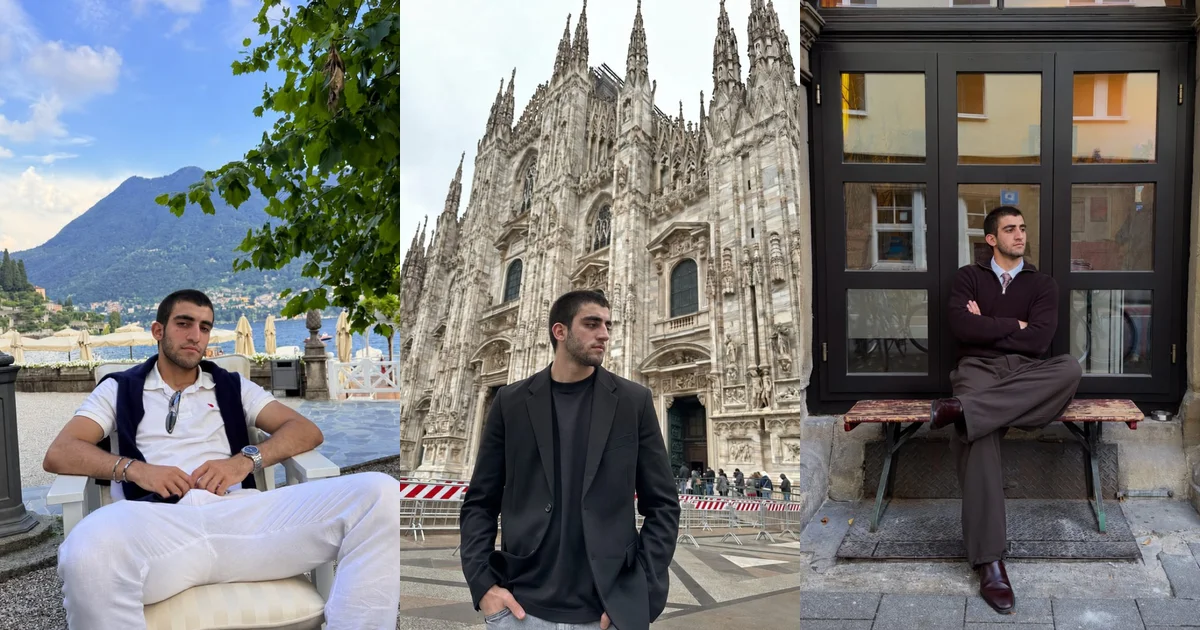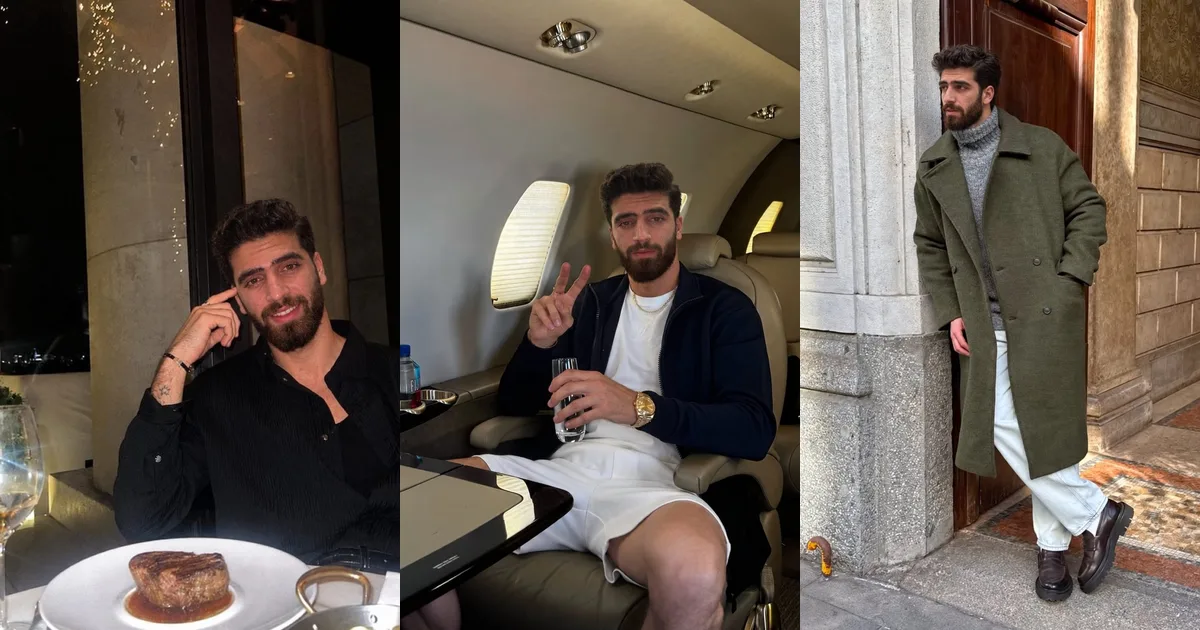
The best AI photo generator for Tinder is one that produces casual, phone-style photos of your actual face, because Tinder judges you mostly on a single swipe card and, for new users in many regions, compares your profile photos with a live video selfie. Look for exact likeness, realistic everyday lighting, enough scene variety to fill several distinct photo slots, and privacy terms you can find and understand. Dating-focused tools such as TrueLook, TinderProfile.ai, DatePhotos.AI and Fotto.ai fit Tinder better than LinkedIn headshot generators, whose polished studio look tends to stand out on a swipe card for the wrong reasons.
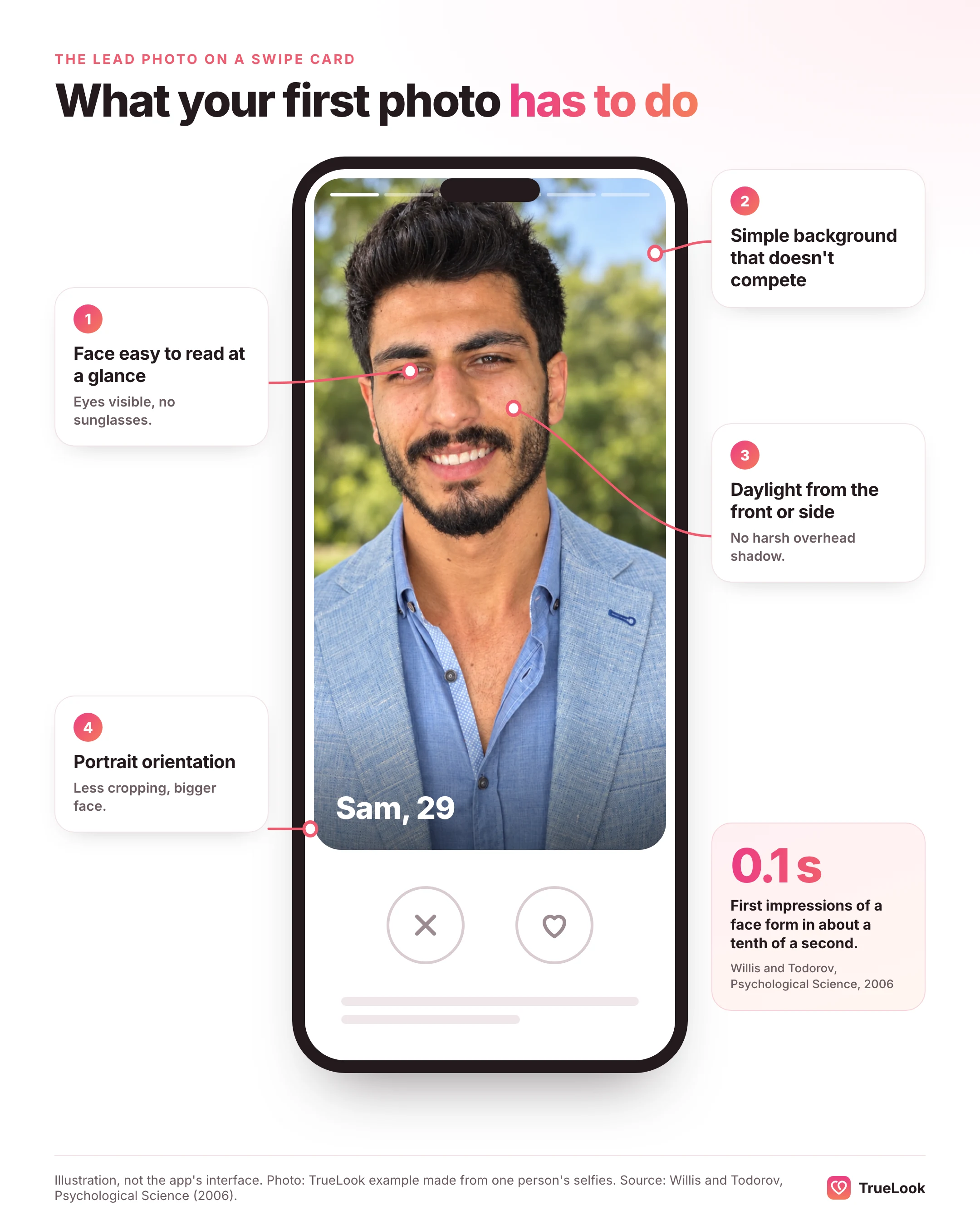
- Tinder is a first-photo app. A classic 2006 study found people form judgments of attractiveness and trustworthiness from a face in a tenth of a second, and a Tinder card puts one photo in front of that snap decision.
- Face Check changes what "good" means. Since October 2025, Tinder has required many new users to record a video selfie that is compared with their profile photos. Any generator that subtly reshapes your face is working against you.
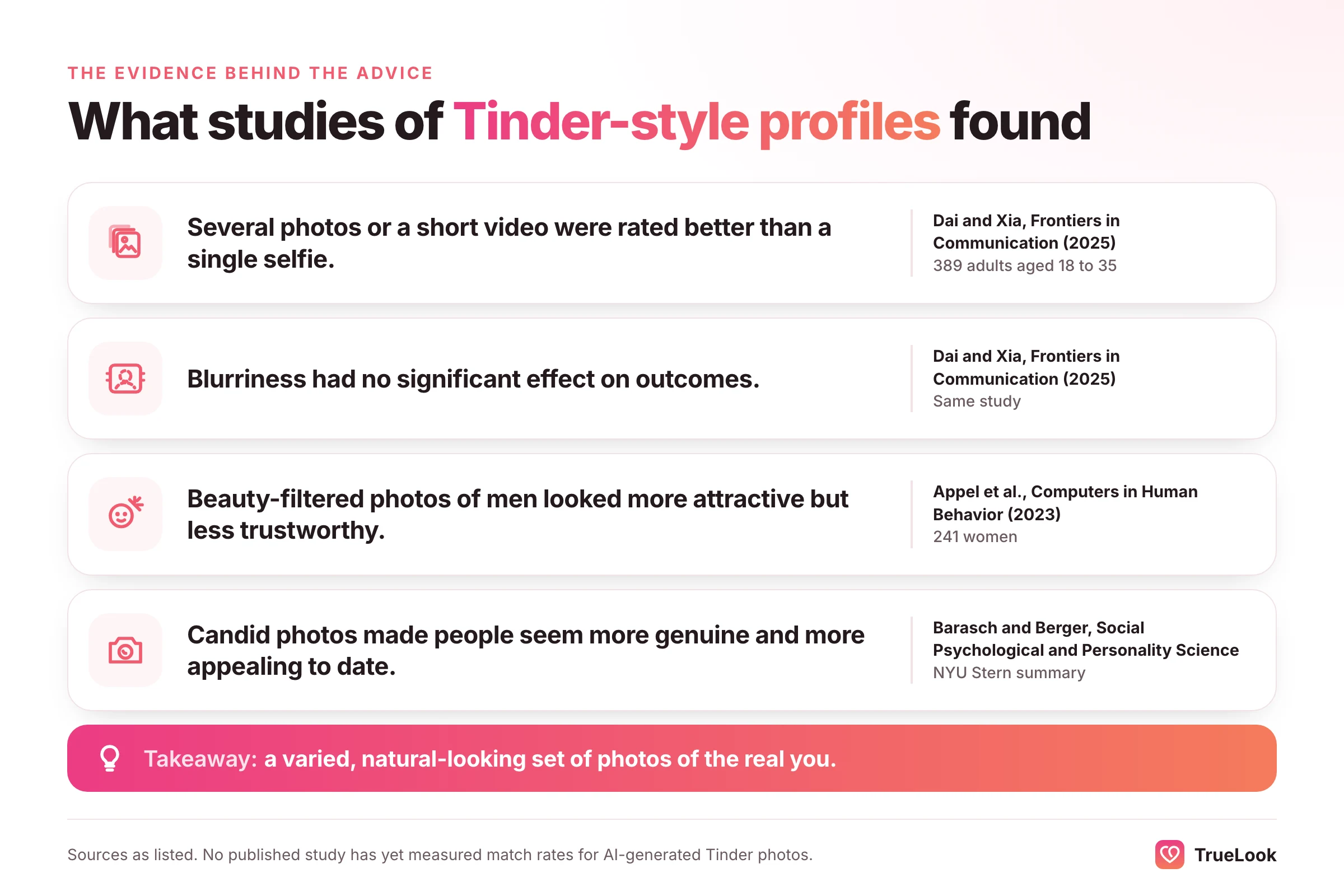
- Edits cut both ways. In a 2023 experiment, beauty-filtered photos of men on Tinder-style profiles looked more attractive but less trustworthy to the women rating them.
- Variety beats volume. A 2025 Frontiers in Communication experiment found Tinder-style profiles with several pictures or a video were rated better than a single selfie. Five or six distinct photos do more than a stack of near-copies.
- Tinder's own tools reward a varied set. Smart Photos rotates your lead photo and Photo Selector suggests shots from your camera roll; both work best with real options to choose between.
- Candid beats posed. Research from NYU and Wharton found candid-looking photos made people seem more genuine and more appealing to date.
- Keep one real photo, verify in good light looking the way you do in your pictures, and choose a pricing model that matches how often you will refresh your profile.
This guide is the Tinder-specific companion to our broader roundup of the best AI dating photo generators. It covers what makes Tinder different, how Face Check works and what it means for generated photos, what the research says about Tinder-style profiles, how the main tools compare on their own stated prices and features, and how to build and test a Tinder lineup from the results. All vendor details were checked on each company's own site on 2 November 2026. There are no invented scores or rankings.
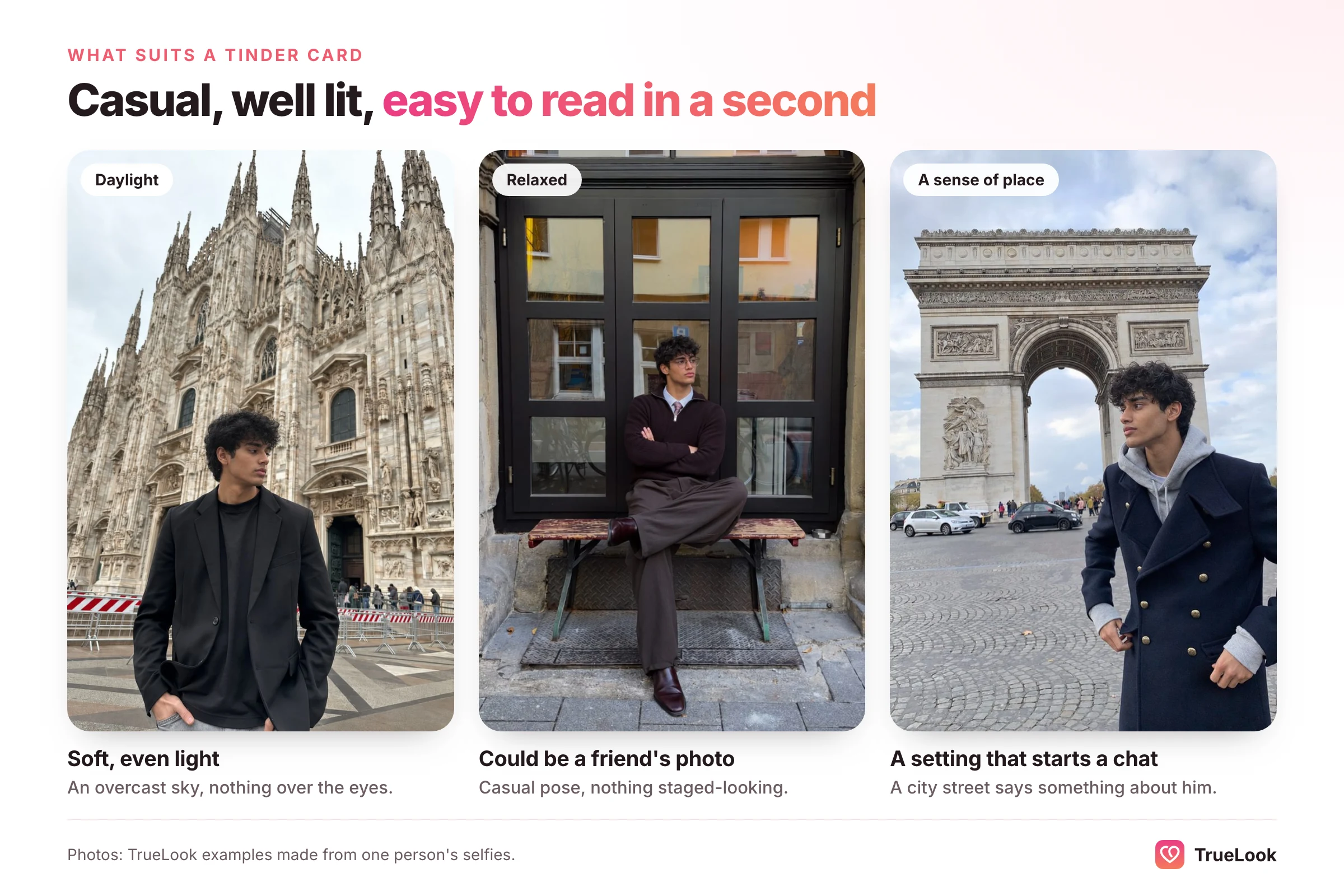
Why Tinder needs a different kind of AI photo
On Hinge, people scroll through photos and prompts together and can like one specific picture. On Bumble, the profile reads more like a page. On Tinder, most people see a single photo on a card, with your name and age over it, and decide in a moment. That one design choice shapes everything you should want from an AI photo tool.
One photo carries the first impression
Faces are judged fast. In a 2006 study in Psychological Science, Janine Willis and Alexander Todorov found that a 100-millisecond look at a face was enough for people to form judgments of attractiveness, likeability, trustworthiness, competence and aggressiveness that closely matched their judgments with unlimited time. Extra viewing time mostly made people more confident, not more accurate. On a swipe card, that means your lead photo needs to communicate clearly at a glance: a well-lit face, a natural expression and a background that doesn't compete.
The swipe economy is lopsided
Tinder works differently for men and women. In "A First Look at User Activity on Tinder", Gareth Tyson and colleagues found that women attain large numbers of matches rapidly while men accumulate matches slowly. Their survey data also suggested that modest effort on a profile, especially for men, substantially increases the attention it receives. That is the realistic case for better photos: not a miracle, but a meaningful edge in a crowded queue.
The ranking system reacts to how people respond
Tinder retired its old Elo-style desirability score years ago. In its own explainer on matching, last updated in 2022, Tinder calls Elo "old news" and says its system now considers how members engage through likes and nopes, profile content, how active you are and how close you are. In plain terms, photos that people respond to help, but there is no secret score that AI photos raise or lower by themselves. Being active matters too.
Smart Photos tests your order for you
Tinder's Smart Photos setting rotates which picture appears first, records how people react, and moves the strongest photo to the front. When Tinder introduced Smart Photos in 2016, it reported up to a 12% increase in matches in testing. The photo-testing service Photofeeler has criticized the feature for drawing conclusions from small numbers of right swipes, which are scarce for many men, and for testing whole profiles rather than single photos. Both points lead to the same advice: Smart Photos can only pick between real alternatives, so give it a varied set of strong photos rather than five versions of the same pose.
Photo Selector picks from your camera roll
In July 2024 Tinder launched Photo Selector in the US. As TechCrunch reported, you take a selfie, the app builds a facial profile, finds your face in your camera roll and suggests ten photos based on criteria such as lighting and composition, favoring solo shots over group photos. Tinder cited its own survey in which 52% of participants said they had trouble choosing profile photos. Photo Selector only helps if good photos already exist on your phone. AI generators address the other problem: having no suitable photos at all.
Face Check compares your photos with you
The biggest change is verification, covered in detail in the next section. In short: for many new users, Tinder now records a video selfie and checks that the face in it matches the faces in your profile photos.
Face Check and AI photos: what Tinder actually compares
Match Group announced in October 2025 that Face Check, already mandatory for new Tinder users in seven countries and California, would expand to more US states, with other Match Group apps to follow in 2026. New members record a short video selfie in the app. The system checks that the person is real and physically present, that their face matches their profile photos, and whether the same face appears across multiple accounts. Members who pass get Tinder's Photo Verified badge. Match Group reported more than a 60% drop in exposure to potential bad actors and more than a 40% drop in bad actor reports, figures it attributed to Face Check together with other safety measures. TechCrunch's coverage describes the check as building a 3D scan of the face for comparison.
Tinder's FAQ on the mandatory liveness check adds the technical detail. The video is checked to confirm it shows a real, live person and was not digitally altered. The system then detects your face in the video and in your profile photos and compares them. It builds a "FaceMap" from your facial geometry and a "FaceVector", a number derived from it that is compared across accounts. The video itself is deleted promptly; the FaceMap and FaceVector are kept for the life of your account and deleted within 30 days of closing it, and two audit images from the video are retained for longer. To earn the Photo Verified badge, you need a clear solo face photo that matches the face in your video selfie.
| What Face Check looks at | What it means for AI photos |
|---|---|
| Is the video selfie a real, live, unaltered person? | Nothing to do with your photos; just record it honestly in good light |
| Does the face in the video match the faces in your profile photos? | Any result that reshapes your jaw, nose, eyes or proportions is a liability, however flattering |
| Does the same face appear on other accounts? | Irrelevant if you have one account and the photos are of you |
| Is there a clear solo photo of your face, for the badge? | Make sure at least one photo shows your face clearly, alone, without sunglasses or heavy shadow |
Two honest caveats. First, Tinder doesn't publish thresholds or say how it treats generated images specifically, so no photo tool can promise a pass, and none of the claims you will see on vendor sites change that. Second, the rule underneath is simple and long-standing: Tinder's community guidelines tell members not to create a fake account or pretend to be someone they're not. The safest AI photo is one that a face-matching system and your friends would both recognize as you. If a check has already failed, our guide to failed Tinder photo verification walks through the common causes, and are AI photos allowed on dating apps covers the policy side across apps.
What the research says about Tinder-style photos
No published study has yet measured match rates for AI-generated Tinder photos. The research below is about the qualities AI tools change, which is what you are really choosing between.
Several photos beat one; blur matters less than you think
In a 2025 experiment published in Frontiers in Communication, Mu Dai and Shuyang Xia showed 389 adults aged 18 to 35 Tinder-style profiles in ten versions: a single selfie, several pictures, a short video loop, a blurry selfie and a beautified selfie, for both a man and a woman. Profiles with several pictures or a video generally scored better than the single selfie. Blurriness had no significant effect on the outcomes, and beautification improved ratings of the woman's profile but not the man's. The study was small and the authors note limitations, but the direction is useful: a varied set of photos is worth more than one polished image, and heavy beautification is not a reliable win, especially for men.
Filters can raise attractiveness and cost trust
A 2023 experiment in Computers in Human Behavior by Markus Appel and colleagues, reported by PsyPost, edited photos of young men with FaceApp and showed them to 241 women in Tinder-style profiles. Edited photos raised physical attractiveness and dating intention but lowered perceived trustworthiness. A generator that idealizes your face applies a stronger version of the same trade-off, and the trust cost tends to arrive at the worst moment: when you meet.
Candid-looking photos feel more genuine
Alixandra Barasch of NYU Stern and Jonah Berger of Wharton ran five experiments on candid versus posed photos, published in Social Psychological and Personality Science. As NYU Stern summarizes, observers were more interested in dating or befriending people shown in candid photos, because candid shots made them seem more genuine. The advantage shrank when viewers learned the person knew the photo was being taken. On LinkedIn, by contrast, posed photos did better. That is the clearest argument for choosing AI scenes that look caught in the moment rather than staged for a camera.
Daters are watching for fakes
In October 2026, CBS MoneyWatch described women who now look specifically for "AI-free photos" and skip profiles with signs of generation. One example was a profile photo of a man in a suit tiling a bathroom wall: a scene that made no sense. Incongruity, not image quality, is often what gives a generated photo away.
What to look for in an AI Tinder photo generator
Use this checklist before paying. The first three items decide whether a tool is usable on Tinder at all; the rest decide whether it is the right fit for you.
| Feature | Why it matters on Tinder | How to check before paying |
|---|---|---|
| Exact likeness | Face Check compares your photos with a video of you, and matches compare them with you in person | Look for sample sets shown next to the person's real selfies, and a refund if results don't look like you |
| Casual, phone-style realism | Candid photos read as more genuine; studio gloss stands out on a swipe card | Check whether samples look like friends' photos or magazine shoots |
| A clear solo close-up | Your lead photo and the Photo Verified badge both need one | Make sure the tool offers close or medium shots, not only wide scenes |
| Scene range across slots | Smart Photos and viewers need distinct options: outdoors, full length, evening, activity | Count the scene types that fit your actual life |
| Control over scenes | Fewer unusable results and fewer scenes you can't talk about | See whether you pick scenes, write prompts, or receive a fixed set |
| Readable privacy terms | You are uploading your face | Find statements on training, retention and deletion |
| A pricing model that fits | One refresh and a profile you will keep testing need different plans | Compare cost per photo you would actually post |
Tinder-specific red flags
- Samples with no "before" photos. Without the original selfies, you can't judge likeness.
- Only glossy studio portraits. Tools built for LinkedIn rarely produce a convincing Tinder lead.
- Promises about verification or matches. Tinder makes those decisions, not a photo vendor.
- No information on what happens to uploads. If you can't find it, assume the worst.
AI Tinder photo tools compared
These are the prices, inputs, outputs and delivery times each company listed on its own site on 2 November 2026. They change often, so check the vendor's pricing page before buying. Our comparison of AI dating photo generators covers more tools in more depth.
| Tool | How you get photos | Selfies asked for | Listed price | Listed output | Stated turnaround |
|---|---|---|---|---|---|
| TrueLook | Pick from 43 styles, 4 shots each | 4 | $29 or $49 one-time | Up to 30 or 140 photos | About a minute per photo |
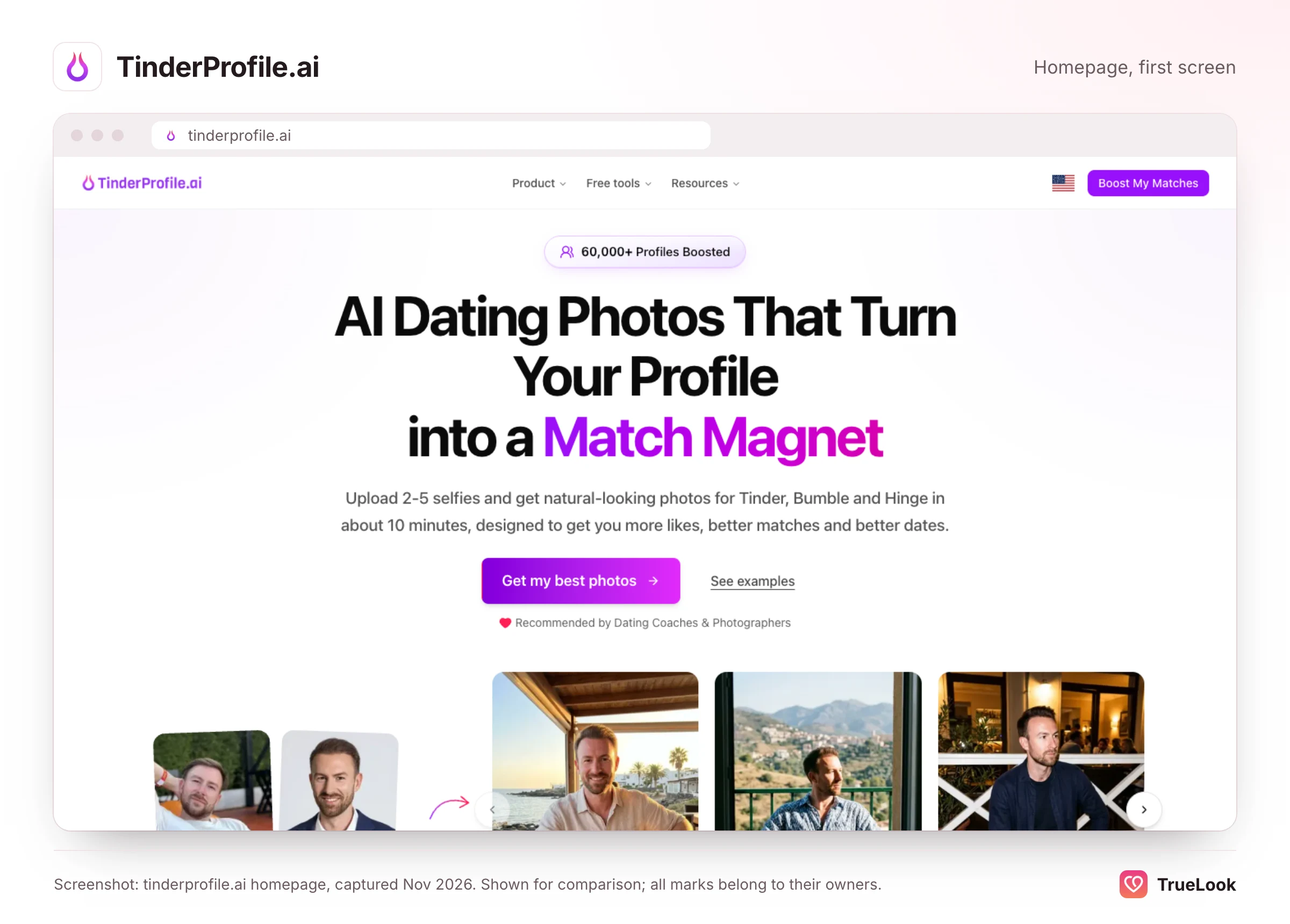
| TinderProfile.ai | Scene packs or your own text prompts | 2 to 5 | From $14 | 20 to 100 photos by package | About 10 minutes |
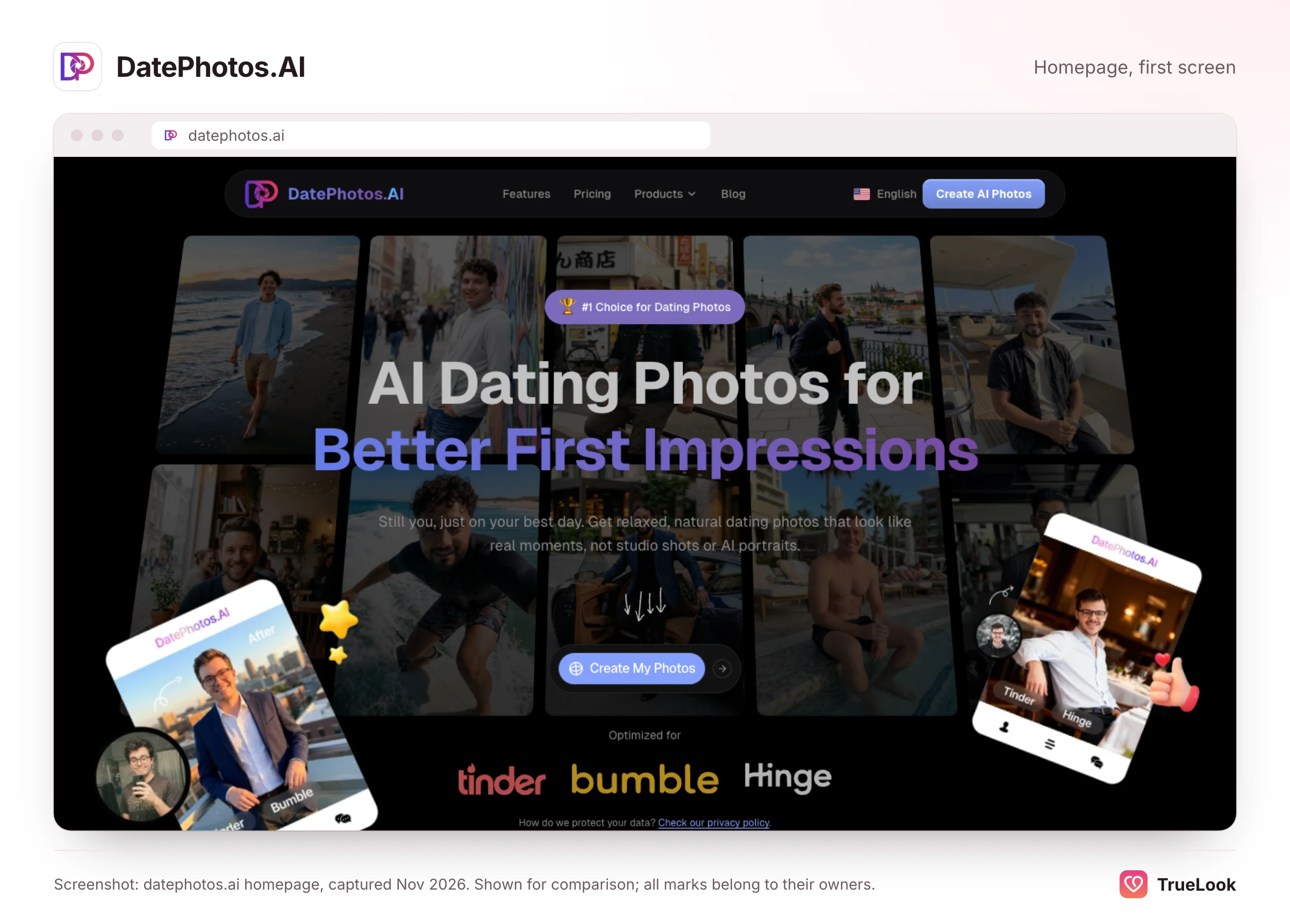
| DatePhotos.AI | Preset scenes, one batch | Not stated on homepage | $29, $49 or $79 one-time | 80 to 180 photos, 40+ scenes | 20 to 30 minutes |
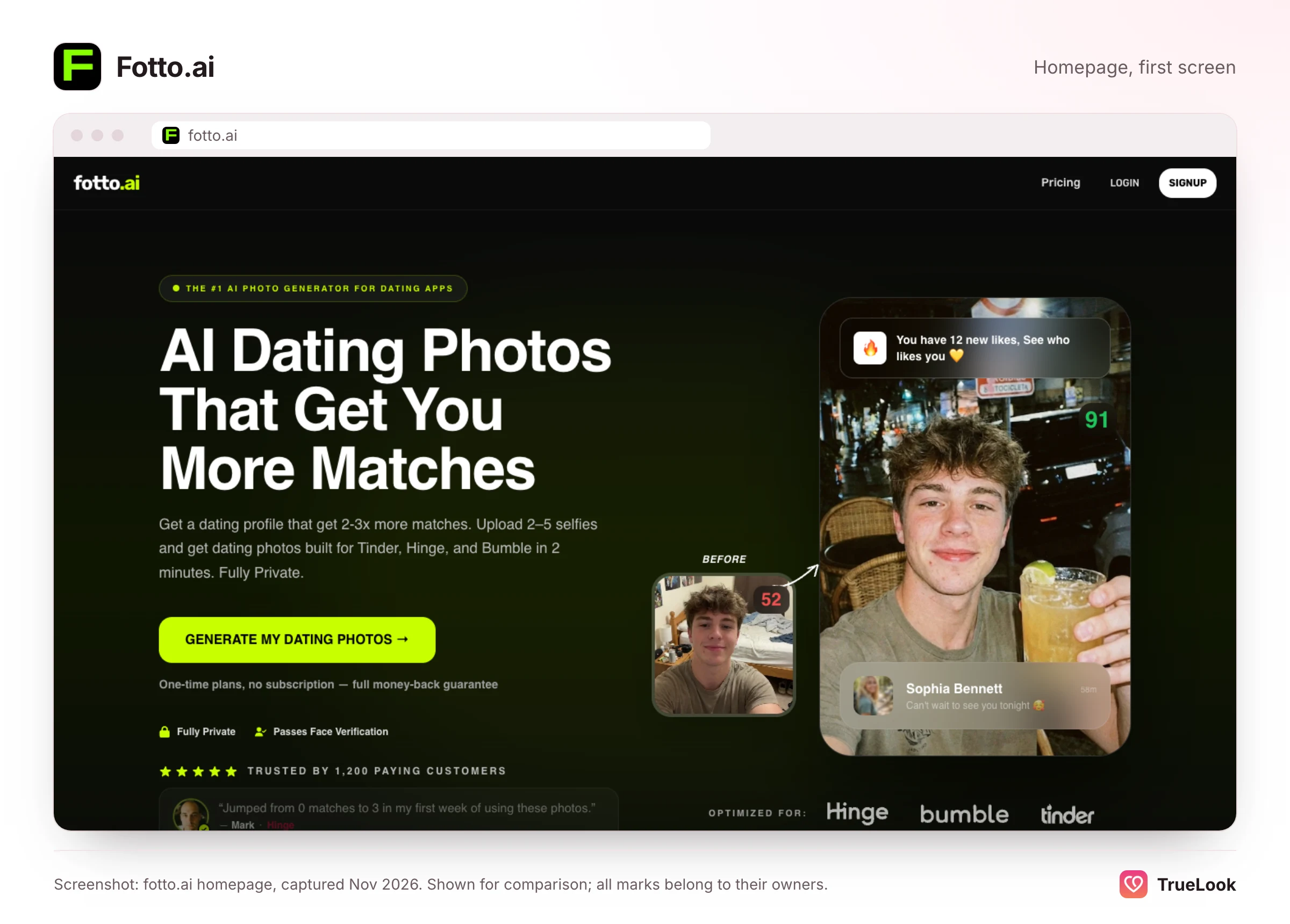
| Fotto.ai | Scene styles, one-time packs | Not stated on homepage | €27.59 or €45.99 one-time | 40 or 80 photos, 25 dating styles | 30 to 90 seconds per photo |
| DatingShoot | One large batch plus edit credits | Not stated on homepage | $69 one-time | 200+ photos plus 50 custom photo credits | About 2 hours on average |
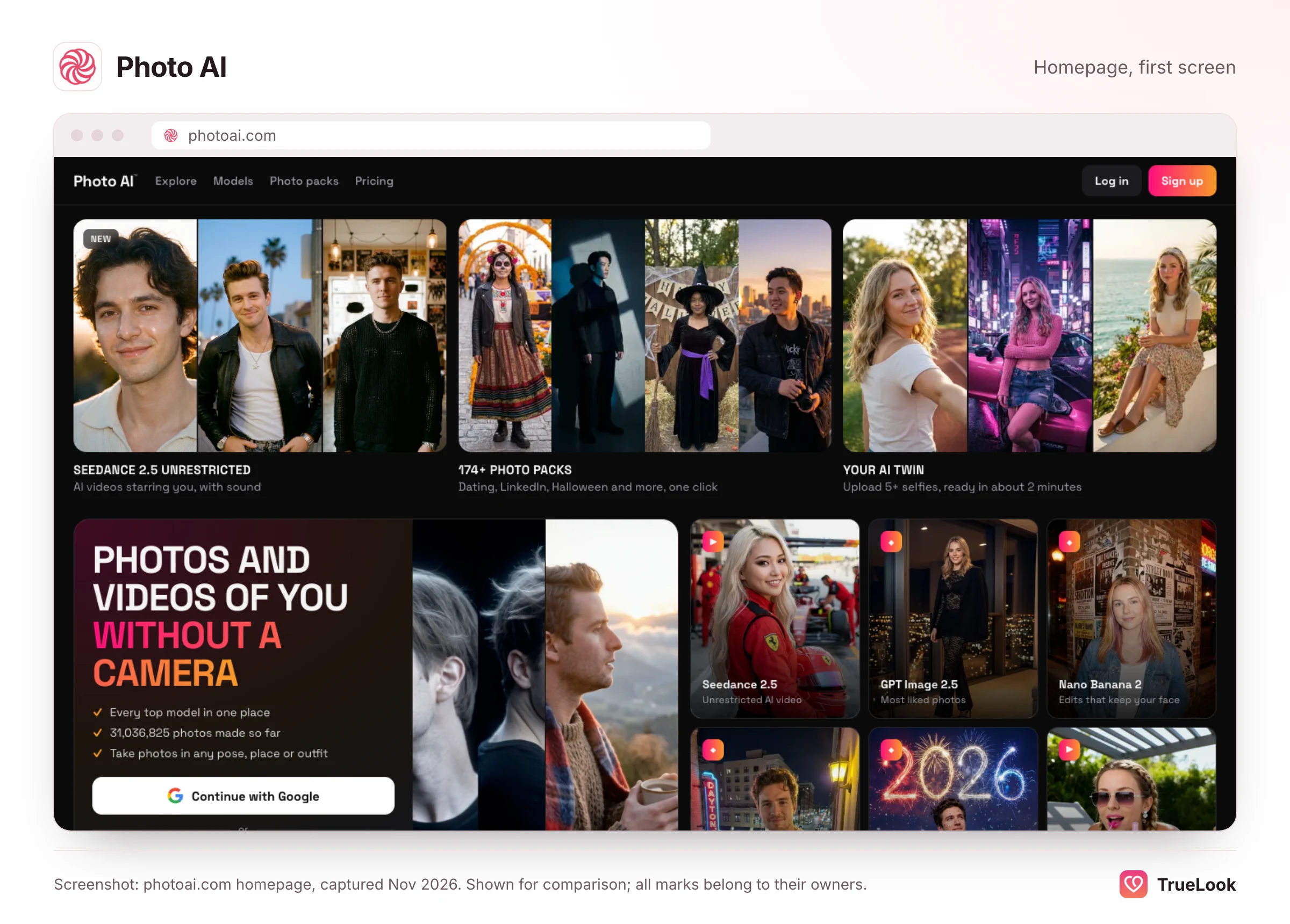
| Photo AI | General generator with dating packs | 5 or more | From $19 a month billed monthly, or $9 a month billed yearly | Credits; a 30-photo AI Dating pack | About 2 minutes to set up your model |
TrueLook
TrueLook builds AI Tinder photos from four of your selfies using its HyperReal™ method, which aims for the look of an ordinary phone photo rather than a studio portrait, while aiming to keep your features as they are. The Fix Pack is $29, paid once, for up to 30 photos; the Pro Pack is $49, paid once, for up to 140 photos. Both packs include all 43 styles, and each style gives you 4 different shots. Each photo takes about a minute, which suits Tinder's test-and-swap rhythm: make a lead photo, try it for a few days, make another. Your photos are never used for AI training, and a 14-day refund is available under the conditions on its refund page. As with any tool, the app decides on verification and matches. There is no subscription: you generate photo by photo until your pack's photos are used, then buy another pack or a one-time top-up if you want more. Someone who would rather get one big batch at once and sort it may prefer a batch tool.

TinderProfile.ai
TinderProfile.ai asks for two to five everyday photos and lets you choose curated scene packs (city, travel, sports and others) or write custom text prompts. At the time of writing, its site lists packages from $14 for 20 to 100 photos, editing of the results, delivery in about 10 minutes and a money-back guarantee. It says uploads are kept for up to 12 months after you last use a photoshoot and deleted within 48 hours if you delete your account. Prompts are flexible, but writing a good one requires knowing what a strong Tinder photo looks like. See TrueLook vs TinderProfile.ai.
DatePhotos.AI
DatePhotos.AI delivers a large batch across preset scenes. At the time of writing, its site lists one-time plans of $29, $49 and $79 for 80 to 180 photos in 20 to 30 minutes; its $49 plan is described as 120 photos across 35 scenes with a shortlist of 30 top picks. A big batch gives plenty to choose from for a Tinder lineup, but budget time for sorting and for cutting near-duplicates. It offers a 7-day money-back guarantee on a first order under its refund policy. See TrueLook vs DatePhotos.AI.
Fotto.ai
Fotto.ai sells one-time packs with credits its site says never expire: at the time of writing, €27.59 for 40 photos or €45.99 for 80, with 25 dating styles at 30 to 90 seconds per photo. Non-expiring credits suit someone who wants to generate a few photos now and come back later without a subscription. See TrueLook vs Fotto.ai.
DatingShoot
DatingShoot sells one large shoot aimed mainly at men. At the time of writing, its site lists $69 for more than 200 photos and 50 custom photo credits, with same-day delivery averaging about two hours, and a full refund any time before model training starts. See TrueLook vs DatingShoot.
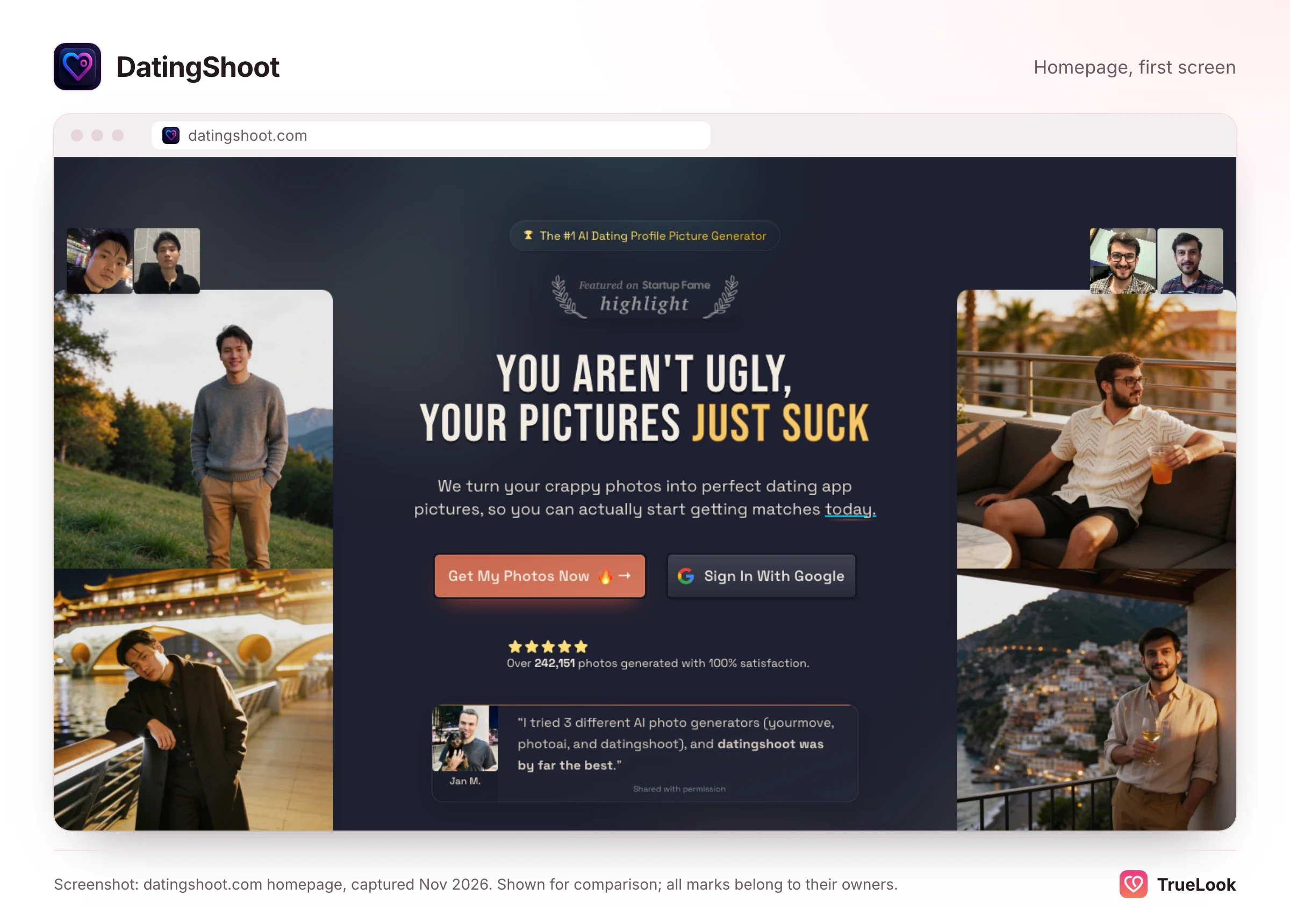
Photo AI
Photo AI is a general generator where dating is one pack among many. At the time of writing, it lists a 30-photo AI Dating pack, plans from $19 a month on monthly billing or $9 a month billed yearly, and pricing in credits rather than photos. It suits people who also want other kinds of AI imagery. See TrueLook vs Photo AI.
Headshot generators and creative suites
Aragon AI and HeadshotPro are built for professional headshots. Their output can make a decent dressed-up photo, but the studio lighting and neutral backdrops usually look stiff as a Tinder lead (TrueLook vs Aragon AI, TrueLook vs HeadshotPro). MagicShot is a broad creative suite whose credits are shared across many tools, with dating photos as one use of its photoshoot feature (TrueLook vs MagicShot).
Which tool fits which Tinder plan
| Your plan | Consider | Why |
|---|---|---|
| Test a new lead photo every few days and keep refining | TrueLook | A minute per photo, made one at a time from a one-time pack, suits iterative testing |
| Describe unusual scenes from your real hobbies | TinderProfile.ai | Custom prompts alongside scene packs |
| Get everything at once and sort it on a weekend | DatePhotos.AI or DatingShoot | Large one-time batches |
| Pay once and use credits whenever | Fotto.ai | Credits it says never expire |
How to build a Tinder lineup from AI photos
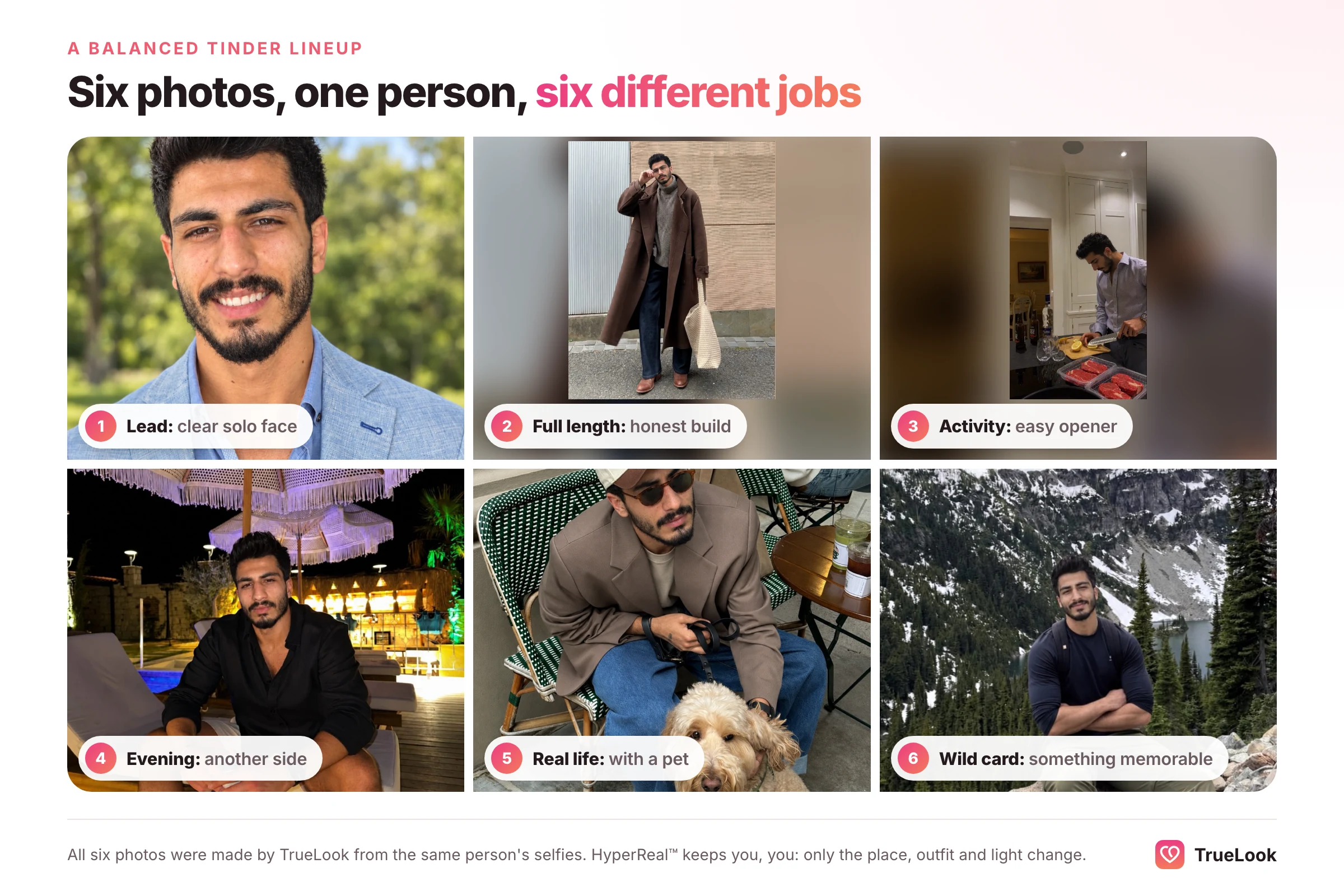
Tinder gives you more photo slots than most people have good pictures for. Fill them with a plan, not a quota: every photo should show something the others don't. Here is a slot-by-slot structure that works for most people.
| Slot | Its job | AI or real? | Good scenes | Avoid |
|---|---|---|---|---|
| 1. Lead | Win the snap judgment | Either; must be a clear solo face | Head and shoulders outdoors or by a window, natural smile | Sunglasses, hats, group shots, heavy shadow |
| 2. Full length | Show your build honestly | Either | Standing on a street, in a park, at a doorway | Extreme angles that change your proportions |
| 3. Activity | Give an easy opener | Best if it matches a real hobby | Cooking, climbing, cycling, playing music | Activities you have never done |
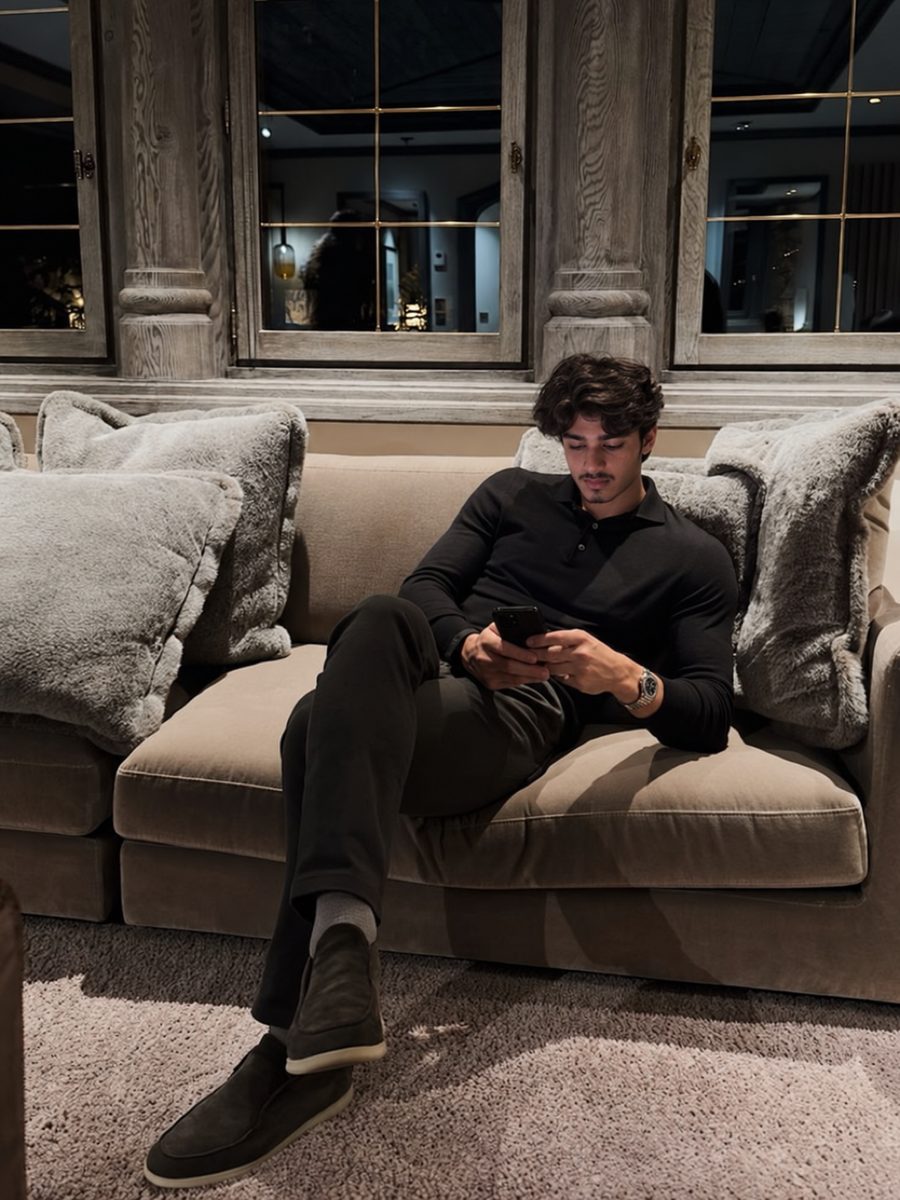
| 4. Evening or dressed up | Show another side of you | Either | Dinner, a bar terrace, a wedding-guest look | Corporate headshot lighting |
| 5. Social or real-life | Prove you exist off the app | Real photo strongly preferred | With friends (you clearly identifiable), with a pet | Group shots where nobody can tell which one is you |
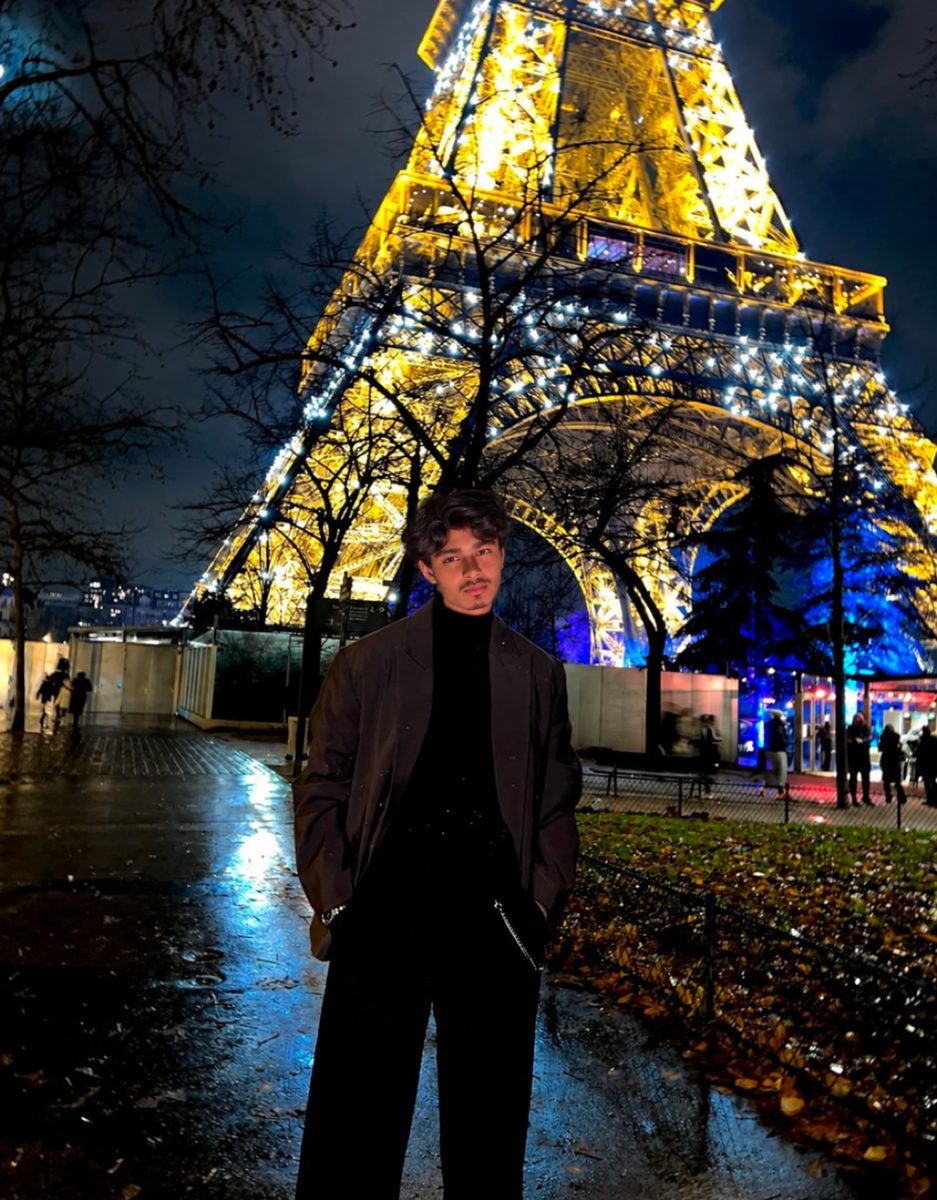
| 6. Wild card | Something specific and memorable | Either | A trip you took, a place you love | Landmarks you have never visited |
Worked example (illustrative)
Example profile: a 31-year-old nurse who works nights, hikes on days off and has almost no recent photos except gym-mirror selfies.
- Before: three mirror selfies in scrubs, one group photo from a wedding where he is third from the left, one photo from four years ago with longer hair.
- Plan: generate a lead close-up on a trail at golden hour, a full-length shot in a city park, a relaxed dinner photo, and a coffee-shop photo in a sweater. Keep the wedding photo but crop it so he is clearly the subject, and keep one recent real photo with a friend's dog.
- Cut: any result where his jaw looks sharper or his hair thicker than in his selfies; a generated rock-climbing shot, because he has never climbed; and two dinner photos in the same shirt.
- After: six photos, four generated and two real, each doing a different job, all recognizably him. The hiking lead gives an obvious opener ("Which trail is that?") that he can answer honestly.
Before and after: choosing the lead photo
| Before | Problem | After |
|---|---|---|
| Car selfie from below, sunglasses on | Distorted angle, eyes hidden, cramped background | Eye-level close-up outdoors, sunglasses off, soft daylight |
| Group photo at a festival | Viewer has to guess who you are | Solo medium shot, with the group photo moved to slot 5 |
| Studio-style AI headshot on grey | Looks like a LinkedIn profile on a dating card | Candid-style café or street photo with the same face and natural light |
| Glossy AI shot with flawless skin | Looks too good to be the person who turns up | A version with your real skin texture and features, even if slightly less polished |
A seven-day plan for launching AI photos on Tinder
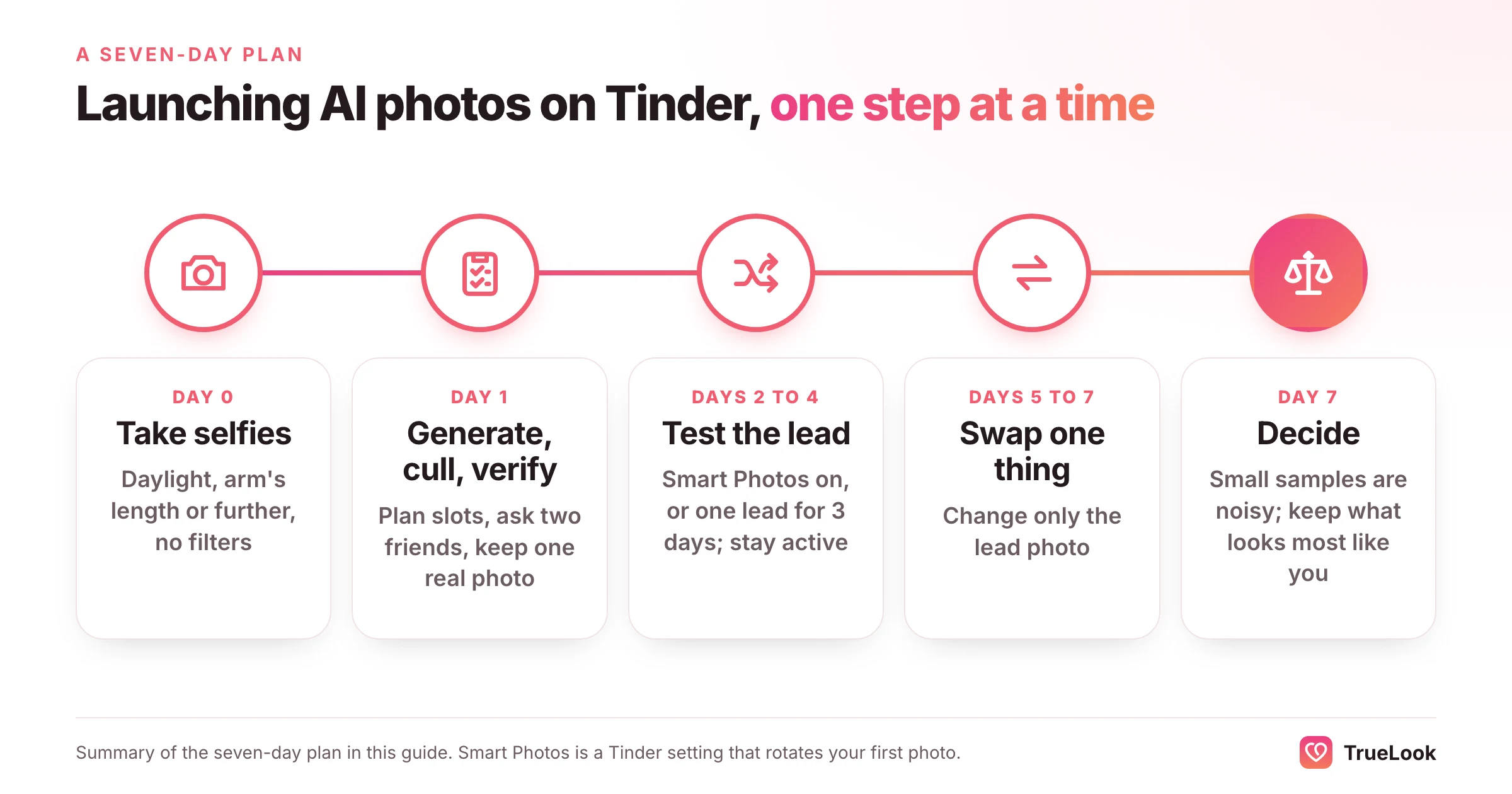
- Day 0: take your input selfies. Recent, sharp and unfiltered, in daylight, with your whole face and hairline in frame. Hold the phone at full arm's length or use the rear camera with a timer; very close selfies exaggerate the nose and narrow the face. Include straight-on and slightly turned angles, with a relaxed smile and a neutral expression.
- Day 1: generate against your slot plan. Make the lead close-up first, then the full-length shot, then the rest. Generate two or three options per slot rather than one of everything.
- Day 1: cull hard. Delete anything with altered features, odd hands, melted text, mismatched lighting, or a scene you couldn't talk about. Ask two friends to pick their favorite lead; research on profile photos shows other people often choose better than we do for ourselves.
- Day 1: update and verify. Upload the set, keep at least one real photo, and complete any Face Check or verification prompt in good, even light, looking the way you do in your photos.
- Days 2 to 4: let Smart Photos work, or test by hand. Turn Smart Photos on, or keep one lead for three days and note likes and matches. Be active during this time; Tinder says activity is one of the most important factors in who sees you.
- Days 5 to 7: swap one variable. Change only the lead photo and compare. Changing everything at once tells you nothing.
- Day 7: decide with humility. A handful of swipes is a small sample, as Photofeeler points out about Smart Photos. Treat small differences as noise and keep the photos that look most like you.
Tinder photo quality: size, sharpness and blur
Many people search for why their Tinder photos look blurry. Whether a photo is generated or real, most blur problems come from what happens to the file, not the camera.
- Upload originals. Download generated photos at full resolution and upload those files, not screenshots of them.
- Avoid messaging-app copies. Photos sent through chat apps are often compressed; save the original instead.
- Shoot and generate in portrait orientation. Tinder cards are tall, so a portrait photo needs less cropping and keeps your face larger.
- Keep the face sharp. A softly blurred background is fine; a soft face is not. If your eyes aren't crisp at full size, don't use the photo as your lead.
- Check after upload. View your profile from the app's preview and redo any photo that looks soft or oddly cropped.
AI Tinder photos to avoid, and the fix for each
| Mistake | Why it backfires on Tinder | Fix |
|---|---|---|
| A result that changes your face | Works against Face Check and disappoints on a first date | Delete it, however good it looks |
| A studio portrait as your lead | Reads as posed and corporate on a swipe card | Lead with a candid-style outdoor or café shot |
| Scenes that don't fit together | Incongruity, like a suit on a building site, gives generation away | Choose scenes that match each other and your life |
| Six photos from one look | Wastes slots and gives Smart Photos nothing to test | Vary outfit, setting, framing and light |
| Obvious rendering errors | Extra fingers and melted signs end the swipe | Zoom in on hands, text and edges before uploading |
| Landmarks you've never visited | Invites travel questions you can't answer | Use generic streets or real places you know |
| No real photo at all | Makes the whole profile feel staged | Keep at least one recent unedited photo |
Myths and facts about AI photos on Tinder
| Myth | Fact |
|---|---|
| AI photos boost or hurt your Elo score. | Tinder says it no longer uses Elo. Its system considers likes and nopes, profile content, activity and distance. |
| Tinder bans AI-generated photos. | Tinder's guidelines prohibit fake accounts and pretending to be someone you're not. Face Check compares your photos with you rather than screening for how they were made. |
| A good generator guarantees Face Check. | Tinder makes the decision and doesn't publish its thresholds. Accurate likeness is the only part you control. |
| More beautification means more matches. | Studies of Tinder-style profiles found beautifying men's photos didn't help ratings, or raised attractiveness at a cost to trust. |
| Filling every slot is always better. | Variety helps; repetition doesn't. Five or six distinct photos beat a full set of near-copies. |
How matches may check your photos
Tinder users are understandably cautious. The US Federal Trade Commission reported that nearly 70,000 people reported a romance scam in 2022, with losses of $1.3 billion, and it advises daters to run a reverse image search on profile pictures. Photos generated from your own selfies won't show up as someone else's, which is good, but a match who asks for a video call or meets you will compare the photos with your face. Consistency across your photos, your verification and your real self is what keeps that moment easy. For the rest of the profile, see our guides to the best photos for Tinder and how to get more matches on Tinder, and if you are getting nothing at all, start with why you're getting no matches on Tinder.
What AI photos can't fix on Tinder
Better photos solve one problem: being swiped left before anyone sees the rest of you. They can't fix low activity, a very small local pool, swiping right on everyone, an empty bio or weak first messages. They also can't make up for a mismatch with reality, which only gets more visible as verification spreads. Treat AI photos as a way to show yourself well in scenes you don't have pictures of, not as a way to be someone else, and the rest of your effort on Tinder will pay off more.
Frequently asked questions
What is the best AI photo generator for Tinder?
The best one keeps your face exactly as it is, produces casual phone-style photos rather than studio headshots, offers enough scene variety to fill distinct Tinder slots, and is clear about privacy. Dating-focused tools usually fit Tinder better than headshot generators built for LinkedIn.
Are AI photos allowed on Tinder?
Tinder's guidelines prohibit fake accounts and pretending to be someone you're not, rather than banning a type of image. Photos generated from your own face that accurately show what you look like are a different matter from someone else's pictures, but anything that alters your features works against those rules and against Face Check.
Can AI photos pass Tinder's Face Check?
Face Check compares a live video selfie with your profile photos, and Tinder makes the decision without publishing its thresholds, so no generator can promise a pass. Photos that preserve your real features, plus one clear solo face photo, give the comparison the best chance.
Can Tinder tell if a photo is AI-generated?
Tinder doesn't say how it treats generated images specifically. What it does publish is that Face Check detects your face in your video selfie and in your profile photos and checks they match. The practical question is whether your photos look like you, so choose only results that do.
How many AI photos should I put on Tinder?
Five or six varied, strong photos are better than filling every slot with repeats. Make each one do a different job, such as a close-up, a full-length shot and an activity, and include at least one recent real photo alongside any generated images.
Does Smart Photos work with AI photos?
Smart Photos rotates your lead photo and moves the one people respond to most to the front, whatever produced it. It works best with genuinely different options. Critics note it can draw conclusions from few right swipes, so treat small differences with caution.
What is Tinder's Photo Selector?
Photo Selector, launched in the US in July 2024, uses a selfie to find your face in your camera roll and suggests ten photos based on factors such as lighting and composition. It helps if good photos already exist on your phone; an AI generator helps when they don't.
Why do my Tinder photos look blurry?
Most blur comes from the file rather than the camera: screenshots, photos compressed by messaging apps, or heavy cropping of a small image. Upload full-resolution originals in portrait orientation, make sure your eyes are sharp at full size, and check the result in the app's profile preview.
Sources
- Willis, J. and Todorov, A., First impressions: making up your mind after a 100-ms exposure to a face, Psychological Science (2006). https://pubmed.ncbi.nlm.nih.gov/16866745/
- Tyson, G., Perta, V. C., Haddadi, H. and Seto, M. C., A First Look at User Activity on Tinder, arXiv (2016). https://arxiv.org/abs/1607.01952
- Powering Tinder: the method behind our matching, Tinder Newsroom (2019, updated 2022). https://www.tinderpressroom.com/powering-tinder-r-the-method-behind-our-matching
- Introducing Smart Photos for the most swipeworthy you, Tinder Newsroom (2016). https://www.tinderpressroom.com/introducing-smart-photos-for-the-most-swipeworthy-you
- Should I use Tinder Smart Photos? How does it work?, Photofeeler Blog (accessed 2026). https://blog.photofeeler.com/tinder-smart-photos-photo-rating-ranking/
- Tinder's AI photo selection feature launches, TechCrunch (2024). https://techcrunch.com/2024/07/17/tinder-ai-photo-selection-feature-launches
- Tinder to Expand Facial Verification Feature Across the U.S., Setting a New Standard for Dating Safety, Match Group (2025). https://mtch.com/?p=1143
- Tinder will require new users in the US to verify their identity with a selfie, TechCrunch (2025). https://techcrunch.com/2025/10/22/tinder-will-require-new-users-in-the-us-to-verify-their-identity-with-a-selfie/
- FAQ: Mandatory Liveness Check, Tinder (accessed 2026). https://policies.tinder.com/faq-mandatory-liveness-check/intl
- Community Guidelines, Tinder (accessed 2026). https://policies.tinder.com/community-guidelines/intl/en/
- Dai, M. and Xia, S., The impacts of media richness, blurriness, and beautification of online dating profile visual elements on dating outcomes, Frontiers in Communication (2025). https://www.frontiersin.org/journals/communication/articles/10.3389/fcomm.2025.1572179/full
- Beauty filters boost men's attractiveness but dent their trustworthiness in online dating profiles (on Appel et al., Computers in Human Behavior), PsyPost (2023). https://www.psypost.org/2023/09/beauty-filters-boost-mens-attractiveness-but-dent-their-trustworthiness-in-online-dating-profiles-189526
- A Candid Advantage? The Social Benefits of Candid Photos (Barasch and Berger, Social Psychological and Personality Science), NYU Stern (2019). https://www.stern.nyu.edu/experience-stern/faculty-research/candid-online-photos-improve-social-status-and-dating-prospects-alixandra-barasch
- In the cutthroat world of online dating, men use AI to put their best face forward, CBS MoneyWatch (2026). https://cbsnews.com/news/dating-apps-ai-photos-authenticity/
- Romance scammers' favorite lies exposed, US Federal Trade Commission (2023). https://www.ftc.gov/news-events/data-visualizations/data-spotlight/2023/02/romance-scammers-favorite-lies-exposed
- Vendor pricing and product pages, checked 2 November 2026: TinderProfile.ai (https://tinderprofile.ai/), DatePhotos.AI (https://www.datephotos.ai/), Fotto.ai (https://fotto.ai/), DatingShoot (https://www.datingshoot.com/), Photo AI (https://photoai.com/pricing), MagicShot (https://magicshot.ai/pricing).
Get better dating photos from your own selfies
TrueLook’s HyperReal™ method turns 4 selfies into hyperrealistic photos of you for Tinder, Hinge and Bumble.
AI Tinder photos made from your selfies
Written by the TrueLook Team
TrueLook makes hyperrealistic dating photos from your own selfies. Our articles cover dating profile photos, the apps and how to get noticed.