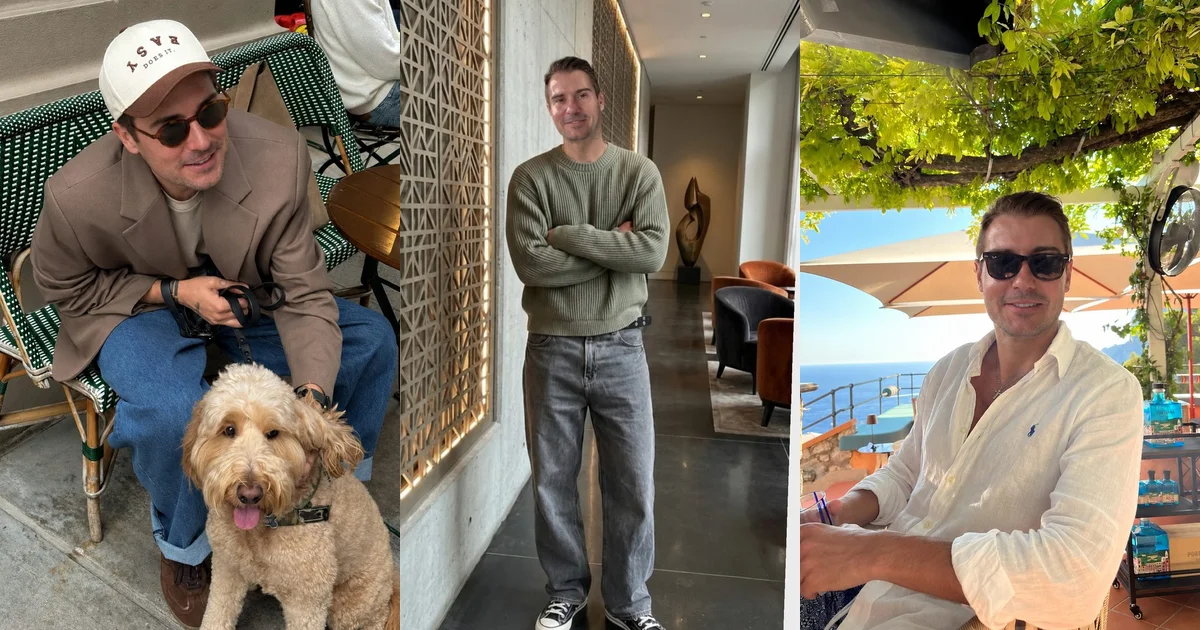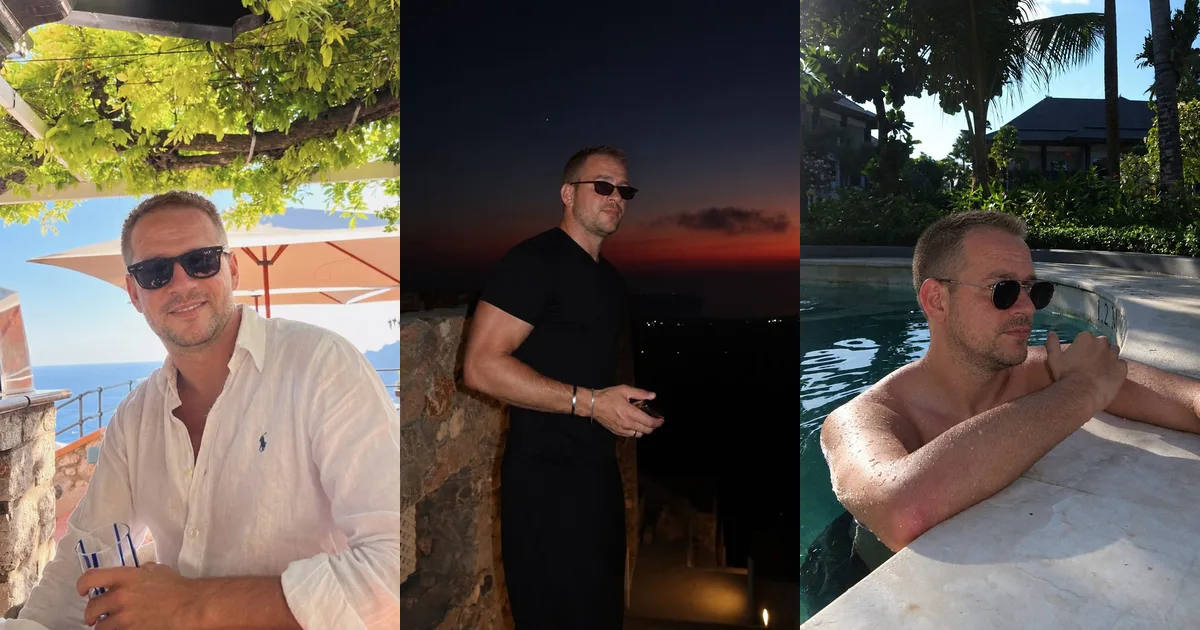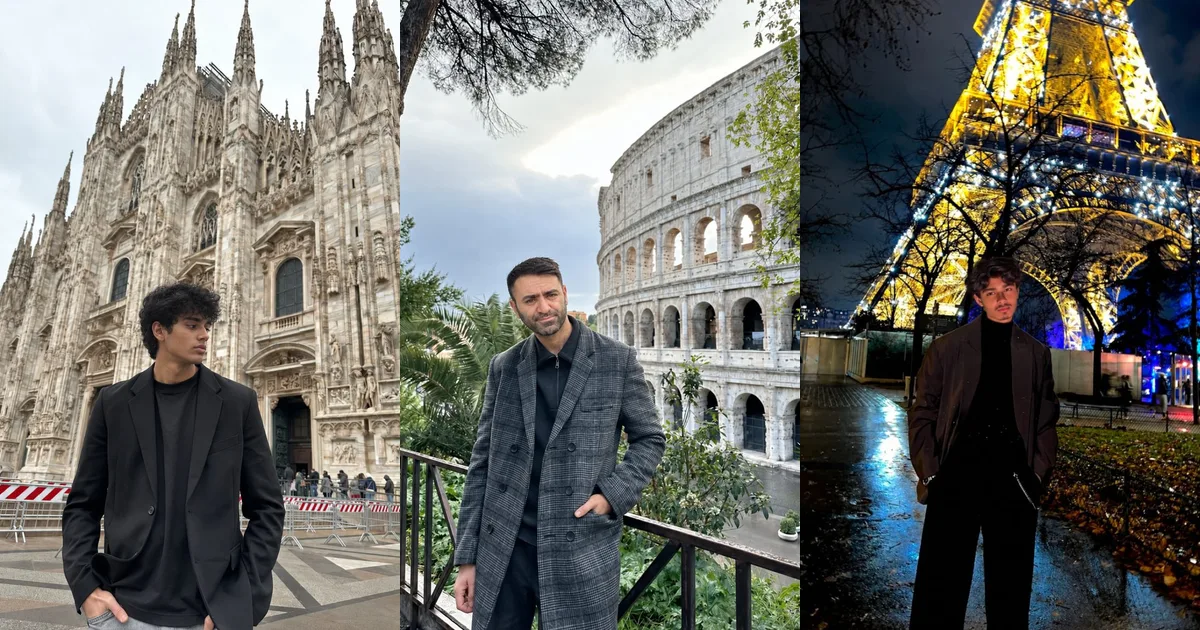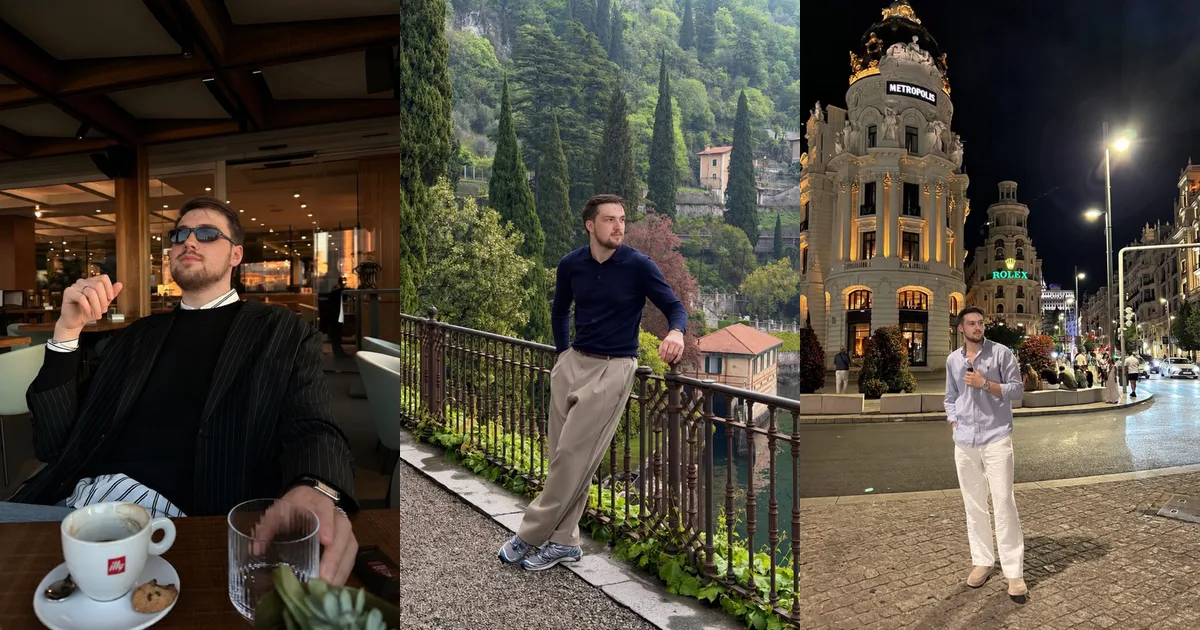
The best AI photo generator for Bumble is one that makes believable, everyday photos of the real you: your face stays recognisable from shot to shot, skin and light look like a phone camera caught them, and the scenes are places you actually go. For most people that means a dedicated dating-photo tool that learns from several of your selfies, publishes its privacy terms and prices plainly, and lets you redo any shot that misses. Headshot generators and chatbot editors can produce one good image, but they rarely give you a full, consistent six-photo Bumble lineup.
- Bumble's rules are about deception, not software. Its guidelines ask members to represent themselves accurately, require at least one photo that shows only you with your full face visible, and ban "artificially generated photos, or enhanced photos" used to deceive others.
- Realism is no longer the hard part. In a 2022 PNAS study, people picked out AI-generated faces at about chance level (48%), so the real test of a generator is likeness, not whether a photo "looks AI".
- Bumble already shapes your photos for you. Its Best Photo feature tests your first three photos and moves the most-liked one to the top, so those three need to be genuinely different shots.
- Compare tools on five things: likeness, realism, range of everyday scenes, control over redoing shots, and clear terms on training, deletion and refunds.
- Price per usable photo matters more than the headline price. A cheap batch you mostly discard can cost more than a smaller plan you can steer.
- Verification is Bumble's decision. Your verification selfie is checked against your profile photos, so any AI photo that drifts from your real face is a liability, not an upgrade.
- Others pick better than you do. Research on profile photos found that strangers chose more flattering images of a person than the person chose for themselves, so get a second opinion on your final set.
Why Bumble needs its own approach to AI photos
Many people build one set of photos and paste it into every dating app. That is understandable, but Bumble has a few mechanics that change what a good set looks like, and they matter even more when the photos come from a generator.
Who starts the conversation
For most of its history Bumble asked women to send the first message in opposite-sex matches. In 2024 it added Opening Moves: a woman can set a question (her own or a suggested one) that goes to her matches, and the match answers it to start the chat. Fortune reported the change in May 2024, noting that women can still use the original model if they prefer. According to Bumble's own explainer, a profile can hold up to three Opening Moves, which can be a suggested question, a custom question or a photo with a caption, and in non-binary and same-gender connections either person can set and answer one.
Whatever the exact flow in your market, the effect on photos is the same. Before someone messages, they need something to say. A profile made of six polished portraits against blurred backdrops gives them very little. A profile with a dog, a half-finished pottery bowl or a recognisable hiking trail hands them an opener.
Bumble tests your lead photo for you
Bumble's Best Photo feature looks at your first three photos, tracks which one gets the most right swipes and moves it to the top. That is useful, but only if the three photos are different enough to be a real test. Three near-identical AI portraits in the same jacket and light tell the feature nothing.
Bumble now gives AI feedback on photos
In February 2026 Bumble announced an AI Photo Feedback tool for members in the US. Bumble's announcement says it gives real-time suggestions to help you pick photos, and gives examples such as fewer shots hidden behind sunglasses and more variety, like an outdoor photo or one with friends. TechCrunch's coverage describes the same advice. Bumble has not said the tool scores photos for being AI-generated, so treat claims that it "detects AI" with caution.
The quick reference
| Bumble feature | What it does | What it means for AI photos |
|---|---|---|
| Opening Moves | A prompt (question or captioned photo) sent to matches to start the chat | Include photos with clear, specific details people can ask about |
| Best Photo | Promotes whichever of your first three photos gets the most right swipes | Make photos 1 to 3 genuinely different: framing, setting and mood |
| AI Photo Feedback (US) | Suggests changes such as fewer sunglasses shots and more varied settings | Generate a mix: outdoor, social, full length, clear face |
| Photo Verification | You copy a pose in a selfie; it is checked against your profile photos | Every AI photo must look like the face in that selfie |
| Up to six photo slots | Bumble's tips say to use them all | Plan six roles before you generate anything |
Are AI photos allowed on Bumble?
Bumble does not publish a rule that bans AI-made photos outright. What it does publish is a set of rules about honesty, and those rules decide which AI photos are fine and which are not.
What the guidelines say
Bumble's Community Guidelines open the section on inauthentic profiles by saying members are expected to represent themselves accurately, and they rule out impersonation, misrepresentation and creating a persona that isn't you. The profile photo rules add two specific requirements:
- at least one profile photo must show only you and clearly show your full face;
- photos may not carry exaggerated or unnatural digital effects to the point where it can't be clearly determined that you're the person in them.
Bumble went further in a case study it submitted to the Partnership on AI. In that document, Bumble quotes its inauthentic-profiles policy as covering "using someone else's photos, artificially generated photos, or enhanced photos to deceive others", and explains that from a safety point of view it is mainly concerned with what an image shows rather than how it was made. The key word in both is deceive.
How Bumble polices it
Two enforcement tools are public. In February 2024 Bumble launched Deception Detector, which combines AI and human moderators to find fake profiles, scammers and spammers. In July 2024 it added a report option: a member can choose "Fake profile" and then flag a profile for using AI-generated photos or videos. TechCrunch covered both, including Bumble's claim that member reports of spam, scams and fake profiles fell by 45% after Deception Detector launched. That figure is Bumble's own.
The practical takeaway: an AI photo that someone you meet would recognise as you is a very different thing from one that changes your face, body, age or life. The second kind is what the report button is for.
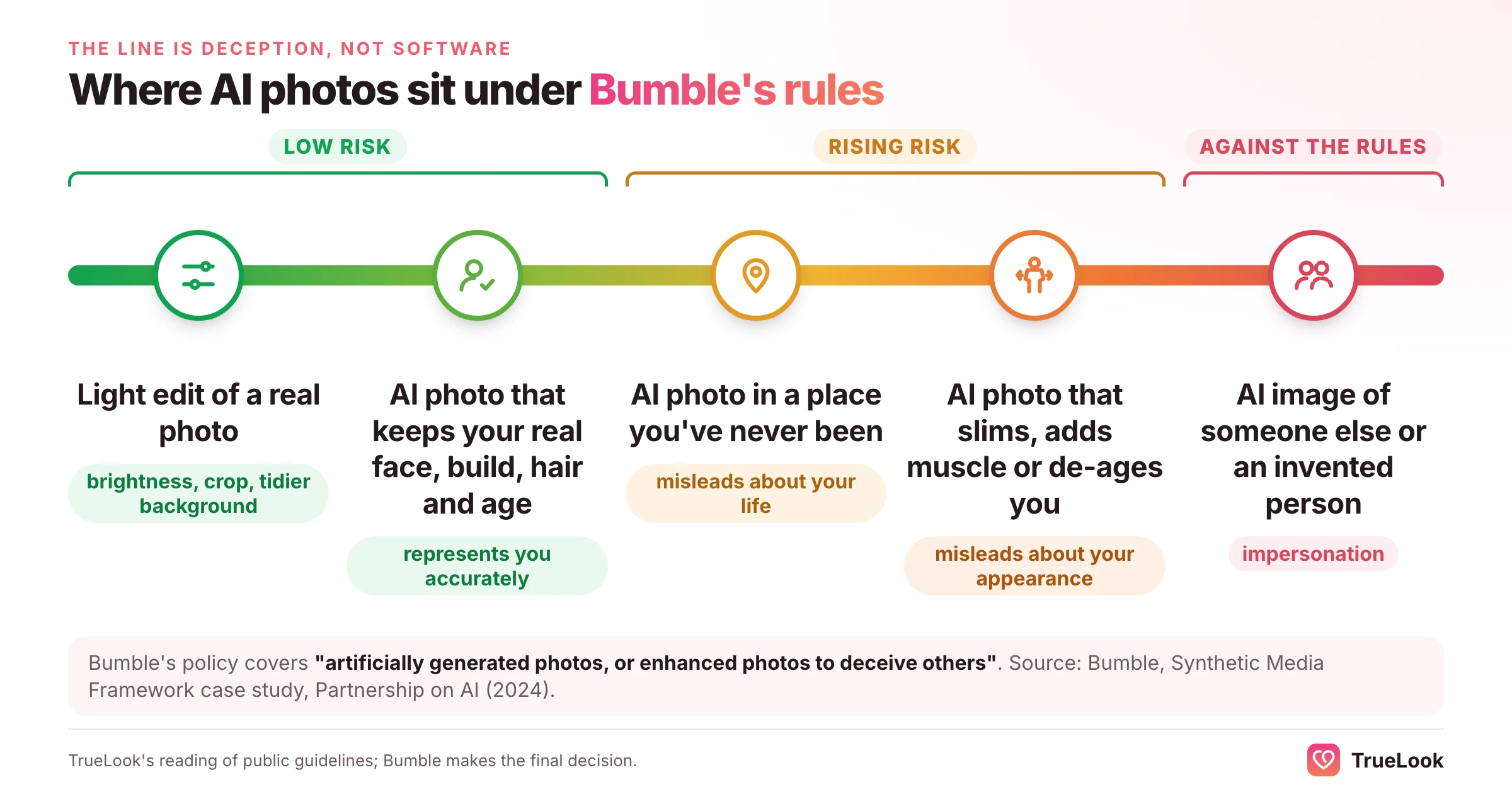
| How the photo was made | How it lines up with Bumble's rules | Our read on the risk |
|---|---|---|
| AI photo that keeps your real face, build, hair and age, in an everyday setting | Represents you accurately | Low, as long as you look like this in person |
| Real photo with light edits: brightness, crop, tidier background | Ordinary photo editing | Low |
| AI photo that slims you, adds muscle, smooths age lines or changes hair | Moves toward misrepresentation | Medium to high: matches notice on the first date |
| AI photo placing you somewhere you have never been, presented as real | Misleads about your life rather than your face | Medium: it invites questions you can't answer honestly |
| AI image of a different or invented person | Impersonation; a persona that isn't you | High: grounds for removal |
This table is our interpretation of public guidelines, not a ruling from Bumble. Bumble alone decides what stays up. For each app's position side by side, see our guide to whether AI photos are allowed on dating apps.
What the research says about AI faces and dating photos
Several strands of research are useful when choosing a generator. None of them is about Bumble specifically, and you should read them as context rather than proof that any tool will work for you.
People can no longer spot AI faces by eye
Sophie Nightingale and Hany Farid tested whether people could tell real faces from ones made by a generative model. As Lancaster University's summary of the 2022 PNAS paper explains, 315 participants scored 48% accuracy, close to a coin toss. A second group given training and feedback reached only 59%. A third group rated the synthetic faces as slightly more trustworthy on average than the real ones.
A 2023 paper in Psychological Science took this further. As the British Psychological Society's Research Digest reports, White AI faces were judged human more often than photos of real White people, and the participants who did worst at the task had the poorest insight into their own ability. The effect did not appear for non-White faces, which the authors link to training data that over-represents White faces.
Two lessons follow for anyone choosing a tool:
- "Does it look AI?" is the wrong test. Modern images often pass that test easily. The harder and more important question is whether the photo looks like you.
- Quality may not be even across faces. If a model was trained mostly on certain faces, it may render others less faithfully. Look for sample photos of people who resemble you in skin tone, age and features before you pay.
Dating photos have always been stretched
Long before AI, Jeffrey Hancock and Catalina Toma studied 54 online daters' main profile photos and compared them with how the daters looked in person. In their 2009 Journal of Communication paper, independent judges rated nearly a third of photos (31.5%) below the midpoint of an accuracy scale. The differences that hurt accuracy most were weight, hair and age, and 46 of the 54 photos contained at least one discrepancy.
That is a useful checklist for AI photos too. A generator that shaves off five kilos or a decade is repeating the exact changes people already read as dishonest.
One face, many impressions
Alexander Todorov and Jenny Porter showed that different photos of the same person can create impressions as varied as photos of different people. Their 2014 study in Psychological Science also found that people preferred different images of the same person depending on the purpose, such as a dating profile versus a political campaign. This is the honest case for AI photos: you are not changing who you are, you are choosing which true version of your face gets seen first.
You are not the best judge of your own photos
A study by David White, Clare Sutherland and Amy Burton asked people to choose their own best profile pictures and a stranger's. The paper, published in Cognitive Research: Principles and Implications, found that images picked by others created more favourable impressions than images people picked for themselves. When a generator hands you 30 or 100 options, this matters. Ask a friend to make the final cut.
Candid beats posed for dating
Research by Alixandra Barasch at NYU Stern found that people were more interested in dating or befriending someone shown in a candid photo than in a posed one, because candid shots looked more genuine. NYU's summary notes that the advantage shrank when viewers learned the subject knew the photo was being taken, and that posed photos did better in a hiring context. For Bumble, choose AI scenes that look caught in the moment, not staged for a studio.
Why trust matters so much on dating apps
Pew Research Center's 2023 survey found that 28% of Americans who have used dating sites or apps had used Bumble, and that 52% of all online daters said they had come across someone they thought was trying to scam them. People on Bumble arrive cautious. A photo that feels slightly off does more damage than a plain one.
| Finding | Source | What to do with it |
|---|---|---|
| People identified AI faces at 48% accuracy | Nightingale and Farid, PNAS (2022) | Judge generators on likeness, not on "looking real" |
| AI realism varied by the race of the face | Miller and colleagues, Psychological Science (2023) | Check samples of people who look like you |
| 31.5% of dating photos were rated inaccurate | Hancock and Toma, Journal of Communication (2009) | Never let a tool change weight, hair or age |
| Different photos of one person give different impressions | Todorov and Porter, Psychological Science (2014) | Use the variety honestly to pick your best true version |
| Others choose better profile photos than we do | White, Sutherland and Burton (2017) | Get a second opinion before uploading |
| Candid photos make people seem more genuine | Barasch and colleagues, NYU Stern (2018) | Pick natural, in-the-moment scenes |
The five-point test for any AI Bumble photo generator
Ignore star ratings and "best of" badges for a moment. Any tool can be judged on five things, and you can check most of them before paying.
1. Likeness
The photos have to look like you, consistently. Check face shape, skin tone, hairline, eye colour, teeth, build and any distinctive features such as freckles, a scar or a gap in your teeth. A tool that turns you into a slightly more handsome cousin fails here, however polished the result.
How to check: look at sample sets where the company shows the input selfies next to the outputs. If it only shows outputs, you can't judge likeness at all.
2. Realism
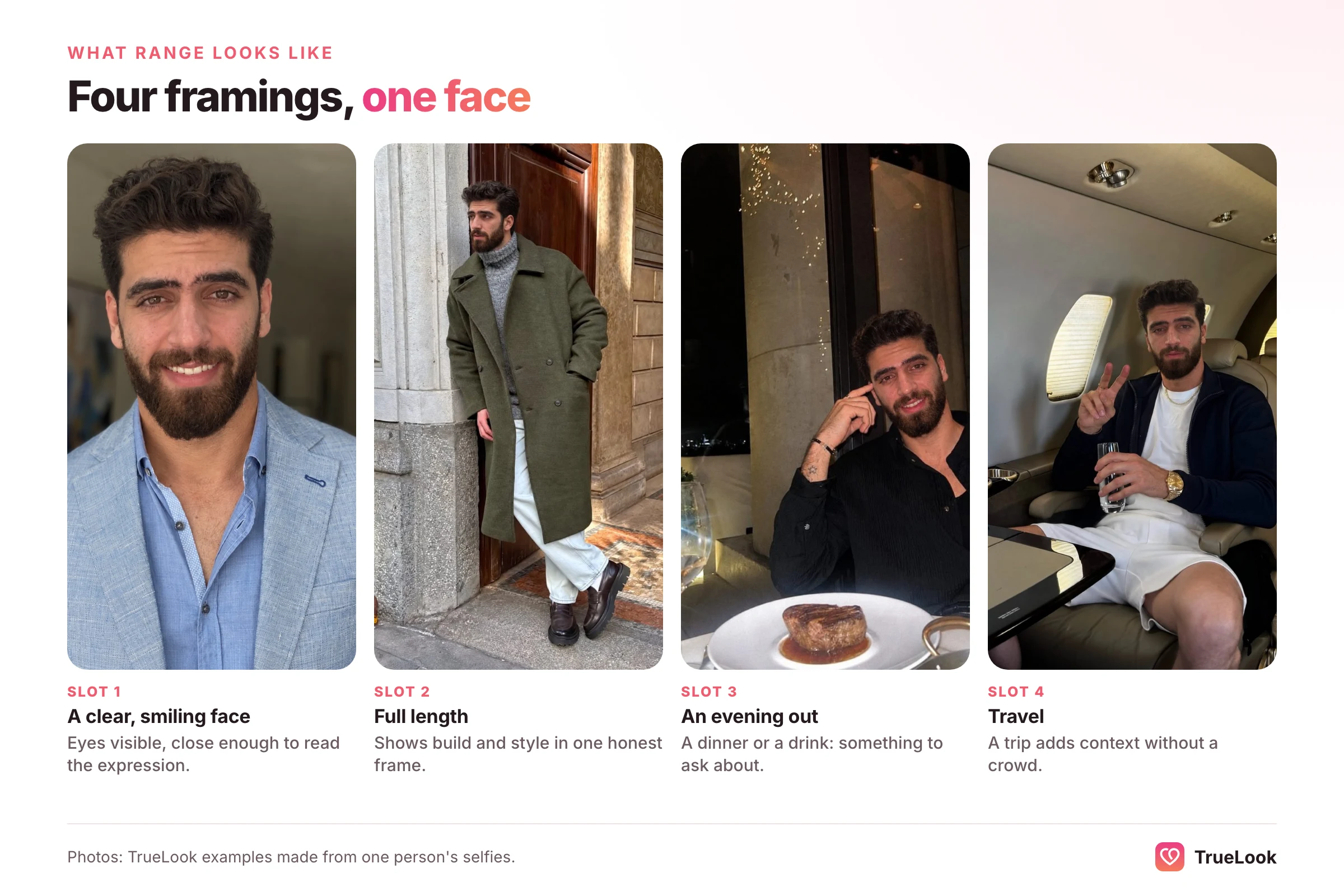
Even if most people can't name an AI face, they notice when something feels wrong. Zoom in on full-size samples and look for:
- skin with no pores or texture, like wax or plastic;
- hands with odd fingers, or jewellery and watches that melt into skin;
- text on signs or shirts that turns into nonsense;
- shadows that point in different directions from the light source;
- hair edges that blur into the background;
- backgrounds that are too perfect, such as an empty street at golden hour in every shot.
3. Range of everyday scenes
Bumble's own tips call for variety, and its photo feedback nudges people toward outdoor and social shots. A useful generator offers ordinary settings: a park, a kitchen, a bar with friends, a hiking trail, a city street, a dinner. Studio portraits and fantasy travel backdrops are much less useful.
4. Control
Can you pick the scene, outfit and framing? Can you redo one photo without paying for a whole new batch? Tools that deliver one large batch hours later leave you sorting through what they chose. Tools that generate photo by photo let you steer.
5. Terms
You are handing over clear photos of your face. Before you upload, find answers to these questions in the privacy policy and FAQ:
- Are your selfies or generated photos used to train AI models?
- How long are uploads kept, and can you delete them yourself?
- Who owns the generated photos, and can you use them on any app?
- Is pricing clear before checkout, and what is the refund policy?
If any answer is missing or vague, move on.
| Test | Ten-minute check | Pass looks like | Fail looks like |
|---|---|---|---|
| Likeness | Find before/after sample sets | Inputs shown beside outputs; same person throughout | Outputs only, or faces that drift between shots |
| Realism | Open three samples at full size | Pores, natural hair edges, sensible shadows | Waxy skin, warped hands, garbled text |
| Range | Read the style or scene list | Ordinary places and casual outfits | Mostly studio, corporate or fantasy scenes |
| Control | Check how regeneration works | Choose scenes; redo single photos | One fixed batch, no redos |
| Terms | Search the privacy policy for "training" and "delete" | Plain answers, refund terms visible | Silence, or answers only after payment |
AI photo tools for Bumble, compared by type
We have not run a controlled, side-by-side test of every tool on Bumble, and nobody outside Bumble can see its match data, so we are not going to rank products with invented scores. What we can do is compare the categories honestly and list what each company's own site says.
| Tool type | How it works | Good for Bumble when… | Watch out for |
|---|---|---|---|
| Dedicated dating-photo generators | Learn your face from several selfies, then make photos in dating-style scenes | You need a full set of casual, varied photos | Quality, likeness and privacy terms vary widely |
| AI headshot generators | Turn selfies into professional portraits | You want one clean, sharp face shot | Corporate look; few casual or full-length options |
| General AI photo studios | Train a model of you, then offer many style packs and credits | You also want photos for other uses | Dating is one pack among many; credits can run out |
| Chatbots and image editors | Edit or restyle a photo you upload, one prompt at a time | You want to tidy one existing photo | Likeness drifts; hard to make a consistent six-photo set |
| Enhancement apps | Relight, retouch, upscale or swap the background of a real photo | Your photos are fine but dark or cluttered | Can't create new scenes or rescue a weak original |
| Avatar and art-style apps | Turn your face into illustrations | Never, for a dating profile | Not photos of you as you appear |
What the main tools list on their own sites
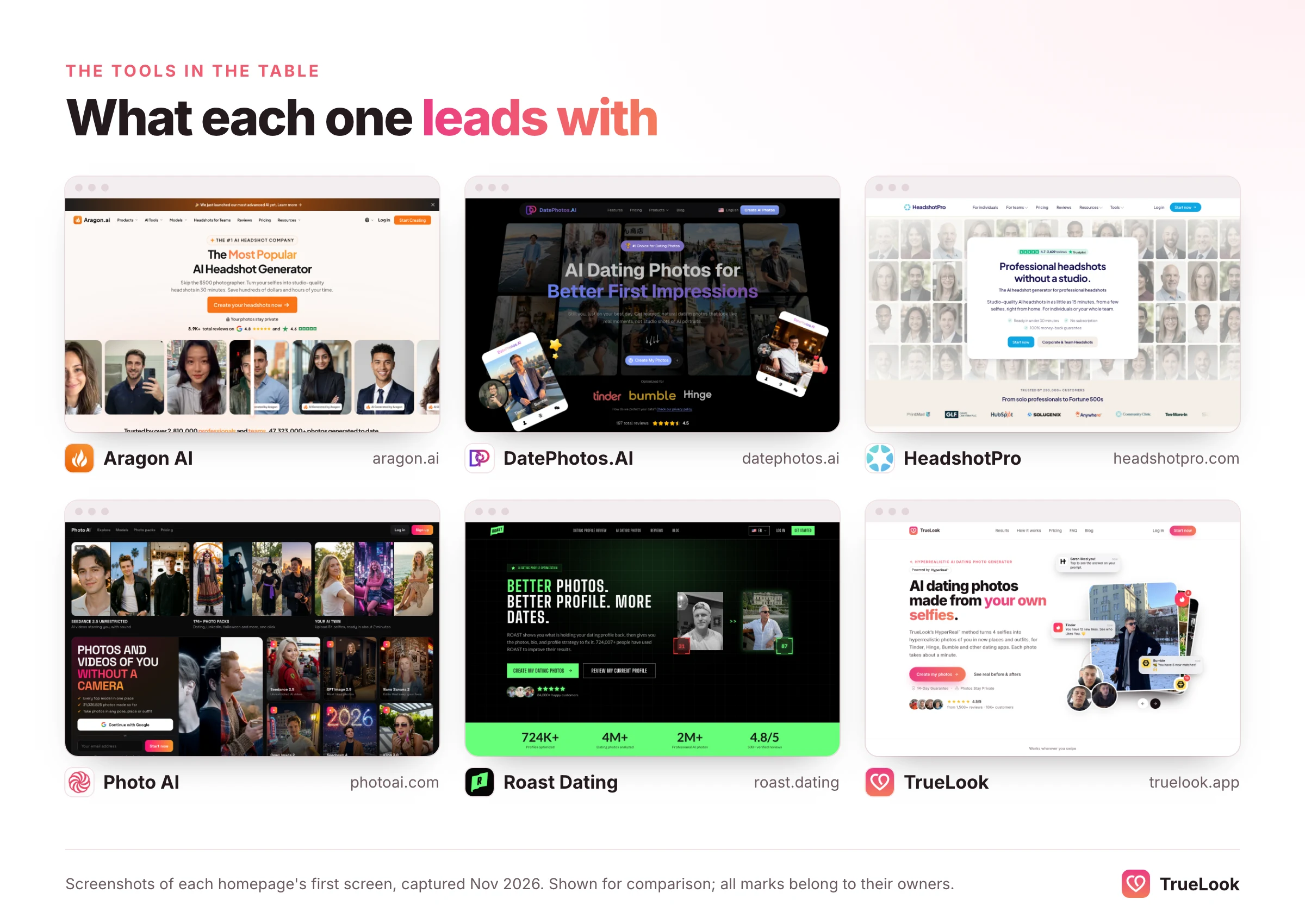
The details below come from each company's pricing or home page at the time of writing (November 2026). Prices and plans change often, so check the live page before you buy. The order is alphabetical, not a ranking.
| Tool | Built mainly for | How you pay | What its site lists |
|---|---|---|---|
| Aragon AI | Professional headshots; has a dating photos page | One-time plans | 40, 60 or 100 headshots, from $35, with generation times of 15 to 45 minutes depending on plan |
| DatePhotos.AI | Dating photos as one batch | One-time, $29 to $79 | 80 to 180 photos, 20 to 30 minutes, 5 to 20 selfies requested, 7-day money-back guarantee on a first order |
| HeadshotPro | Corporate and LinkedIn headshots | One-time, $29 to $59 | 30 to 70 headshots, about 2 hours down to about 15 minutes; pricing page doesn't mention dating |
| Photo AI | General AI photos and video | Subscription, from $19 a month billed monthly | Many photo packs, including dating packs for Bumble, Hinge and Tinder; an "AI twin" built from 5 or more selfies |
| Roast Dating | Dating profile reviews, plus photos | $39 a month for the photo pack | 40 AI photos with 1-hour delivery |
| TrueLook | Dating profiles on Tinder, Hinge and Bumble | One-time, $29 or $49; no subscription | Up to 30 or 140 photos, made from 4 selfies and generated photo by photo, about a minute each; photos not used for AI training |
For a fuller look at any one of these, see our side-by-side pages: TrueLook vs Aragon AI, TrueLook vs DatePhotos.AI, TrueLook vs HeadshotPro, TrueLook vs Photo AI and TrueLook vs Roast Dating, or the full comparison of AI dating photo tools.
Which type fits your situation
| If this is you… | Start with… | Why |
|---|---|---|
| Few or no usable photos at all | A dedicated dating-photo generator | You need six varied shots, not one portrait |
| Good photos that are dark, blurry or cluttered | An enhancement app, used lightly | Fixing a real photo carries the least risk of misrepresenting you |
| Strong casual photos but no clear face shot | A headshot generator or one dating-tool photo | You only need to fill one slot |
| You want to test different lead photos over time | A tool that generates photo by photo | You spend your pack on the shots you want to test, instead of buying a whole new batch each time |
| You'd rather have real photos and coaching | A dating photographer | Costs more, but every photo is genuine |
| You are unsure AI photos suit you at all | A friend with a phone and an hour of daylight | Free, real and often good enough |
Our guide to dating profile photographers vs AI covers the photographer route in detail, and the roundup of AI dating photo generators looks at tools across all the main apps.
Working out what a tool really costs
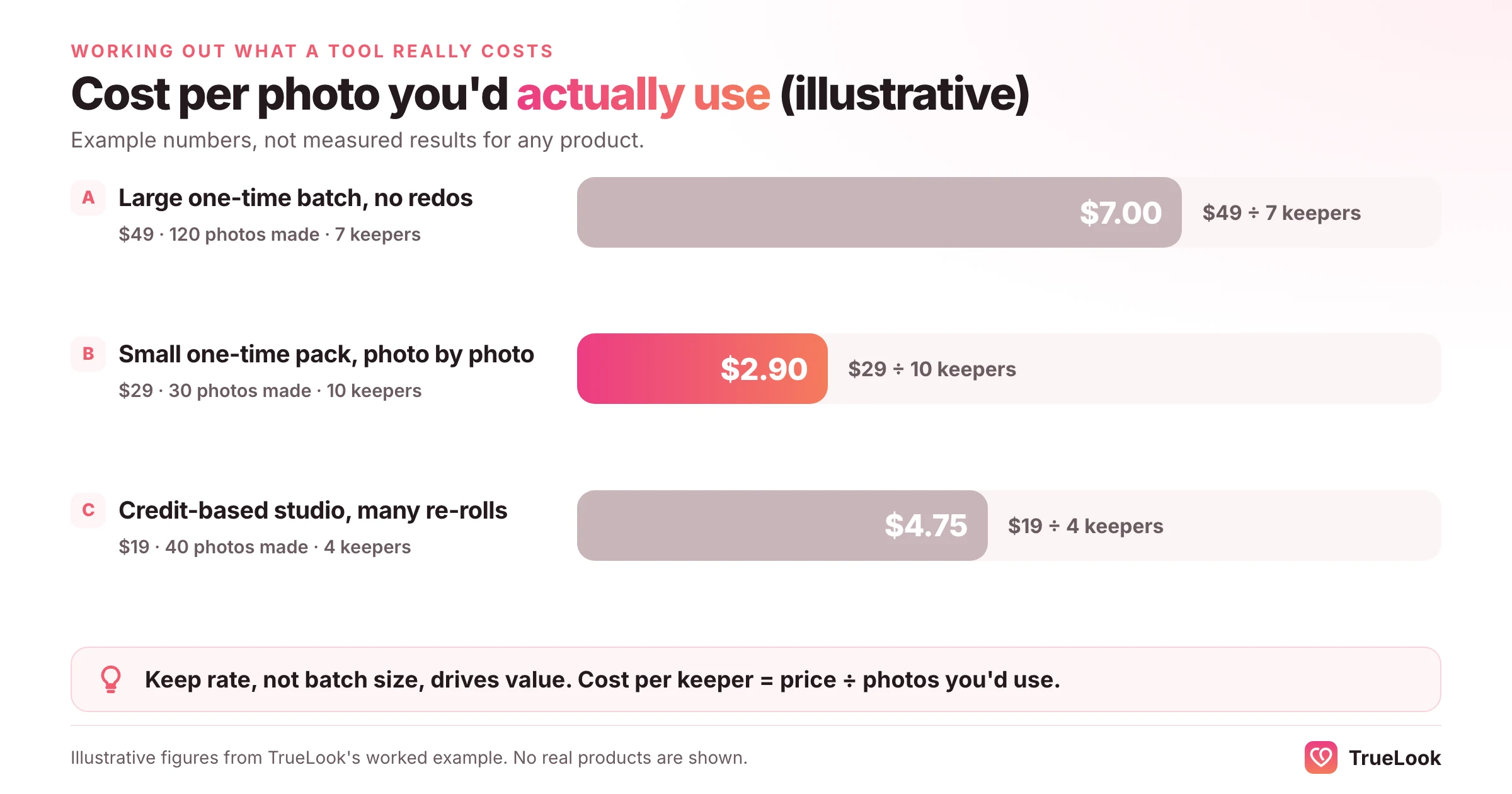
Headline prices compare badly because tools sell different things: a fixed batch, a pack you spend photo by photo, a monthly allowance, or credits. The number that matters is cost per usable photo: the price divided by the photos you would actually put on Bumble.
Step by step
- Write down the price and the number of photos (or the credits and what each costs).
- Estimate how many you'd keep. Be strict: a photo with an odd hand or a face that is 90% you does not count.
- Add the cost of redos if they are charged separately.
- Divide the total price by the keepers.
- Note whether the price repeats monthly, and set a reminder to cancel if you only need one round.
Illustrative example
These numbers are invented to show the method, not measured results for any product.
| Scenario | Price | Photos made | Keepers | Cost per keeper |
|---|---|---|---|---|
| Large one-time batch, no redos | $49 | 120 | 7 | $7.00 |
| Small one-time pack, photo by photo | $29 | 30 | 10 | $2.90 |
| Credit-based studio, many re-rolls | $19 | 40 | 4 | $4.75 |
The point is not which row wins. It is that keep rate, not batch size, drives value. A tool you can steer usually has a higher keep rate, because you aren't sorting through scenes you would never use.
How to build a Bumble lineup with AI photos
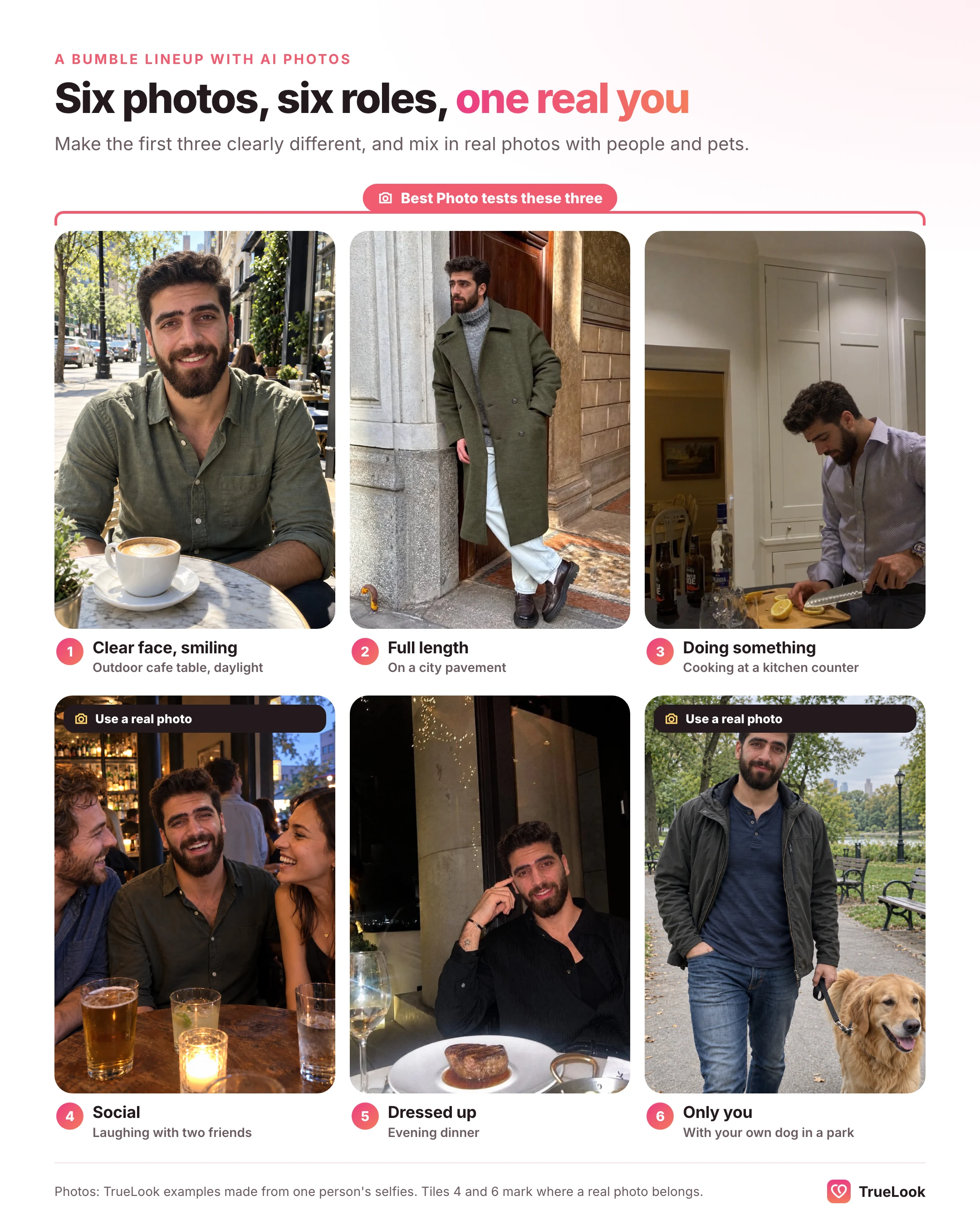
Plan the six slots first, then generate for them. Working the other way round, generating everything and seeing what sticks, is how people end up with six versions of the same portrait.
A six-slot plan
| Slot | Its job | AI scene ideas | Realism risk |
|---|---|---|---|
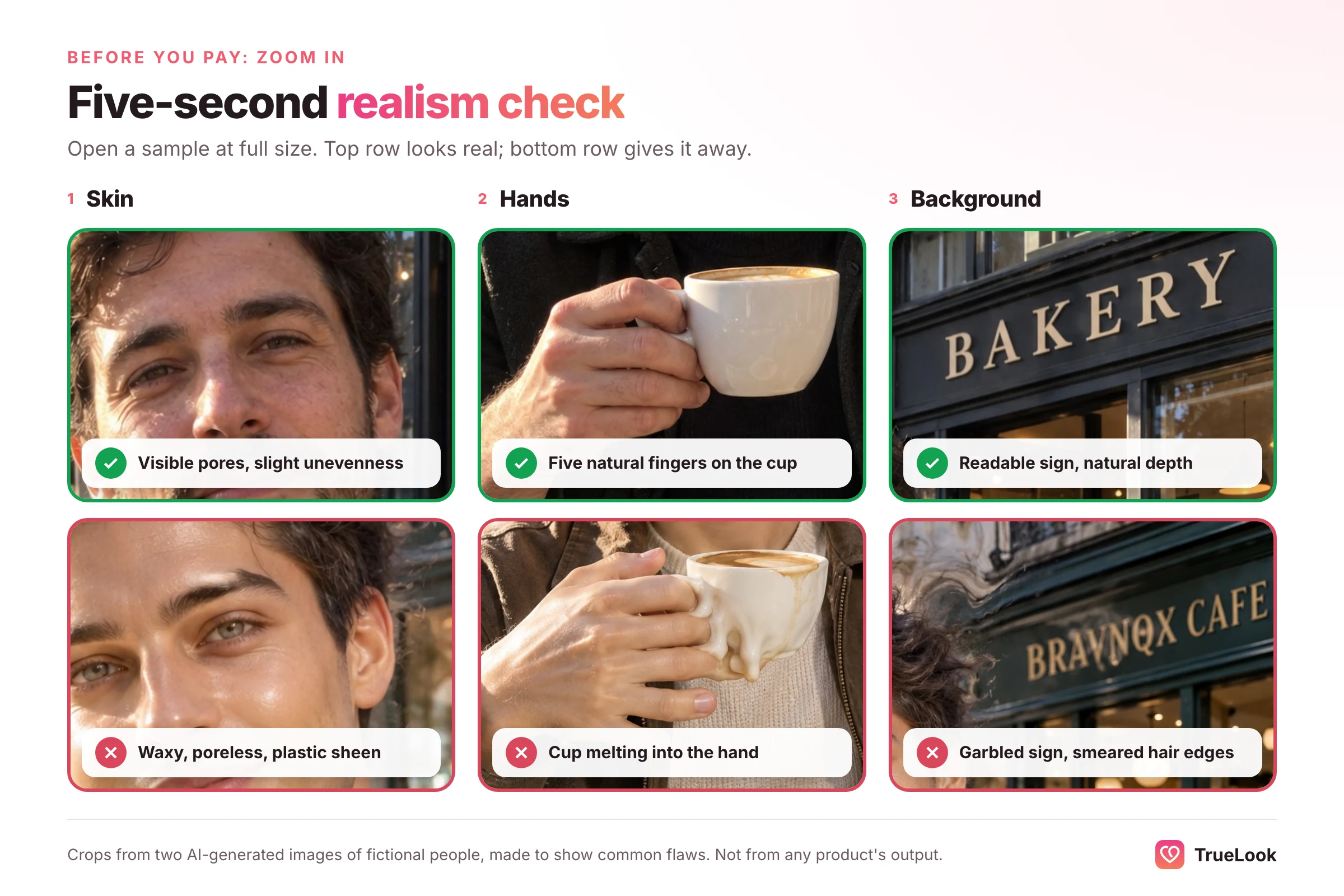
| 1. Clear face, smiling | Recognition at a glance; meets the "full face, only you" rule | Outdoor café table, park bench, soft daylight | Low |
| 2. Full length | Shows your build honestly | Walking down a street, leaning on a railing | Medium: check proportions closely |
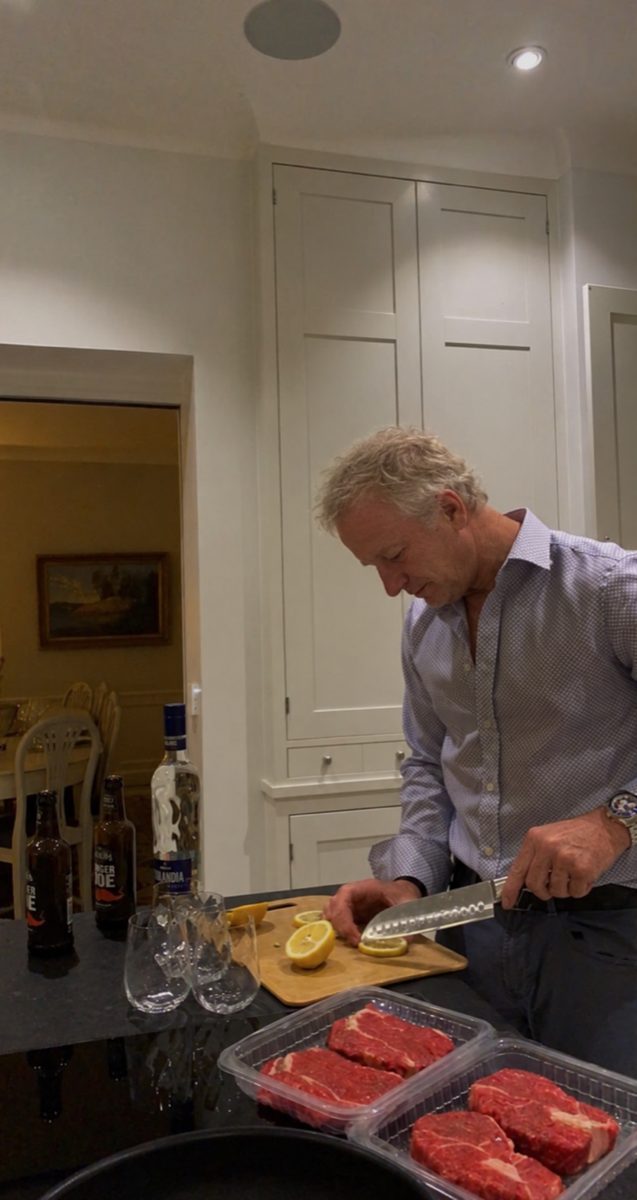
| 3. Doing something | Gives a conversation hook | Cooking, climbing, playing guitar, at a market | Medium: hands and objects need care |
| 4. Social | Shows you have people in your life | Use a real group photo if you can | High if generated: invented friends are a bad idea |
| 5. Dressed up | Shows another side of you | Dinner, a wedding, an evening out | Low |
| 6. Something only you have | Makes you memorable | Your actual dog, your bike, your garden | Use real photos for real pets and objects |
Bumble's own photo tips back up several of these choices: its advice includes leading with a photo of only you, smiling, skipping sunglasses, hats and filters, using recent photos (ideally from the last six months) and looking basically the same across all of them. A separate Bumble article says profiles with four or more photos get the most matches. That last point is Bumble's claim; it doesn't publish the underlying study.

Make the first three a real test
Because Best Photo chooses between your first three, vary them on purpose: a close, smiling face shot outdoors; a full-length shot in a different outfit; an activity shot in a different setting. If one of them is a real photo, even better, because it anchors the set.
Give people an opener
Every photo after the first should answer the question "what could someone ask me about this?" A few ways to build that in:
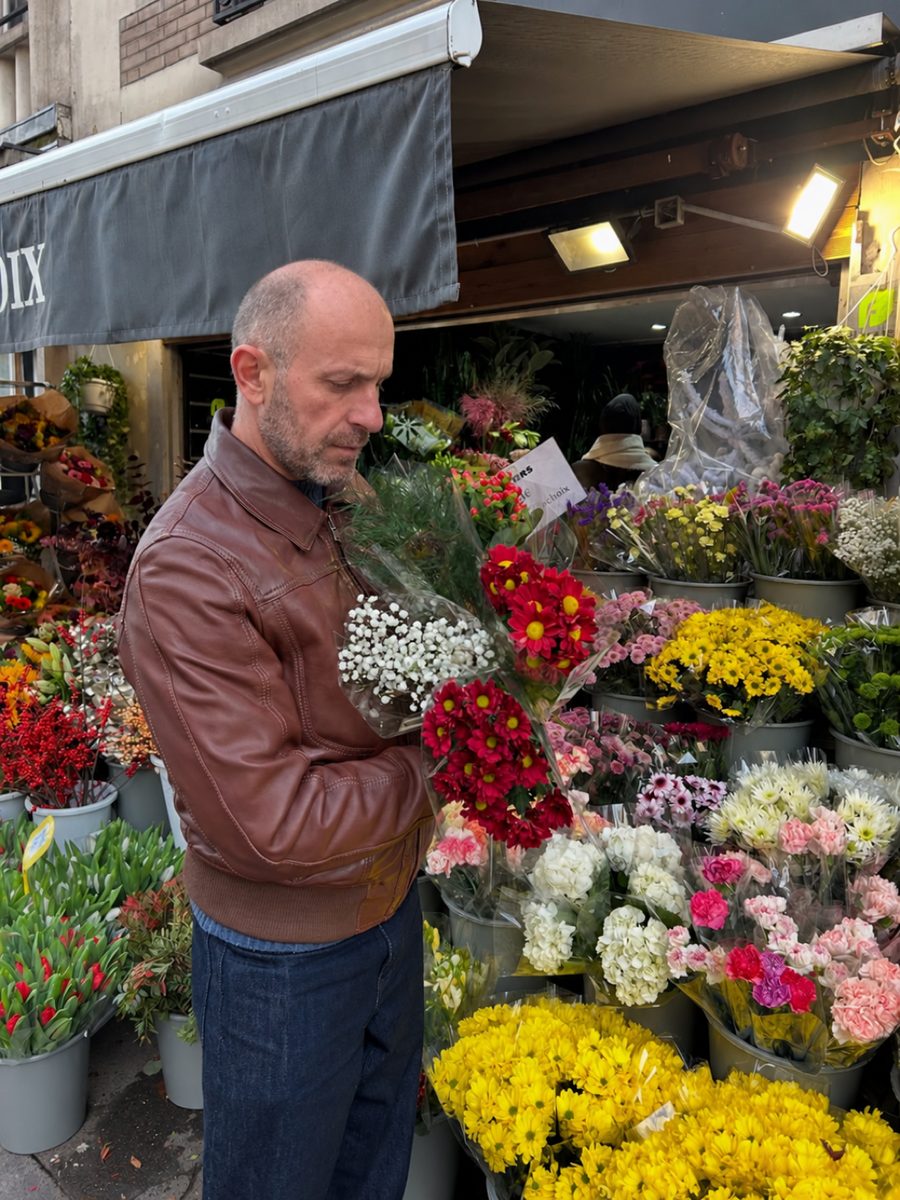
- Specific over generic. "At a farmers' market holding a bunch of flowers" is easier to message about than "standing in a city".
- Match photos to prompts. If a profile prompt mentions cooking, put the cooking photo nearby so the two reinforce each other.
- Keep scenes true. Only choose activities you actually do. If someone asks about your climbing photo, you want a real story.
Mix in real photos
AI photos work best alongside a few genuine ones. A real group photo, a real photo with your pet, or a candid a friend took last summer makes the whole profile feel grounded. If you have none, take one this week: Bumble's tips suggest propping your phone up and using a self-timer.
Ask someone else to choose
Given the research showing that others choose better profile photos than we do, send your shortlist of ten to two friends and ask each to pick six. Use the photos they agree on. If either says "that doesn't look like you", drop it without arguing.
For more on order and composition, our guide to the best Bumble profile pictures goes slot by slot.
Verification and staying honest with AI photos
How Bumble's photo verification works
According to Bumble's guide to verification, you start from your profile settings, copy a randomly chosen pose in a selfie, and send it to Bumble. The selfie is cross-referenced against your profile photos and, per that guide, reviewed by a real person on Bumble's team. If it fails, you can try again. Once you're verified, you can also ask matches to verify.
Bumble's case study for the Partnership on AI explains why this matters to them: from the second half of 2022, the company saw more fake profiles attempting verification with AI-generated images. Verification exists to catch exactly the gap between a profile and a real face.
What this means for AI photos
- If your AI photos look like you, verification is simply a selfie.
- If they look like an improved version of you, the reviewer is comparing your selfie with someone slightly different. That is a risk you take on, and no tool can promise how it will go.
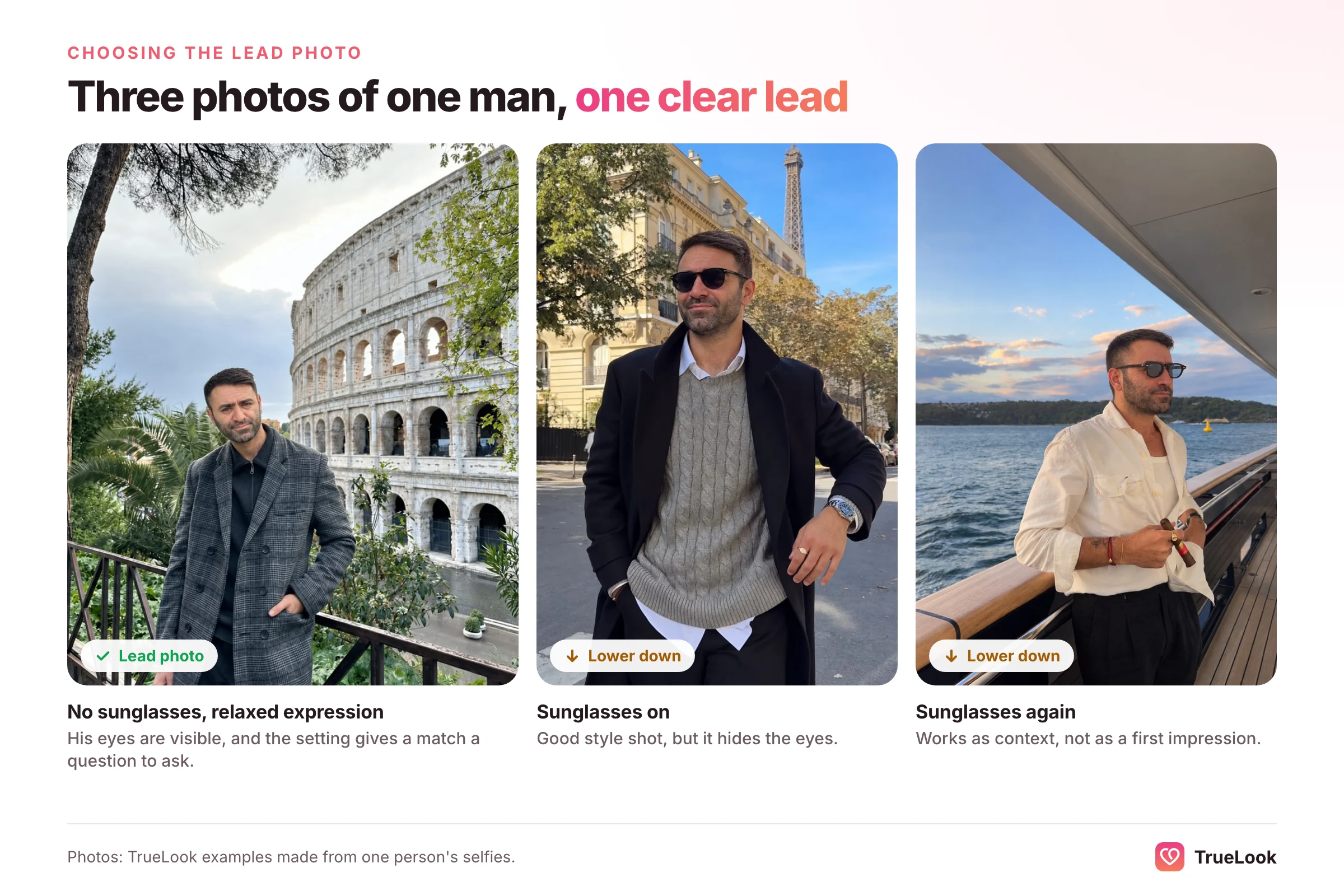
- Avoid sunglasses, hats and heavy filters in the photos that show your face most clearly, since those make comparison harder.
The first-date test
Before you upload any AI photo, ask: if this person met me tomorrow evening, with my current hair, my current weight and today's tiredness, would they recognise me straight away? If the honest answer is "probably not", the photo is working against you, however good it looks.
Our article on failed photo verification covers what to do if a check doesn't go through on Tinder, and much of it applies to Bumble too.
Common mistakes with AI Bumble photos, and the fix for each
| Mistake | Why it hurts | Fix |
|---|---|---|
| Six portraits with the same framing | Best Photo has nothing to test; profile feels repetitive | Plan six different roles before generating |
| Letting the tool "improve" your face or body | Weight, hair and age are the changes people read as deceptive | Reject any photo a friend says doesn't look like you |
| Uploading blurry or filtered selfies | The model learns the wrong face | Use recent, sharp, unfiltered selfies in varied light |
| Luxury scenes you have never been near | Invites questions you can't answer honestly | Choose places and activities from your real life |
| Generated group photos | Invented friends are a misrepresentation | Use a real group shot or skip the slot |
| Sunglasses in most shots | Hides your eyes; Bumble's feedback tool suggests fewer such shots | Keep sunglasses to one photo at most |
| Different hairstyles across the set | Bumble advises looking basically the same in every photo | Match your current hair in every scene |
| Picking your own favourites alone | People choose less flattering photos of themselves | Let two friends vote on the shortlist |
Myths and facts about AI photos on Bumble
| Myth | Fact |
|---|---|
| Bumble bans AI photos. | Its guidelines target deception and photos where you can't be clearly identified, not a production method. |
| Bumble's AI Photo Feedback is an AI detector. | Bumble describes it as photo-picking advice, such as fewer sunglasses shots and more variety. It hasn't said it detects AI images. |
| Verification checks every photo automatically, in real time. | Bumble describes a pose selfie compared against your profile photos and reviewed by its team. |
| If a photo doesn't look AI, it's fine to use. | Realism and honesty are different tests. Likeness is what matters. |
| More photos from a tool means better results. | Keep rate matters more than batch size. Six strong photos beat sixty mediocre ones. |
| Confident photos always backfire on Bumble. | No public data shows this. A 2016 PNAS study found open, expansive poses drew more positive responses in speed dating and on a dating app, as ScienceAlert reported. Relaxed and open is a safer aim than either stiff or showy. |
Why the same AI photos can do well on Tinder and badly on Bumble
Bumble doesn't publish match rates by photo style, so any precise claim here is guesswork. The mechanics do suggest some honest reasons a set might perform differently:
- The step after the match is different. On Bumble, someone usually has to start the chat or answer an Opening Move. Photos with nothing to talk about can produce matches that never turn into conversations.
- The first three photos get compared. If those three are interchangeable, Best Photo can't help you.
- The rest of the profile weighs more. Bumble profiles include prompts and details that photos either support or contradict.
- Audiences differ by city and age. The same photos can land differently in different places, on any app.
If you get matches but few conversations, change the photos in slots 3 to 6 first, adding specific, askable details. If you get few matches at all, start with slots 1 to 3. Our guide to getting no matches on Bumble covers the non-photo causes, and the companion guides to the best AI photo generator for Tinder and for Hinge explain how the other apps differ.
Where TrueLook fits
TrueLook is a dedicated dating-photo generator. Its HyperReal™ method creates photos from four of your selfies, aiming to keep your face recognisable rather than idealised, and each photo takes about a minute, so you can choose scenes one at a time and redo any that miss. Your photos are never used for AI training. There is no subscription: the Fix Pack is $29, paid once, for up to 30 photos, and the Pro Pack is $49, paid once, for up to 140 photos, with all 43 styles on both packs. You generate until your pack's photos are used, and can buy another pack or a top-up if you need more. Both carry a 14-day refund under the conditions on the refund page.
If that sounds like what you need, you can see example AI photos for Bumble. Like any tool, TrueLook can't guarantee matches, and Bumble alone decides on verification and on what stays on its platform.
The honest limits of AI photos on Bumble
- Photos open the door; the profile and messages keep it open. Great photos with an empty bio still stall.
- Nobody outside Bumble sees its match data. Treat any "tested on Bumble" ranking or match-rate promise with scepticism, including ours.
- Policies change. Bumble updated its guidelines on synthetic media in 2023 and added an AI report option in 2024. Check the current guidelines before relying on any article, this one included.
- The real you shows up on the date. That is the person the photos need to match.
Frequently asked questions
What is the best AI photo generator for Bumble?
The best one for you produces realistic photos that clearly look like you, in everyday scenes suited to a dating profile, with clear terms on training, deletion and refunds. Dedicated dating-photo generators that learn from several selfies and let you redo individual shots usually fit Bumble better than headshot tools or chatbots.
Can you use AI photos on Bumble?
Bumble's guidelines expect members to represent themselves accurately, require at least one photo that shows only you with your full face, and prohibit artificially generated or enhanced photos used to deceive. AI photos that genuinely look like you are a different matter from ones that change your appearance, but Bumble makes the final decision on any profile.
Can Bumble tell if photos are AI-generated?
Bumble hasn't published how it checks images. It uses a mix of AI and human moderation to find fake profiles, runs selfie-based photo verification, and since July 2024 lets members report profiles they believe use AI-generated photos or videos. The safest approach is to use photos that match how you look in person.
Will AI photos pass Bumble's photo verification?
Verification compares a pose selfie with your profile photos, so the result depends on how closely your photos match your real face. Bumble decides each case, and no generator can promise a pass. Photos that keep your real features, hair and build give the comparison the least to question.
How many photos should I put on Bumble?
Use all six slots if you can. Bumble's own tips say to fill them, and one of its articles says profiles with four or more photos get the most matches. Make the first three clearly different, because Best Photo tests those against each other.
What does Bumble's AI Photo Feedback tool check?
Bumble describes it as real-time suggestions to help members in the US choose their best photos, such as fewer shots hidden behind sunglasses and more variety, like an outdoor photo or one with friends. Bumble hasn't said it scores photos for being AI-made.
How much do AI dating photos cost?
At the time of writing, tools range from one-time packs of around $29 to $79 to monthly plans of roughly $19 to $39 and up. Compare the cost per photo you'd actually use, whether the charge repeats, and the refund terms, not just the headline price.
Is it safe to upload my selfies to an AI photo tool?
It depends on the tool. Check whether uploads are used for AI training, how long they are stored, whether you can delete them, who owns the results and where the company is based. Skip any tool that doesn't answer those questions clearly before you pay.
Sources
- Bumble makes big changes to its dating app, Fortune (2024). https://fortune.com/2024/05/01/bumble-changes-dating-app-women-make-first-opening-move/
- Try an easier way to start conversations on Bumble with Opening Moves, Bumble (n.d.). https://bumble.com/the-buzz/bumble-opening-moves
- How to use Bumble's Best Photo feature, Bumble (n.d.). https://bumble.com/the-buzz/how-to-use-bumble-best-photo-feature
- Bumble announces two new features for confidence and clarity in dating, Bumble Inc. investor relations (2026). https://ir.bumble.com/news/news-details/2026/Bumble-Announces-Two-New-Features-For-Confidence-and-Clarity-in-Dating-2026-36eaJ_omGR/default.aspx
- Bumble adds AI-powered photo feedback and profile guidance tools, TechCrunch (2026). https://techcrunch.com/2026/02/26/bumble-adds-ai-powered-photo-feedback-and-profile-guidance-tools
- Community Guidelines, Bumble (accessed 2026). https://bumble.com/en/guidelines
- Synthetic Media Framework case study: Bumble, Partnership on AI (2024). https://partnershiponai.org/wp-content/uploads/2024/03/pai-synthetic-media-case-study-bumble.pdf
- Bumble users can now report profiles that use AI-generated photos, TechCrunch (2024). https://techcrunch.com/2024/07/09/bumble-reporting-option-ai-generated-profiles/
- AI generated faces are more trustworthy than real faces, say researchers who warn of "deep fakes", Lancaster University (2022), summarising Nightingale and Farid, PNAS. https://www.lancaster.ac.uk/news/ai-generated-faces-are-more-trustworthy-than-real-faces-say-researchers-who-warn-of-deep-fakes
- AI faces seem realer than real, British Psychological Society Research Digest (2023), summarising Miller and colleagues, Psychological Science. https://bps.org.uk/research-digest/ai-faces-seem-realer-real
- Putting your best face forward: the accuracy of online dating photographs, Journal of Communication (2009), Hancock and Toma. https://socialmedialab.sites.stanford.edu/sites/g/files/sbiybj22976/files/media/file/hancock-cr-putting-your-best-face-forward.pdf
- Misleading first impressions: different for different facial images of the same person, Psychological Science (2014), Todorov and Porter, via PubMed. https://pubmed.ncbi.nlm.nih.gov/24866921/
- Choosing face: the curse of self in profile image selection, Cognitive Research: Principles and Implications (2017), White, Sutherland and Burton, via PMC. https://pmc.ncbi.nlm.nih.gov/articles/PMC5391387
- A candid advantage? The social benefits of candid photos, NYU Stern School of Business (2019). https://www.stern.nyu.edu/experience-stern/faculty-research/candid-online-photos-improve-social-status-and-dating-prospects-alixandra-barasch
- Key findings about online dating in the U.S., Pew Research Center (2023). https://www.pewresearch.org/internet/2023/02/02/key-findings-about-online-dating-in-the-u-s/
- How to take the best Bumble profile pics, Bumble (n.d.). https://bumble.com/the-buzz/best-bumble-profile-photo-tips
- 10 ways your photos can help you get better matches, Bumble (n.d.). https://bumble.com/the-buzz/10-ways-profile-photos-get-better-matches
- How to use Bumble's photo verification feature, Bumble (n.d.). https://bumble.com/the-buzz/request-verification
- Study shows an expansive posture can make you more attractive to others, ScienceAlert (2016), on Vacharkulksemsuk and colleagues, PNAS. https://www.sciencealert.com/study-shows-an-expansive-posture-can-make-you-more-attractive-to-others
- Pricing, Aragon AI (accessed November 2026). https://www.aragon.ai/pricing
- Home page, DatePhotos.AI (accessed November 2026). https://www.datephotos.ai/
- Pricing, HeadshotPro (accessed November 2026). https://www.headshotpro.com/pricing
- Pricing, Photo AI (accessed November 2026). https://photoai.com/pricing
- Home page, Roast Dating (accessed November 2026). https://roast.dating/
Get better dating photos from your own selfies
TrueLook’s HyperReal™ method turns 4 selfies into hyperrealistic photos of you for Tinder, Hinge and Bumble.
AI Bumble photos made from your selfies
Written by the TrueLook Team
TrueLook makes hyperrealistic dating photos from your own selfies. Our articles cover dating profile photos, the apps and how to get noticed.